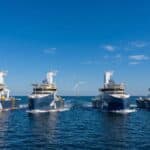
AET, a leading global owner and operator of maritime transportation assets and specialized services, and Fleetzero, a developer and manufacturer of modular marine batteries for hybrid and electric ships, have signed a groundbreaking agreement to develop the world’s longest-range plug-in hybrid-electric vessel. This collaboration marks a significant milestone in the maritime industry’s transition to sustainable shipping solutions.
The signing ceremony took place at the AET Offshore office in Galveston, Texas, with representatives from both companies present. The agreement was signed by Capt. Ron Wood, AET’s Global Director, Commercial, and Mr Steven Henderson, Fleetzero’s CEO.
Under the agreement, one of AET’s Lightering Support Vessels (LSV)1 will be retrofitted with a plug-in hybrid-electric system. The vessel will operate primarily on battery power, reducing greenhouse gas emissions by ~82% when compared to conventional LSVs2 on a tank-to-wake3 basis. This is estimated to avoid 1,220 tonnes of greenhouse gases significantly reducing fuel consumption and maintenance costs2, while maintaining high safety standards.
“This partnership marks a pivotal step in our decarbonisation journey and energy transition strategy. We are proud to partner Fleetzero in developing the world’s largest plug-in hybrid-electric LSV, reinforcing our commitment to innovative and sustainable solutions in the maritime industry,” said Mr Zahid Osman, President & Group CEO of MISC Group. “By integrating plug-in hybrid electric solutions into our fleet, we are transforming ambition into action to deliver more energy with less emissions. This pilot project also allows us to evaluate the feasibility and operational performance of this technology, paving the way for potential deployment across AET’s and potentially MISC’s fleet.”
Mr Steven Henderson, Co-Founder & CEO of Fleetzero said: “We are so excited about this project because it promises to advance marine electrification in a commercially viable way, and the impact is immense – drastically reducing emissions from the vessel operations. Many of us at Fleetzero have served at sea as mariners, and we designed our technology to enhance mariner safety and ease of operations, not only to improve emissions and efficiency. Fleetzero’s technology is built by mariners for mariners.”
This collaboration underscores AET’s dedication to advancing sustainable maritime transportation, driving innovation, and reaffirming commitment to environmental stewardship, in alignment with the industry’s broader decarbonisation efforts.
1 LSV: Lightering Support Vessels are used to transport equipment and crew to conduct ship-to-ship cargo transfer operations.
2 Reduction in fuel consumption, CO2 emissions, and maintenance costs in comparison with traditionally run LSVs based on Fleetzero operational assumptions
3 “tank-to-wake” emissions refer to emissions of a vessel based on fuel combustion in operations only and excludes emissions generated upstream in fuel extraction and distribution