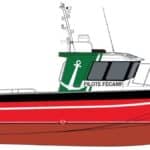





Retrofitted with Fleetzero’s electric propulsion system, AET Innovator offers an estimated 500 nautical mile all-electric range and 13,500 nautical mile hybrid range
AET, a global owner and operator of maritime transportation assets and specialised services, has partnered with maritime technology company Fleetzero to unveil AET Innovator, described as the world’s longest-range plug-in hybrid-electric vessel.
The vessel will be unveiled in New Orleans on 1 December 2026, alongside the International WorkBoat Show, following the successful completion of its hybrid-electric retrofit and sea trials.
Owned and operated by AET, the lightering support vessel has been retro fitted with Fleetzero’s electric propulsion system and will be deployed in AET’s ship-to-ship (STS) lightering operations in the US Gulf.
With a global fleet of approximately 80 vessels and over 30 years of specialist experience, AET is the world’s largest full-service STS lightering provider, conducting 545 STS cargo transfers across the US Gulf, Brazil and Uruguay in FY2025. The project combines AET’s investment and operational expertise with Fleetzero’s technology, bringing hybrid-electric propulsion into a specialised maritime service where reliability, range and operating costs are critical.
With an estimated all-electric range of 500 nautical miles and a hybrid range of 13,500 nautical miles, AET Innovator is designed to deliver the efficiency benefits of electric propulsion while retaining the range and flexibility required for lightering operations.
AET’s preliminary analysis projects up to 49% lower propulsion-related fuel and maintenance costs compared with conventional diesel propulsion. The vessel is also expected to reduce tank-to-wake greenhouse gas emissions by approximately 82%, equivalent to an estimated 1,220 tonnes of emissions avoided annually.
“Our customers count on us to deliver safe, reliable operations, and increasingly, to find smarter and more efficient ways of doing so,” said Nick Potter, President & CEO of AET. “AET Innovator is about bringing new technology into one of our core businesses, where we see real potential to improve performance, reduce emissions and strengthen the value we deliver to customers. Working with Fleetzero, we’re testing what hybrid-electric propulsion can achieve in commercial operations and building the experience to inform where we invest next.”
The retrofit involved converting two former diesel fuel tanks into advanced battery rooms, housing approximately 11 MWh of lithium iron phosphate batteries, fitting substantial energy storage into the existing vessel while keeping its overall weight largely unchanged.
Developed by Fleetzero, the modular propulsion system was factory-built and pre-commissioned to streamline installation and minimise vessel downtime. The vessel also incorporates autonomous-ready technology. The retrofit demonstrates how substantial battery capacity and electric propulsion can be integrated into an existing commercial vessel, offering an alternative to conventional diesel propulsion without requiring a newbuild.
“This is about fundamentally changing the economics of shipping,” said Steven Henderson, co-founder and CEO of Fleetzero. “Electric propulsion means less maintenance, lower operating costs, and more reliable vessels. Combined with autonomous technology, we’re building a future where ships can move cargo more efficiently and at a fraction of today’s cost.”
The project addresses a central challenge for commercial shipping: reducing emissions without compromising the economics and reliability of vessel operations. For AET, one of the world’s largest owners of LNG dual-fuel tankers, electrifying an existing lightering support vessel forms part of a wider strategy to improve fleet efficiency while investing across different fuel and technology pathways. For Fleetzero, the retrofit demonstrates how its modular propulsion technology can be applied to existing commercial vessels, expanding the opportunities for electrification beyond newbuilds.