



Alfa Laval has signed a Memorandum of Understanding (MOU) with a reputed Korean shipyard, K Shipbuilding (KSB) for collaboration with respect to entering Alfa Laval OceanGlide Air Lubrication System in KSB’s potential newbuilding projects such as MR and LR1 Tankers.
Through this business agreement, KSB seeks to leverage the benefits offered by OceanGlide to achieve its objective of improving a vessel’s energy efficiency, and performance by reducing the vessel’s frictional resistance while sailing by using air lubrication technology.
OceanGlide serves KSB’s efficiency goals by utilising intelligent integration of fluidics with air lubrication to enhance the vessel’s propulsion power savings by up to 12%. This translates to lower fuel consumption, reduced CO2 emissions and improved EEDI, EEXI and CII compliance.
“We are proud to work with KBS as our business partner in Korea. This agreement signifies the market’s growing trust in Alfa Laval as a reliable partner. It also highlights the recognition of our solutions as being innovative and efficient,” says Rajiv Sarin, Head of Air Lubrication, Alfa Laval.
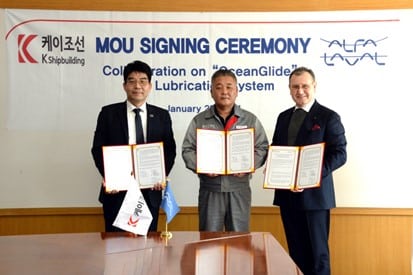
“OceanGlide is an innovative solution that helps improve ship operation efficiency, and we expect it to align well with our goals of developing and building competitive ships,” says Tae-Hyun Koh, CTO, K Shipbuilding.
OceanGlide, using fluidic technology, creates highly streamlined airflow sections on a vessel’s flat bottom. Each section has an independently regulated fluidic band that produces a controlled air layer. This feature ensures optimal efficiency, maximum coverage, and reduced compressor power. The system’s high efficiency in controlling air flow not only ensures an effective air layer with fewer compressors but also provides the added advantage of conveniently positioning them anywhere on board.
This technology contributes to energy conservation and enables adherence to environmental regulations, marking a significant step towards sustainable maritime operations.





 with a reputed Korean shipyard, K Shipbuilding (KSB) for collaboration with respect to entering Alfa Laval OceanGlide Air Lubrication System in KSB’s potential newbuilding projects such as MR and LR1 Tankers.)