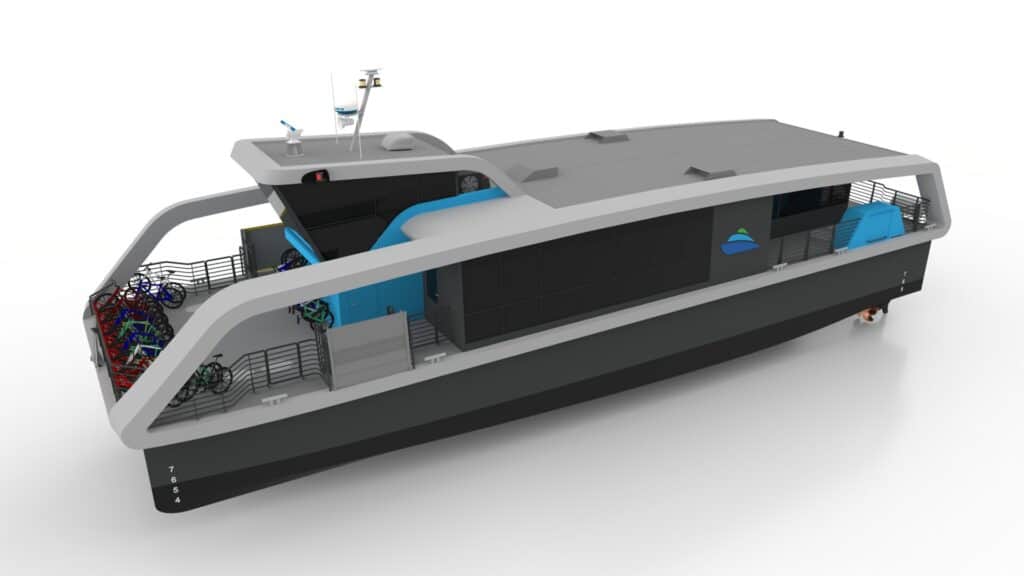
San Francisco Bay Ferry’s Board of Directors have authorised the purchase of the nation’s first three battery-electric, zero-emission high-speed passenger ferries from All American Marine Inc. (AAM) after a competitive bidding process.
The three 150-passenger vessels will be the first delivered as a part of SF Bay Ferry’s Rapid Electric Emission Free (REEF) Ferry Program, a transformative suite of projects to transition the agency’s fleet to zero-emission propulsion technology. The first ferry is expected to join the SF Bay Ferry fleet in early 2027.
“Once again, the Bay Area leads the way,” said Jim Wunderman, Chair of SF Bay Ferry’s Board of Directors. “This investment will connect new neighborhoods in San Francisco and lay the groundwork for widespread regional and national adoption of zero-emission water transit. This is an historic moment for SF Bay Ferry’s electrification efforts.”
All American Marine will build the ferries at their 57,000-square-foot facility in Bellingham, Wash. The company has 30 years of experience in building aluminum vessels in the Pacific Northwest, including two hybrid electric catamarans and MV Sea Change, the world’s first commercial passenger vessel powered 100% by hydrogen fuel cells, which is currently being operated as a demonstration project by SF Bay Ferry.
The contract for the three new battery-electric ferries is $46 million. The vessels will operate at 24 knots, powered by dual 625-kilowatt electric motors. The ferries will be 100 feet long with 26-foot beam and a 5.9-foot draft.
“We are thrilled to announce our partnership with San Francisco Bay Ferry for the construction of their new REEF vessels,” said Ron Wille, President and COO of All American Marine. “These 150-passenger ferries mark a significant milestone in advancing sustainable and innovative marine transportation. At All American Marine, we are committed to pushing the boundaries of maritime technology and contributing to a cleaner future. The REEF vessel project award is a testament to AAM’s dedication to innovation and our ability to deliver state-of-the-art, emission-free solutions. We look forward to collaborating closely with San Francisco Bay Ferry and our project partners to bring this visionary project to life and to set a new standard in the USA.”
The zero-emission vessels will operate on new SF Bay Ferry routes that connect the rest of the region to two of San Francisco’s fastest growing neighborhoods, Treasure Island and Mission Bay. The contract authorized for award by the Board of Directors includes an option for a fourth 150-passenger vessel.
Aurora Marine Design (AMD), based in San Diego, led the conceptual design of the vessels as a part of SF Bay Ferry’s REEF integration team. Teknicraft, which has 200 vessel designs in service worldwide, will team with All American Marine as the naval architect on this project. SF Bay Ferry’s electrification system integrator Wärtsilä will ensure technology and equipment used for the battery-electric vessels and infrastructure work seamlessly together to maximize system flexibility, resilience and cost-effectiveness.
SF Bay Ferry is also currently requesting proposals for the purchase of two 400-passenger high-speed, battery-electric ferries to operate transbay routes connecting Oakland and Alameda to San Francisco.
SF Bay Ferry will launch its naming process for the new 150-passenger vessels this spring. The final two diesel ferries purchased by the agency, MV Karl and MV Zalophus, are on track to join the fleet in 2025.
SF Bay Ferry has now secured roughly $200 million in funding from local, state and federal agencies to implement its REEF Program. This includes state and federal funding for system planning, new battery-electric vessels and shoreside infrastructure.
In addition to the new battery-electric vessels, the REEF Program includes conversion of four diesel 400-passenger ferries to zero-emission technology, terminal electrification across the system, and expansion and electrification of the agency’s Central Bay Operations and Maintenance Facility in Alameda.
In November, the U.S. Environmental Protection Agency (EPA) awarded the Port of San Francisco and SF Bay Ferry $55 million to build and electrify the Mission Bay Ferry Landing, electrify the Downtown San Francisco Ferry Terminal and purchase an additional 400-passenger battery-electric ferry.