Decreased weight, increased durability and higher energy efficiency – that is what using composite materials in Ampelmann systems will lead to. The use of composites is already well developed and commonplace in many different industries. In the offshore industry however, its use is relatively new. Working and designing with composites poses challenges, but it is well worth overcoming these as the advantages are significant and are valuable to Ampelmann and its clients.
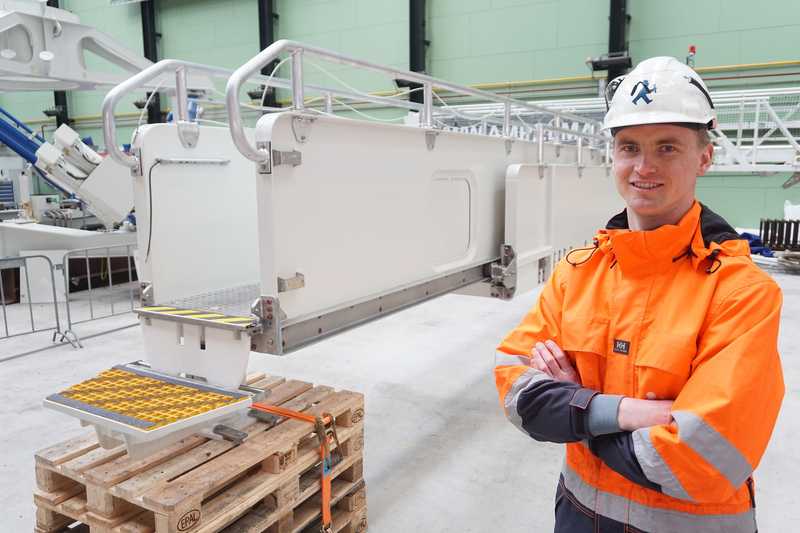
Lead Engineer Siebert Frieling oversees the development of composite technology for Ampelmann’s gangway systems and has helped realise various innovations in the past. “It is a rewarding process, seeing an exciting idea all the way through and making it a reality after overcoming all the challenges along the way,” he says about the joys of his job. And “with the use of composite materials in our products, we raise the standard of safety and efficiency in offshore access operations, like we do with all our innovations.”
“The knowledge and experience we gained from this development should lead to the composite ‘holy grail’, an entire gangway made from composite materials.”- SIEBERT FRIELING, LEAD ENGINEER, AMPELMANN
Composite advancement
Ampelmann’s first innovation using composites is the Composite Slideway which has been realised thanks to a collaboration with Airborne, Pontis and Lloyd’s Register. The slideway is the part of the system that provides access from the vessel to the system’s transfer deck. Because the slideway is also motion compensated, operators and transferees can safely and efficiently reach the transfer deck, while the gangway is connected to an offshore platform.
Compared to other innovations, the development process of the Composite Slideway stands out as designing with composites requires a completely different approach. Moving away from steel meant that structural designs had to be changed and safety factors had to be redefined. And perhaps the most challenging part was selecting and setting up the production method.
The production of composite parts is more complex compared to that of steel parts. This is because construction in steel is more established and allows for more flexibility and last-minute changes. Because the production method of a composite product has such a large influence on the possible design, they both had to be carefully thought-out ahead of time.
Another crucial step in the development of the Composite Slideway was its certification. “Together with Lloyd’s Register, we had to agree upon safety factors, failure mechanisms and material properties in the design, as well as crucial points for inspection and the required tests in order to qualify the production process,” Siebert explains. Certification has been achieved and with that Ampelmann’s Composite Slideway is the first certified composite gangway in the offshore industry.
Lighter, better, more efficient and durable
The use of composites has plenty of advantages over the use of steel. Composites are significantly lighter and can thus reduce the total weight of a system. This has the added benefit of reducing the energy consumption of both the system and the vessel it is installed on.
Another advantage is the durability of composites. Composites are corrosion resistant, which can lead to reduced maintenance costs.
In addition to the increased durability, in collaboration with Somni Solutions, Siebert and his team made room for another innovation, namely the implementation of fibre optics. Optic fibres are embedded in the composite material and can be used in a Structural Health Monitoring System to track the state of the structure during its lifetime. This system can become a valuable tool for predictive and preventive maintenance practices.
The successful development and certification of the Composite Slideway marks the start for more developments with composite materials. “The knowledge and experience we gained from this development should lead to the composite ‘holy grail’, an entire gangway made from composite materials,” Siebert says about his team’s future plans.
A system primarily consisting of composite components will be lighter and more durable compared to a steel system. And apart from reducing operational and maintenance costs, further development with composite materials could significantly improve system specifications. For example, increasing gangway length and hoisting capacity.
Like with other Ampelmann innovations, developments in the use of composite materials aim to raise the standard for safe and efficient offshore access even further.