



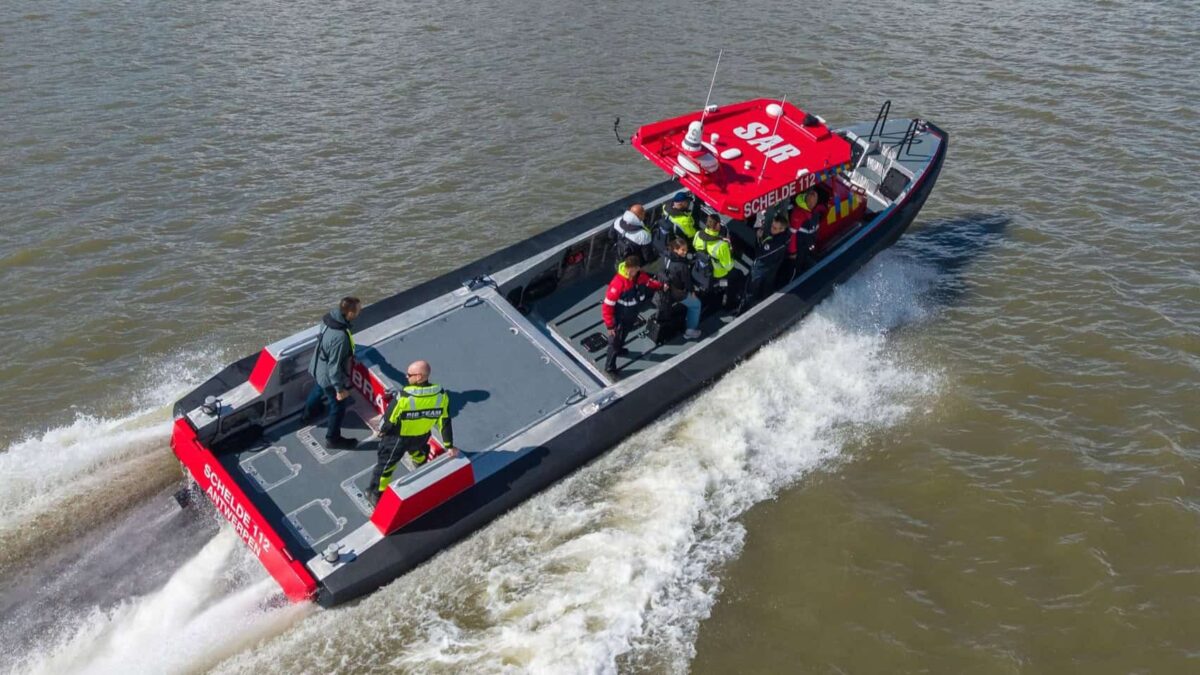
New rescue vessel provides Fire Zone Antwerp with faster, safer and more capable river rescue operations
Fire Zone Antwerp (Brandweer Zone Antwerpen) has officially commissioned ‘Schelde 112’, a high-speed rescue vessel designed to strengthen emergency response capabilities along the 35km stretch of the Scheldt running through Antwerp.
The new vessel was formally welcomed to Antwerp’s waterways by Zone Chair and Mayor Els van Doesburg. Described as the newest and fastest boat in the Antwerp fire brigade’s fleet, Schelde 112 has been purpose-designed for the demanding conditions of the Scheldt.
The river presents a challenging operating environment, with strong tidal currents, changing shallow-water areas, floating debris and heavy commercial, passenger and recreational traffic. The new vessel has been developed to provide faster intervention and improved rescue capability in these conditions.
Schelde 112 is the first aluminium rescue vessel within Fire Zone Antwerp to be purpose-built for the organisation. The vessel was designed and constructed by Rotterdam-based De Haas Shipyards.
One of the key advantages of Schelde 112 is its permanent operational readiness. Unlike the fire brigade’s existing lifeboats, which must be launched using a crane, the new rescue boat is permanently stationed at a centrally located floating pontoon near the Pilotage Service.
Powered by twin FPT engines driving Hamilton waterjets, Schelde 112 can reach a top speed of 50 knots (approximately 90 km/h), enabling the crew to reach critical locations on the river significantly faster, with the vessel capable of reaching Kallo Lock in around six minutes and the North Sea Terminal in approximately 15 minutes.
“In emergency situations in a port city like ours, every second can make the difference. Our firefighters are excellently trained and deserve equipment of the same caliber. Schelde 112 is a prime example of this: fast, agile, and equipped for a wide variety of interventions. It is a significant reinforcement of our operational capabilities on the Scheldt and in the port area, home to one of the largest petrochemical clusters in the world.” — Els van Doesburg, Zone Chair and Mayor of Antwerp
In addition, the rescue vessel is equipped with modern technologies:
- Advanced navigation & detection: chartplotter with GPS, high-sensitivity radar, sonar, and a powerful infrared and thermal imaging camera for nighttime search operations.
- Optimal communication: dual VHF radio system and direct ASTRID radio connection with other emergency services or own dispatching, thanks in part to helmets with integrated Bluetooth communication.
- Precision steering: electronic joystick control for millimeter precision during small maneuvers and docking.
- Automatic position holding: the boat is equipped with the HamiltonJet JETanchor system , which compensates for wind and current, automatically keeping the vessel in the same position and course. This supports the crew during rescue and search operations on the water.
- Crew coomfort: The vessel is fitted with Ullman Dynamics Patrol Jockey seats, complete with integrated storage bases mounted on cargo tracks.
“Due to the increasing passenger transport on the Scheldt, we as a zone must be prepared for larger-scale rescue operations. Schelde 112 is specifically equipped to take on up to 20 drowning victims (and probably more) at the same time, in addition to our two skippers and two rescuers. With the arrival of this vessel, we as a corps are taking a crucial step to always act quickly and effectively on the water.” — Col. Bert Brugghemans, Zone Commander Fire Department Zone Antwerp
With its extensive range and high speed, Schelde 112 can not only reach the protection area of Fire Zone Antwerp but also provide interzonal and cross-border assistance to surrounding zones and the Netherlands. The vessel plays a crucial role in the close cooperation between partners such as Port of Antwerp-Bruges, the Maritime Police, De Vlaamse Waterweg nv, Brabo Group, Hulpverleningszone Waasland, and the KNRM.












 has officially commissioned 'Schelde 112')