


Safety is a critical issue for ferry companies across the world. Artemis Technologies’ revolutionary 100% electric foiling Artemis EF-24 Passenger ferry is designed to meet IMO’s global safety standards
Following a high number of high profile incidents, ferry operators can face heavy fines and even imprisonment if they fail to meet minimum safety standards.
The International Maritime Organization’s High-Speed Craft (IMO HSC) Code provides globally recognised levels of safety in personnel, ship construction, equipment and operation. For this reason, it is often used by operators as a guide for purchasing decisions.
Many Flag States around the globe also rely on this code to lay down the minimum standards for high speed passenger ferry services and any lesser standard is rarely acceptable for even domestic routes.
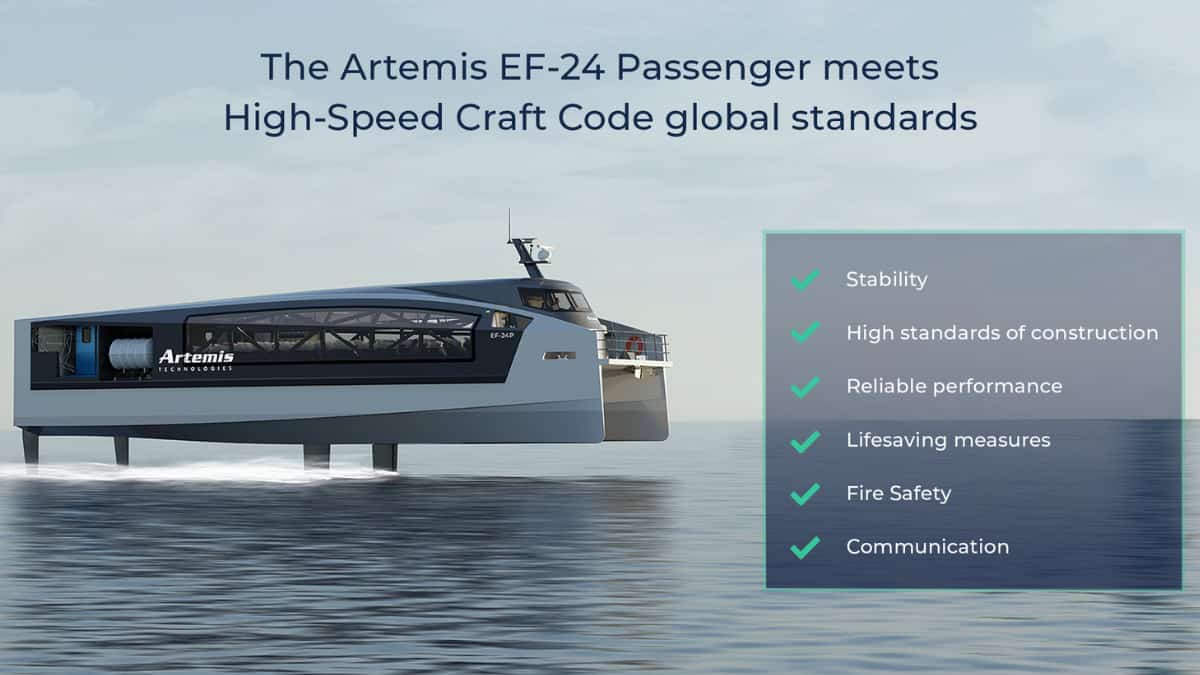
The Artemis Technologies 100% electric foiling Artemis EF-24 Passenger ferry is being proudly built to HSC Code. This ensures:
- Stability: Buoyancy and stability for safe operation
- High standards of construction: Strong structures that can withstand high speeds and wave impacts
- Reliable performance: Meets regulations for machinery, propulsion systems, auxiliary systems, electrical installation, redundancy and control systems
- Lifesaving measures: Life rafts, life jackets, evacuation procedures, and emergency exits
- Fire safety: Fire protection measures, detection systems and firefighting equipment
- Communication: Navigational equipment, communication systems, and emergency procedures
The HSC Code was introduced following the development of many new types of high-speed craft in the 1980s and 1990s. It is incorporated as part of the IMO’s Safety of Life at Sea (SOLAS) and has been updated several times since its introduction.
The Code ensures the safety of passengers and crew on high-speed craft carrying more than 12 passengers and applies to a range of vessels including passenger ferries that meet certain speed and range criteria.
The regulations take into account that high-speed craft are lighter than conventional ships. They allow for use of non-conventional shipbuilding materials, provided that a safety standard at least equivalent to conventional ships is achieved.
Dr Iain Percy, CEO of Artemis Technologies, said: “It is very important to us that we are building our Artemis EF-24 Passenger to meet the standards set by the HSC Code.“
“We cannot, and do not need to, compromise on safety as we work towards our mission to decarbonise high-speed maritime transport. It is critical that we adhere to the global standards within this respected code.“
“The IMO regulations don’t just cover strength and longevity of the vessel structure. They include software, control systems, electrical installations and performance.“
“Our vessels feature transformational e-foiling technology which has been tried and tested and proven to be safe and reliable. The Artemis EF-24 Passenger will fly above the waves with our autonomous flight control system providing crucial stability and comfort for passengers when travelling, including at high speeds.“
“We always launch our first of class vessels for extensive internal testing before releasing it to a customer. Safety is our priority.“
“We have seen examples of non-HSC Coded foiling vessels tipping onto their side because they don’t have the controlled stability our boats have. In a passenger ferry scenario, that would put people at risk of injury. We won’t take that risk.“
“As a result, our flight control software is a standard feature across all Artemis vessels and all our foils are assessed and built under class rules.“
“Ensuring we meet the HSC Code standards adds weight, cost and time to our processes – but this is essential to guarantee that our vessels are safe and will last for their full life.“
“To do otherwise could endanger life and damage the industry’s genuine desire and drive to decarbonise.”