


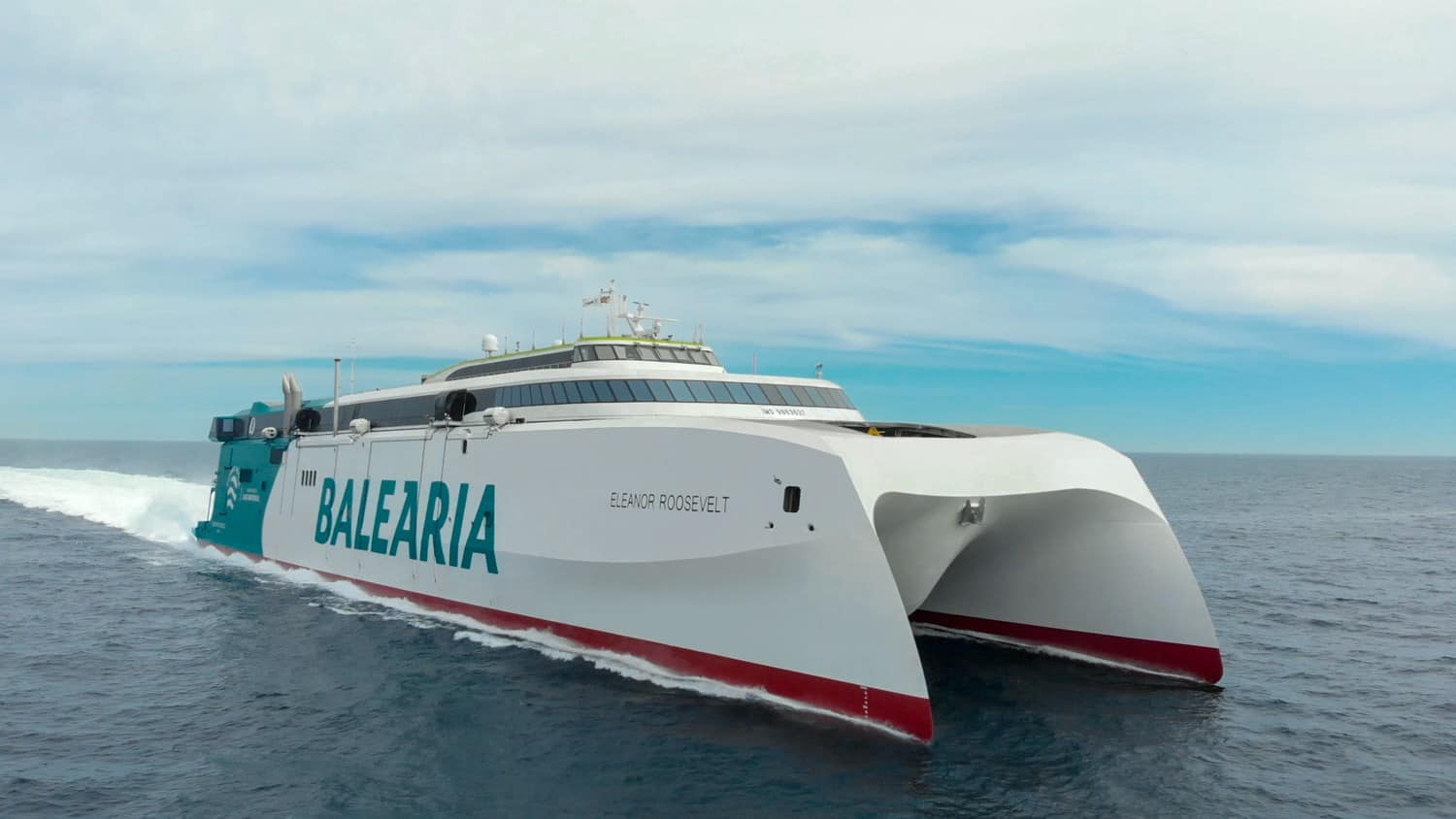
Baleària has begun construction of a second Fast Ro-Pax Ferry with dual-fuel LNG engines at Armon shipyard in Gijón. The construction follows the success of its twin, Eleanor Roosevelt, which has been in operation since 2021. Baleària will name the new vessel after the pioneering biochemist Margarita Salas and expects it to be in operation in 2024.
The president of Baleària, Adolfo Utor, explained the ship “will combine the most competitive features of the Eleanor Roosevelt with a series of upgrades in its design and engineering to enhance the customer experience.” Mr Utor also said “the construction of this second ferry follows the exceptional results of the Eleanor Roosevelt, and the commitment of Baleària to develop an innovative and eco-efficient fleet.”
The new ship will have the same physical characteristics as the Eleanor Roosevelt: 123 metres long, 28 metres wide and with the ability to transport 1,200 passengers and 400 vehicles. As a new feature, Margarita Salas will have a second deck with a lounge in the bow and will double the area of the aft terrace with an outdoor bar service. The installation of four 9,600 kW Wärtsilä dual-fuel LNG engines will mean the Margarita Salas can travel at service speeds of up 35 knots. The propulsion system is made up of four waterjets and two bow azimuth propellers for manoeuvrability when berthing in port.
Margarita Salas will be Baleària’s tenth with dual-fuel LNG engines, a versatile technology that can also consume 100% biomethane, as well as green hydrogen mixtures of up to 25% – renewable fuels that are neutral in CO2 emissions and considered the future of global shipping.
Incorporating the latest technological innovations to enhance the passenger experience, passengers will access their accommodation via a QR code and will enjoy free internet onboard. They will also have an on-demand digital entertainment platform, while those travelling with pets will be able to monitor them via a video surveillance system.
The design of Margarita Salas prioritises the comfort of passengers with spacious seating areas throughout. The stabilisation system considerably reduces movement and allows greater comfort on board. Vibrations and noise will also be minimised by an elastically floating superstructure and the installation of high-tech insulation. Finally, the ship will also have escalators and an elevator to the upper deck.
Baleària have also installed state-of-the-art technology that allows for the real time monitoring of fuel consumption. The installation of sensors also provides real time navigation information and is the eighth ship in Baleària’s fleet that has this monitoring system installed. The technology, part of the Baleària Control Tower project, uses big data to make agile and efficient decisions in terms of safety, preventive maintenance, efficiency commercial and emissions control.