Power & PropulsionElectricBaleària to Build Europe-Africa's First Zero-Emission Ro-Pax Fast Ferries

Baleària to Build Europe-Africa’s First Zero-Emission Ro-Pax Fast Ferries

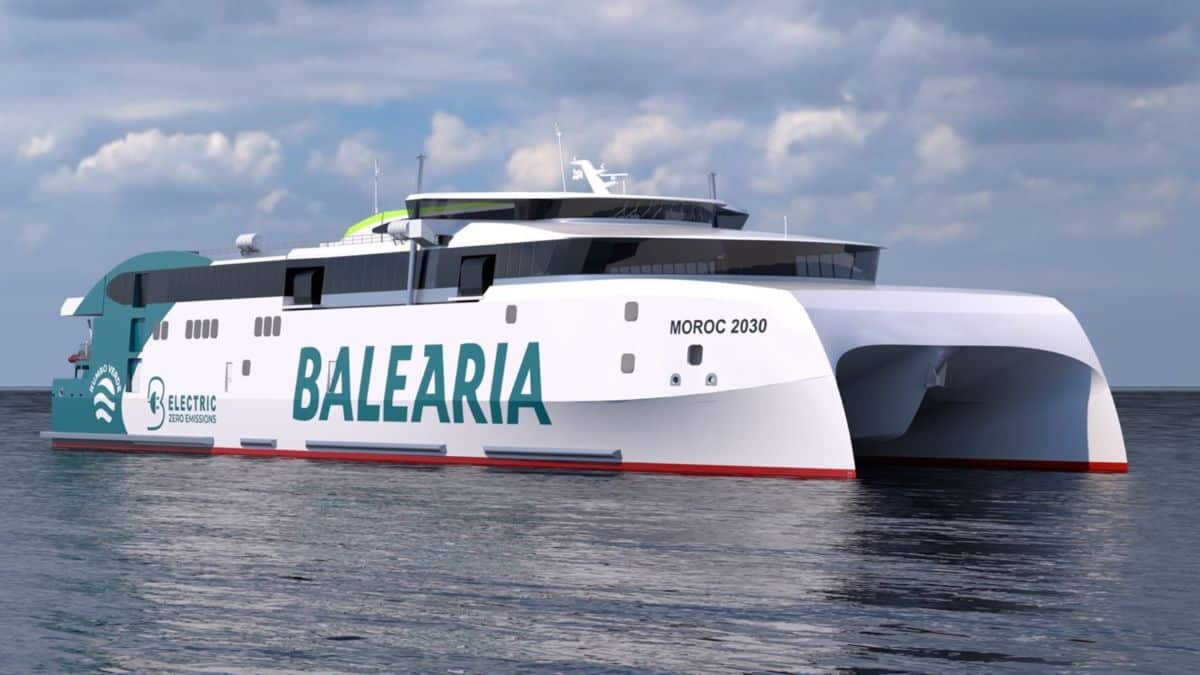
Spanish maritime transportation leader Baleària, has commissioned two 100% electric, zero-emission ro-pax fast ferries be built by Astilleros Armon’s Gijón shipyard, designed by Incat Crowther. Named ESPAÑA 2030 and MAROC 2030, these vessels will establish the first green maritime corridor between Europe and Africa, linking Tarifa (Spain) and Tangier (Morocco) with cutting-edge sustainable technology.

The project comes after Baleària was awarded the tender by the Bay of Algeciras Port Authority to service the route and will see significant investment in onshore charging infrastructure at both ports.

The new project builds on the partnership between Baleària, Astilleros Armon and Incat Crowther that includes the successful delivery of the innovative dual-fuel Ro-Pax ferries Eleanor Roosevelt and Margarita Salas, and a third vessel Mercedes Pinto, that is planned to launch in September 2025.

ESPAÑA 2030 and MAROC 2030,which are expected to commence operation in 2027, will feature an electric power capacity of 16MW thanks to four electric propulsion units powered by 11,500 kWh capacity batteries, enabling full crossings with zero emissions while also eliminating noise and vibrations. The vessels will have the ability to transport up to 804 passengers and 225 vehicles, at a maximum speed of 26 knots.

Charging will be carried out by two innovative autonomous robotic arms installed in each port, which will be connected to the ship via an OPS (Onshore Power System) connection. Each vessel will be capable of recharging the energy needed for the route in just 40 minutes.

In addition to spacious, bright interiors equipped with comfortable seating, the passenger experience is enhanced by a T-foil system that dampens vertical movement. The vessels will be highly manoeuvrable thanks two bow thrusters, four rudders and vision from bridge wing stations. They will also feature two high-capacity stern ramps to optimise operations and manoeuvres in port. Each ship will also have four diesel combustion back-up generators, with a total capacity of 11,200 kW.

President of Baleària, Adolfo Utor said, “This is a pioneering and technologically advanced public-private project that will enable us, for the first time ever, to run the entire route using only electric energy and, therefore, zero emissions. We are taking on the challenge of turning the Tarifa-Tangier Ville line into an example of mobility, modernity and international sustainability.”


Latest News

SWITCH Maritime has secured a Design Basis Agreement (DBA) from the United States Coast Guard (USCG) for its SWITCH-150 hydrogen fuel cell-electric ferry, marking a key milestone in the development of the 150-passenger vessel. Designed by naval architecture firm Incat Crowther, the SWITCH-150 combines hydrogen fuel cell-electric propulsion with onboard hydrogen storage to support high-frequency ferry operations without compromising service schedules or requiring shoreside charging infrastructure.

SWITCH Hydrogen Ferry Clears Key US Coast Guard Milestone

The US Coast Guard agreement establishes a regulatory framework to guide construction, commissioning and future commercial operation of the hydrogen-powered ferry SWITCH Maritime has secured...
Norwegian ocean surface measurement specialist Miros has introduced a new 3D vessel view for its WaveSystem wave monitoring platform, giving crews and offshore operators a consolidated view of measured sea conditions around their vessel.

Miros Introduces 3D Vessel View for Real-Time Wave Monitoring

Miros introduces a vessel-specific 3D visualisation to help operators interpret real-time wave measurements at critical offshore working locations Norwegian ocean surface measurement specialist Miros has...
Elegant Exit Company (EEC) has partnered with Conoship International to develop a high-capacity Floating Dry Dock (FDD) concept designed to provide a controlled, environmentally responsible alternative to traditional ship dismantling methods. Ship recycling through beaching remains a major environmental and humanitarian challenge for the maritime industry, exposing coastal ecosystems to potential contamination and workers to hazardous operating conditions.

EEC and Conoship Develop Versatile Floating Dry Dock Concept

The high-capacity floating dry dock concept is designed to support shipbuilding, maintenance and green ship recycling while improving environmental protection and worker safety Elegant Exit...
A liquefied gas carrier originally designed by FKAB Marine Design has completed what Jiangsu Andefu Energy Development describes as the world’s first commercial ship-to-ship bunkering operation using green ammonia.

Ship to Ship Green Ammonia Bunkering Milestone in China

Shenghang Yongle transfers 1,000 tonnes of green ammonia to CMB.TECH’s ammonia-powered Mineral Europa at Zhoushan anchorage, China A liquefied gas carrier originally designed by FKAB...

Related news