Electronics & CommunicationMarine SoftwareBERG Propulsion OpWind ® optimise for sail and engine propulsion

BERG Propulsion OpWind ® optimise for sail and engine propulsion

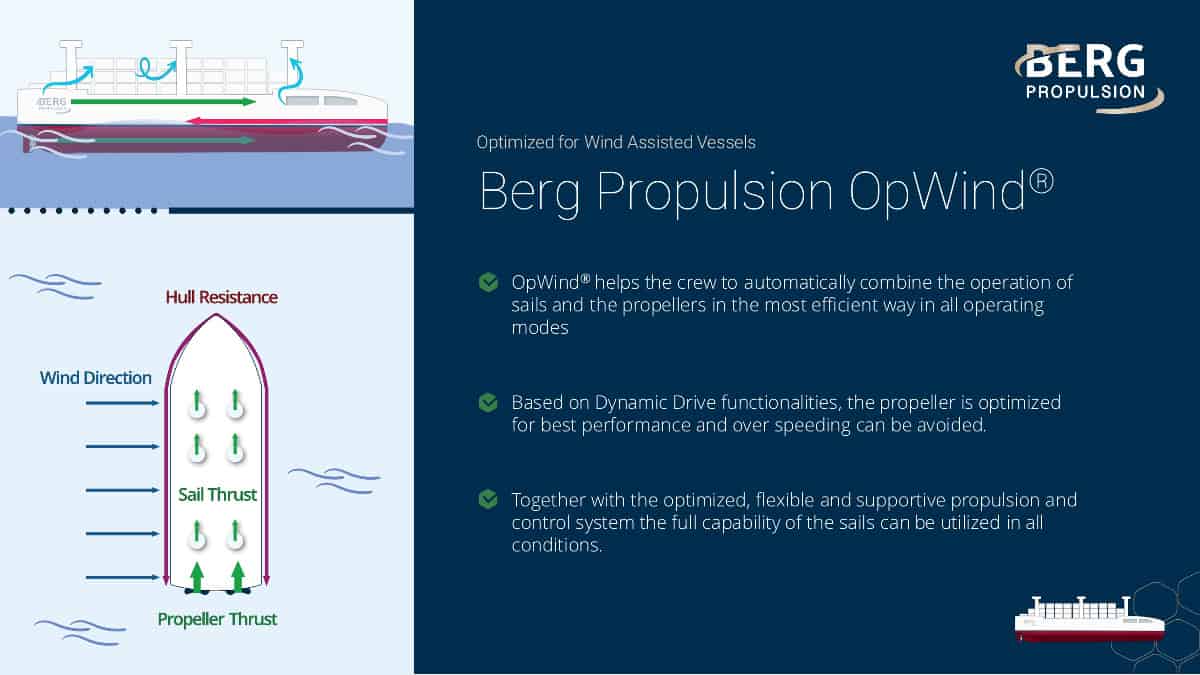
BERG Propulsion unveil OpWind ® software system to help crews combine the operation of sails and propellers in the most efficient way in all sea conditions.

OpWind automatically ensures that engine efficiency can be optimised with respect to propeller rpm and blade pitch angle when wind propulsion is also used to propel a vessel. The approach saves even more fuel than would otherwise be the case.

The system automatically senses any sail contribution to propulsion based on a vessel’s operation data and measured parameters, continuously and automatically adjusting propeller pitch and speed to maximize the efficiency of the combined operation of propeller and sails.

The BERG Propulsion OpWind system has been developed from the Swedish company’s existing Dynamic Drive technology to compare detailed theoretical information and calculations about operating with propellers and sails against measured values on-board the vessel, said Chief Technology Officer Emil Cerdier.

“OpWind is a more advanced system than Dynamic Drive and can be implemented on any ocean-going vessel fitted with any type of sails to identify optimal operating actions,” said Cerdier.

“Savings from reduced fuel consumption will depend on the vessel configuration and its operating profile, as well as on how large the sails are, but they will be considerable,” he added. “Efficiency gains will be available whether it is a newbuilding or retrofit project.”

The system can be run in several modes with settings either to keep a desired maximum speed, maximum fuel consumption or a constant propeller thrust. It is also possible to use the propeller for onboard power generation while in sailing mode.

BERG can also provide a Marine Information Display to visualize performance as part of the system.  A constant vessel speed setting will automatically reduce engine propulsion power when sails contribute to forward thrust. With a feathering propeller design it is also possible to shut down one or two main engines depending on vessel configuration, to further reduce fuel and maintenance costs.

BERG Propulsion has received an initial order for systems to be used in sail/engine combined operation from a major vessel operator.


Latest News

Boluda Towage has expanded its Norwegian fleet with the addition of VB NORWEGIAN FALCON, a new tug built by Sanmar Shipyards to support towing, vessel assistance and offshore operations in demanding maritime environments.

Boluda Towage Takes Delivery of VB NORWEGIAN FALCON

Sanmar-built VB NORWEGIAN FALCON features RAstar 3200 SX design, ASD propulsion and more than 6,700 hp Boluda Towage has expanded its Norwegian fleet with the...
SWITCH Maritime has secured a Design Basis Agreement (DBA) from the United States Coast Guard (USCG) for its SWITCH-150 hydrogen fuel cell-electric ferry, marking a key milestone in the development of the 150-passenger vessel. Designed by naval architecture firm Incat Crowther, the SWITCH-150 combines hydrogen fuel cell-electric propulsion with onboard hydrogen storage to support high-frequency ferry operations without compromising service schedules or requiring shoreside charging infrastructure.

SWITCH Hydrogen Ferry Clears Key US Coast Guard Milestone

The US Coast Guard agreement establishes a regulatory framework to guide construction, commissioning and future commercial operation of the hydrogen-powered ferry SWITCH Maritime has secured...
Norwegian ocean surface measurement specialist Miros has introduced a new 3D vessel view for its WaveSystem wave monitoring platform, giving crews and offshore operators a consolidated view of measured sea conditions around their vessel.

Miros Introduces 3D Vessel View for Real-Time Wave Monitoring

Miros introduces a vessel-specific 3D visualisation to help operators interpret real-time wave measurements at critical offshore working locations Norwegian ocean surface measurement specialist Miros has...
Elegant Exit Company (EEC) has partnered with Conoship International to develop a high-capacity Floating Dry Dock (FDD) concept designed to provide a controlled, environmentally responsible alternative to traditional ship dismantling methods. Ship recycling through beaching remains a major environmental and humanitarian challenge for the maritime industry, exposing coastal ecosystems to potential contamination and workers to hazardous operating conditions.

EEC and Conoship Develop Versatile Floating Dry Dock Concept

The high-capacity floating dry dock concept is designed to support shipbuilding, maintenance and green ship recycling while improving environmental protection and worker safety Elegant Exit...

Related news