



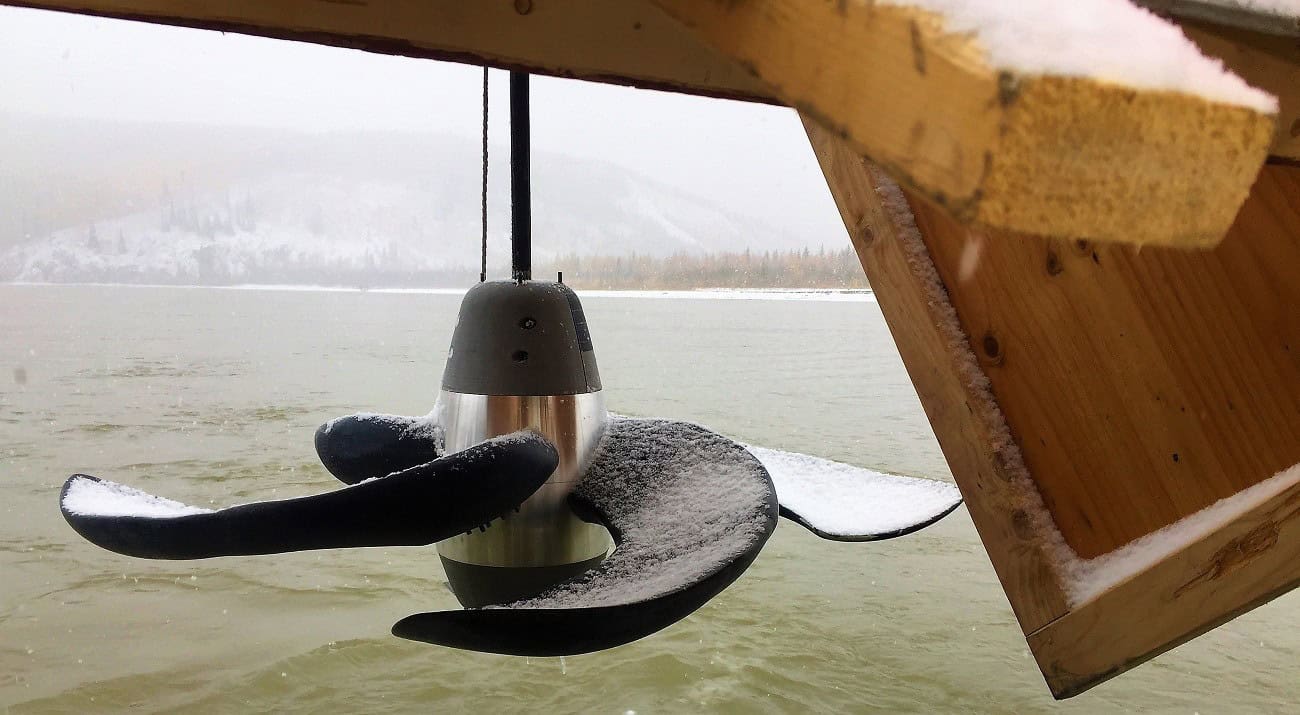
Harnessing the energy from moving water in Alaska comes with the constant threat of damage from river transported debris. A new design from BladeRunner Energy looks to overcome that threat and provide an option for remote, renewable energy.
ACEP and BladeRunner deployed and tested the first full-scale BladeRunner prototype as part of the Submarine Hydrokinetic and Riverine Kilo-megawatt Systems program. It’s one of 11 projects awarded under $35 million in funding from the U.S. Department of Energy’s Advanced Research Projects Agency-Energy to develop high-risk, high-potential approaches to riverine and tidal energy.
The BladeRunner design places the turbine rotor at the end of a flexible but torsionally stiff cable that allows the turbine to submerge while keeping the generator housing on the water surface. This unique system architecture aims to address the multiple hurdles that exist for deploying hydrokinetic devices in remote riverine locations, with the management of debris being a key factor.
“The BladeRunner system has unique potential for remote Alaska riverine applications. Previous systems tested in Alaska have suffered failure due to debris and require expensive deployment platforms or equipment,” said ACEP’s hydrokinetic program manager, Ben Loeffler. “The BladeRunner offers distinct advantages, namely, the rotor design and tethered connection should be debris resilient; the generator system is above the waterline, providing for cost-effective deployment and maintenance and increasing reliability of bearings and seals; the rotor can be scaled to fit a given river resource; and the system can be deployed from shore with no boats or on-water equipment needed.”
This first testing campaign investigated rotor stability, deployment and retrieval methods, and debris resilience. It also collected data for validating the computational fluid dynamic models used to develop the rotor design. All of this information will feed into an iterative co-design process over the next two years.
“As was expected, the testing helped to identify a number of factors that need to be addressed, but that was the whole point of testing,” said BladeRunner co-founder Moriel Arango. “We are excited about where this SHARKS program will take our system design, and getting the insight through testing in the Tanana River will make it so much more valuable than what comes from testing in a controlled laboratory setting.”
UAF is the prime awardee on this award, leading the testing and co-design activities. UAF has subawards to BladeRunner Energy for the rotor and system development and to C-Motive Technologies for novel generator development. Moshman Research is working with BladeRunner on rotor development and optimization. FibreMax is supplying the custom torsional cables, and LifeWater Engineering fabricated the generator housing.
This work is funded in part by the Advanced Research Projects Agency-Energy under Award Number DE-AR0001444.







 and BladeRunner deployed and tested the first full-scale BladeRunner prototype as part of the Submarine Hydrokinetic and Riverine Kilo-megawatt Systems program. It’s one of 11 projects awarded under $35 million in funding from the U.S. Department of Energy’s Advanced Research Projects Agency-Energy to develop high-risk, high-potential approaches to riverine and tidal energy.)