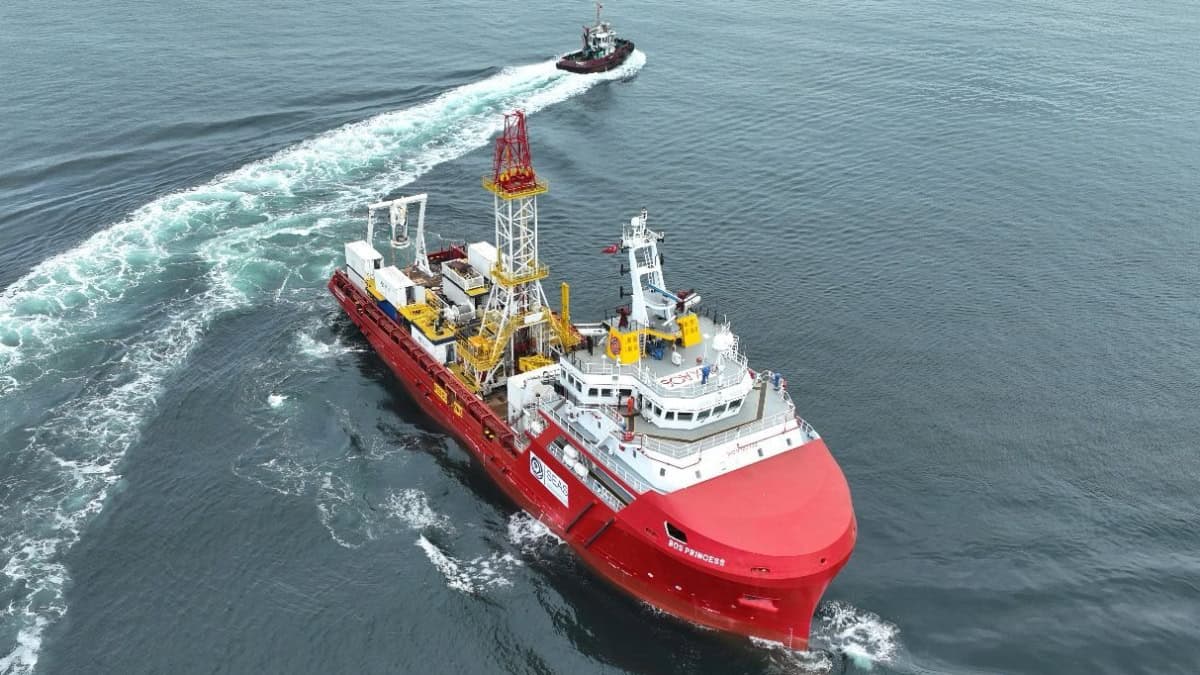
Seas Geosciences, a leader in marine geotechnical solutions, has successfully completed the conversion of the BOS Princess into a state-of-the-art multipurpose geotechnical drilling vessel, now ready to support the global offshore energy sector.
With its 80-metre length and close to 19-metre beam, the BOS Princess is uniquely equipped to support Seas’ geotechnical investigations and has been outfitted with custom tools capable of seamlessly transitioning from water depths of 10 metres to more than 4,000 metres while conducting simultaneous downhole and seabed operations, said Seas Geosciences President Paolo Casciotti.
“This vessel has been specifically designed to serve the global offshore energy industry and is fitted with our fully automated topside geotechnical rig, “Mako40,” our innovative 350KN seabed CPT system, our successful deepwater seabed drill, “Nautilus1,” and an array of geotechnical tools,” Casciotti said. “This investment is part of our commitment to scale up our operations while supporting both our community of shareholders and the health of our oceans. We have created an asset that is 100 percent customised for the typical requirements of today’s offshore developments.”
Seas’ new 350KN seabed cone penetration testing unit and its deepwater drill were designed and built in-house, while the topside rig has been fully customised for safe, efficient and high-quality operations. The seabed CPT is fully automated for safety and streamlined operations, is fitted with both a fully lubricated coiled and a straight rod and will also be launched via the vessel’s moonpool. It is equipped with cameras and telemetry for precise landing operations, and its telescopic legs make it ideal for sloped and uneven seabeds.
The deepwater drill will be launched from the stern using Seas’ uniquely designed launch and recovery system. It can conduct deep-penetration downhole geotechnical boreholes in deep and ultra-deep waters.
Seas will deploy the newly converted BOS Princess on a global scale, serving projects from the Mediterranean to the North Sea to the Atlantic and beyond, Casciotti said.
Dai Nelsey, geotechnical lead at Seas, has more than 15 years of experience in offshore energy development.
“Seas Geosciences has successfully delivered an impressive multi-asset, multipurpose installation on the BOS Princess,” Nelsey said. “Its versatility – capable of operating in shallow to ultra-deep waters – opens up exciting opportunities for Seas Geosciences and our clients. I am personally thrilled to be a part of this advancement.”
Mark Rundle, Seas’ asset integrity manager, said Seas has factored into the vessel design room for more upgrades and expansion that will further set it apart in terms of safety, capacity and efficiency.
“It has been my pleasure to be a part of the Princess’ conversion from regular supply vessel to arguably the most diverse geotechnical vessel on the market,” Rundle said. “The excellent final product, which is the best I have seen during my 15 years in the industry, is a testament to Seas’ plan to stop at nothing in pioneering and operating industry-leading equipment. That ethos, paired with a highly skilled, experienced, and passionate team, has resulted in a groundbreaking asset that truly is safe, reliable and efficient.”
Seas and Britoil Offshore Services entered a multi-year agreement for the vessel in summer 2024.