


CORE POWER has enlisted naval architecture and marine engineering firm Glosten to help their team design a floating nuclear power plant (FNPP) to power ports in the United States.
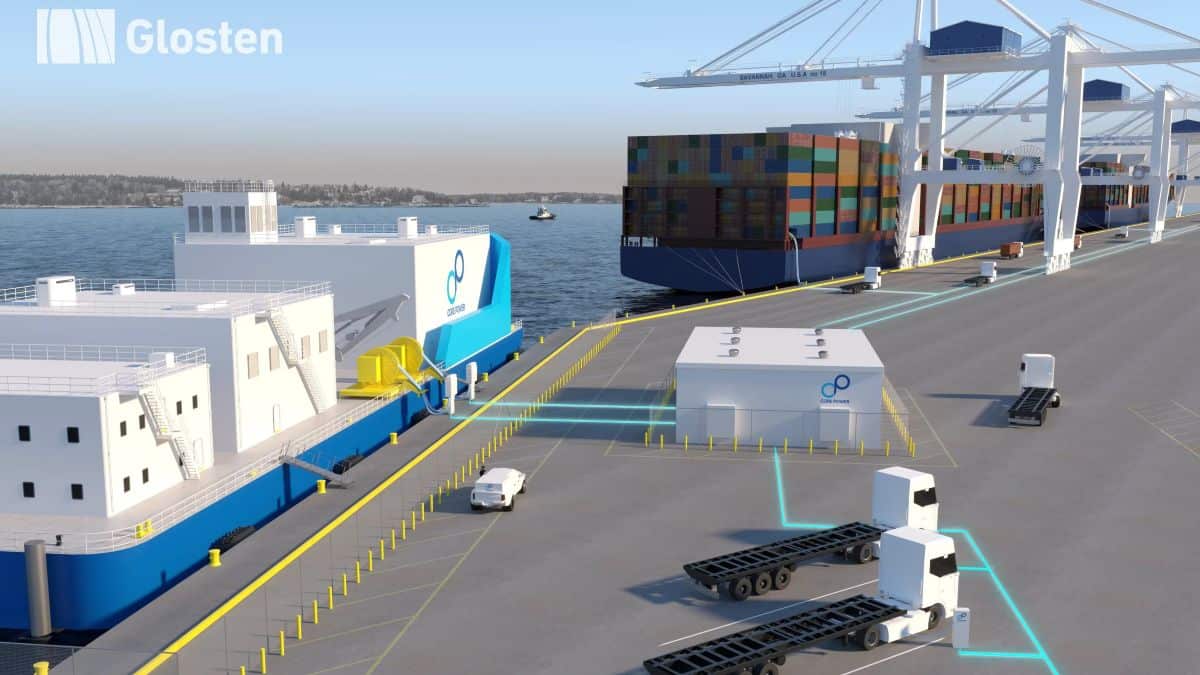
Created by CORE POWER, the floating nuclear power plant concept is a nearshore infrastructure system that includes a barge-based nuclear power plant, barge support services, electrical grid integration, and operational teams. Easy to transport and rapidly deploy, the FNPP will provide an estimated 175GWh of clean electricity per year. The FNPP connection will allow ports to achieve zero-emissions electrical generation for visiting ships, terminal cranes and equipment, and port vehicles.
CORE POWER engaged Glosten to develop the operational concept and design the floating facility for the FNPP. Glosten will also establish a regulatory path for the barge, navigate site location approvals, and identify a potential supply chain network for the FNPP’s fabrication, assembly, integration, transportation, and installation.
“The marine industry has experienced a massive push to decarbonize, and CORE POWER’s floating nuclear power plant offers an effective and practical means to meet that demand,” said Morgan Fanberg, CEO of Glosten. “Glosten’s job is to turn CORE POWER’s vision into a design that demonstrates the practicality of providing reliable, zero-emissions nuclear power to port facilities and has a defined path to regulatory approval.”
Nuclear power has been a feature of the marine industry since the 1950s, when nuclear reactors first made an appearance on military and civilian vessels. The first FNPP, the Sturgis, was deployed in the Panama Canal in 1968. For marine applications, nuclear offers a self-sufficient, carbon-free power supply capable of running for years without refueling. CORE POWER’s FNPP is easy to transport to operation sites and offers scalable deployment through modular construction.
“Nuclear fission is a well-understood and practiced process. It allows us to access an enormous energy resource safely, reliably, and on-demand without emitting greenhouse gases. Over 80% of the cost of nuclear power on land is in civil construction, with reactors and power systems accounting for less than 20%. FNPPs will be shipyard-manufactured and mass-assembled, ensuring delivery speed and low costs. Using FNPPs to power ports solves the electrification challenge and creates local energy security,” said Mikal Bøe, CEO of CORE POWER.
The project is currently in the concept phase and is being designed with the intent to serve a non-specific port located in the Southern United States. Glosten is working closely with CORE POWER to perform risk assessments and develop the general arrangements for the barge which will house the nuclear reactors.
“Our team excels at navigating complex regulatory environments to facilitate the use of alternative energy,” said Fanberg. “We’re taking a very thorough and deliberate approach, making sure we’re performing the necessary risk-based assessments to maximize safety as well as considering the practicalities of implementation. In a way, the FNPP is our definition of the perfect project—in terms of what we can provide, but also because of the greater good it stands to achieve. We’re excited to help CORE POWER realize their vision and help the industry progress towards decarbonization.”