


Renewable EnergyOffshore WindDamen announces offshore charging for fully electric CTVs

Damen announces offshore charging for fully electric CTVs

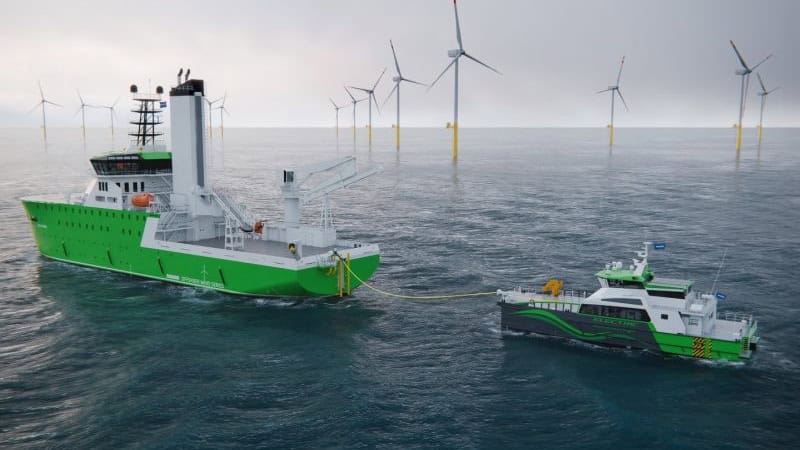
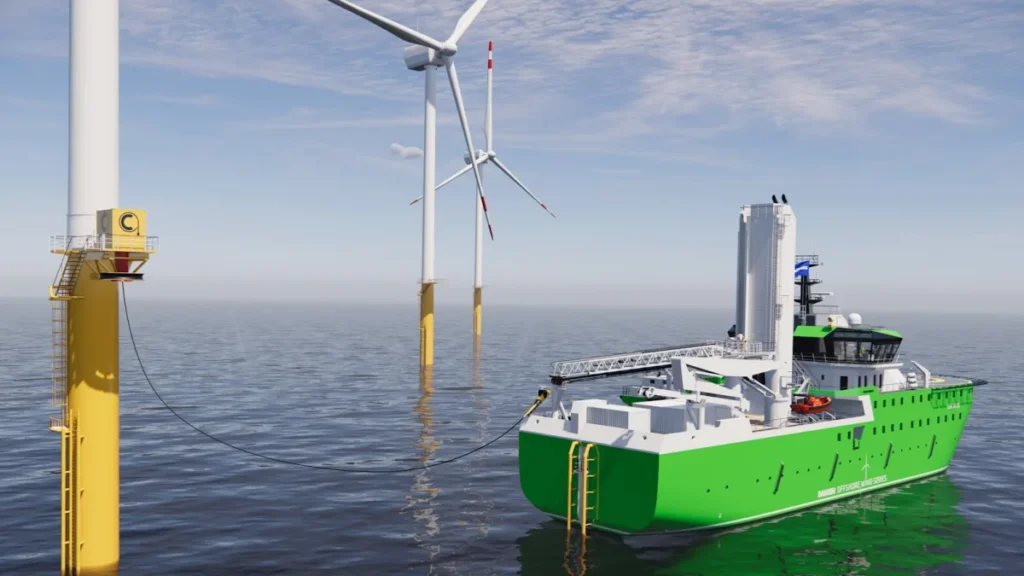
Damen Shipyards Group has developed a new concept for offshore charging, offering a way to dramatically reduce emissions during the operational phase of an offshore wind farm. The system envisages a fully electric crew transfer vessel (CTV) which can charge at either a turbine or one of Damen’s Commissioning Service Operations Vessels outfitted with a charger.

Enabling investment today in the solutions of tomorrow

With the infrastructure for turbine mounted chargers not yet widely available, vessel-to-vessel charging offers crew transfer vessel owners and operators an opportunity to invest in the sustainable technology of the future, at the present time, as Mark Couwenberg Product Manager Service Operations Vessels at Damen explains.

“Offshore charging is an essential feature for a fully electric CTV operation. Typically, this would be dependent on charging infrastructure being present at an offshore wind farm. Our unique position as builders of both CTVs and CSOVs led us to the idea of placing the charging scope within our assets. This can be done with both a conventional, diesel-powered CSOV, or with a fully electric version. Of course, from an emissions reduction perspective, the latter is the more preferable option. However, such a solution makes it possible for CTV operators to invest today, in preparation for the wider distribution of full electric CSOVs tomorrow. We believe this could give a considerable boost to the maritime energy transition.”
Damen announces new offshore charging solution for fully electric CTVs

Easy energy access

Installing a large battery system on board an electric CTV is a challenge, given the weight and space restrictions. Installing the system to the much larger, less space sensitive CSOV gives the smaller vessel access to the energy it requires without compromising on capabilities.

Using the CSOV as a charger host offers further advantages. For one thing, the stern of the vessel is lower than a turbine, which provides the vessel with easier access to the charger. Additionally, unlike the turbine, the CSOV is able to change its position, enabling the CTV to charge in the most sheltered position with regards to wave conditions.

The charging system that Damen has applied to its concept is developed by UK-based MJR, a specialist in offshore charging systems. The CTV would connect via a bell mouth that catches the charger that is lowered from a reel on the aft deck of the CSOV.

Following personnel disembarkation, the vessel could connect using a highly automated, safe process. It is expected that charging could take place in 2-3 hours, depending on the operational profile.


Latest News

LD Armateurs Group has taken delivery of the DP2 multipurpose support vessel TVO Mariner, strengthening the Group’s fleet and expanding the offshore capabilities of its subsidiary LD TravOcean, which specialises in subsea cable installation and protection.

LD Armateurs Takes Delivery of DP2 Vessel TVO Mariner

DP2 multipurpose support vessel TVO Mariner, expands LD TravOcean’s capabilities across subsea cable, telecommunications and offshore wind projects LD Armateurs Group has taken delivery of...
PaxOcean Group, a member of Kuok Maritime Group, and Ulstein Design & Solutions AS have signed a contract for the design and construction of a new ULSTEIN SX222 Service Operation Vessel (SOV) for NYK Line (Nippon Yusen Kabushiki Kaisha).

NYK Selects ULSTEIN SX222 for New Offshore Wind SOV

PaxOcean and Ulstein join forces to deliver NYK’s next-generation offshore wind SOV PaxOcean Group, a member of Kuok Maritime Group, and Ulstein Design & Solutions...
Dutch winch specialist Dijvler is expanding into the sea-going vessel market following the acquisition of the rights, designs, drawings and certifications of C-Nautical, enabling the company to launch a new standardised range of anchor and mooring winches for cargo vessels and offshore support vessels. With nearly 50 years of experience supplying anchor and mooring winches for inland waterway vessels, Dijvler is now applying its established engineering expertise to the wider commercial marine sector. The company expects to deliver its first orders for the new programme in 2027.

Dijvler Targets Sea-Going Vessels With New Winch Range

Dutch winch specialist Dijvler, builds on nearly 50 years of inland vessel experience with a new standardised range for cargo and offshore support vessels Dutch...
Safehaven Marine has launched Ederra 8, an 18-metre Interceptor 60 pilot boat built for the MVD Pilots Association in Montevideo, Uruguay. The vessel is the third pilot boat Safehaven Marine has built for the Montevideo pilots and the fourth vessel supplied to the organisation overall. The latest delivery follows the Ederra 6 and Ederra 7, two Interceptor 48 pilot boats delivered in 2022, which have been operating successfully with the pilots over recent years.

Safehaven Marine Launches Interceptor Pilot Boat Ederra-8

Safehaven Marine has launched Ederra 8, an 18-metre Interceptor 60 pilot boat built for the MVD Pilots Association in Montevideo, Uruguay https://youtu.be/a7ImyS0Er70?si=glEf4QIrKSlrVSZk Safehaven Marine has launched...

Related news