


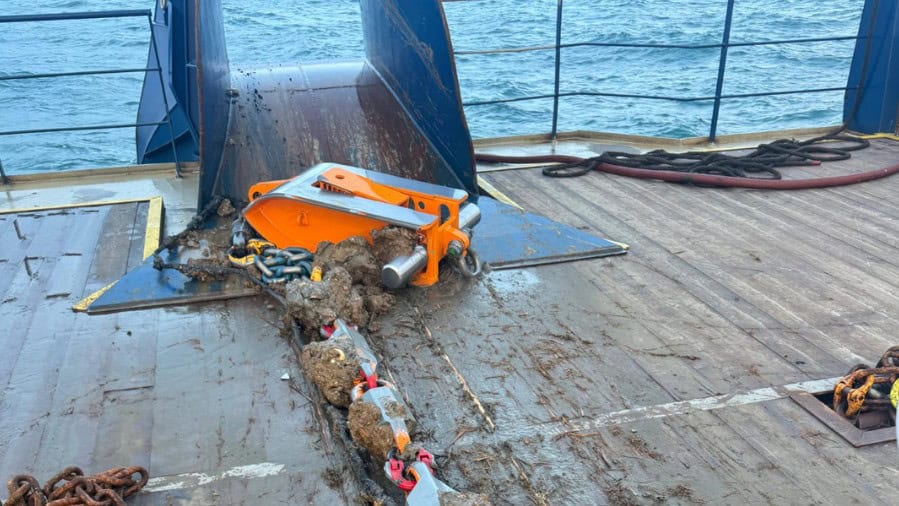
ACSM deploys DLM’s Stingray system to enhance visibility and control during offshore recovery and route clearance projects
Southampton, Uk-based Dynamic Load Monitoring (DLM) has supplied a Stingray Acoustic Positioning Grapnel to subsea and offshore energy services specialist ACSM, supporting the company’s offshore cable route clearance and recovery operations.
The Stingray system is being used to transmit acoustic positioning signals to vessels towing grapnel trains, enabling operators to accurately track equipment during subsea operations and improve operational efficiency.
ACSM, headquartered in Vigo, Spain, provides power and fibre optic pre-lay works and delivers a range of subsea services to offshore energy and telecommunications projects worldwide. The deployment of the Stingray Acoustic Positioning Grapnel forms part of the company’s ongoing investment in technologies that enhance the safety and precision of offshore operations.
While the Stingray is a relatively new DLM innovation, the company has steadily grown its grapnel range, used for recovering lightweight, fibre optic, or heavier-duty armoured cables on the seabed. The products are used by subsea cable lay companies and ship operators for pre-lay grapnel run (PLGR) and route clearance operations.
Prior to any such works, a survey is conducted to determine what is on the seabed, including any obstructions that need to be cleared. The type of seabed (sand, clay, or rock, etc.) can also be investigated to decide on the type of grapnels to be used. A PLGR operation is conducted where the grapnels are towed behind a vessel, and the route where the cable is going to be laid is effectively cleared of obstructions and debris, along with perhaps grappling and recovering out-of-service cables, ready for the cable lay operations to commence afterwards.
Stingray, which gets its name from being relatively flat and moving along the seabed, can be connected in the grapnel train and uses acoustics to send a signal to a vessel towing the train to communicate where it is on the seabed. It is positioned at the rear of a train of multiple grapnels attached together and towed behind the vessel when a PLGR is being undertaken. It is located the furthest away from the ship’s stern.
Alejandro Serret Agelet de Saracibar, Project Coordinator at ACSM, said: “We are very satisfied with its performance and reliability. It has been very beneficial; we are particularly happy with how accurate the positioning is. We have tested the equipment thoroughly and found that a 90-degree configuration provides the best performance in both shallow and deeper waters.”
The Stingray is 1,343mm long and 308mm high with the beacon component closed; with it open, it is 473mm high. The main body is 500mm wide and, depending on what type of stabiliser is fitted, it is 900mm or 1,500mm wide. While there is only one body size, ACSM used the 900mm stabiliser for this particular application. There is also the ability to fit different manufacturers’ ultra-short baseline (USBL) beacons to meet clients’ preferences, and depending on what receiver is already fitted onto the vessel. ACSM used the Kongsberg cNode mini for this project; DLM designs the clamps to fit the beacons that the client is using. The acoustic grapnel is manufactured from high-strength structural steel and covered with a special marine paint.
Adrian Farwell, Head of Sales at DLM, said: “We have been a supplier of grapnels to ACSM for a number of years, so there was a natural progression to the Stingray in line with application requirements at the point of use. The company initially took delivery on a hire basis before proceeding with purchase, which aligns with industry trends to take ownership of the product versus long-term hire, even if a rental option remains readily available.The Stingray is proving to be a popular addition to our catalogue and is now becoming an integral tool to many customers’ offerings. It is the only product like this on the market and provides such valuable information that it is almost too good to be true. Operators typically want to hire one to make sure it does what we say it does and when they find out it works, then purchase it. We have sold units globally with many more enquiries incoming. We are seeing them written into specs for PLGR work, as it is becoming fundamental that operators know where the [PLGR] train is during operations.”