



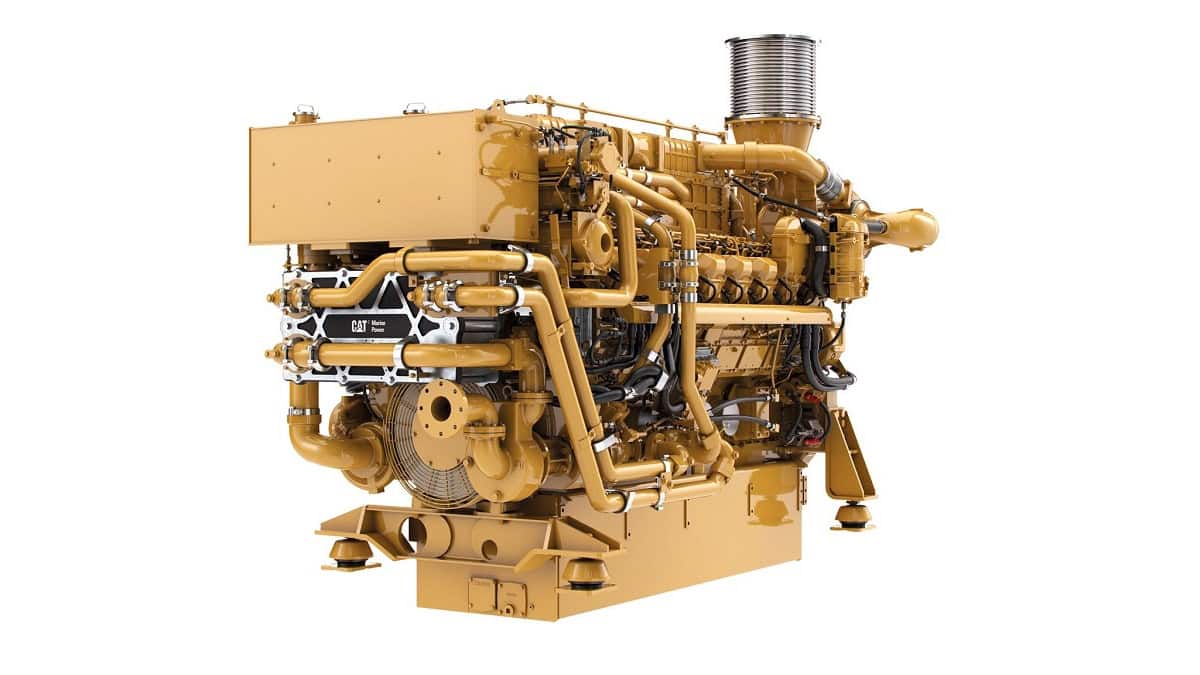
Caterpillar Marine, a world leader in power system research, design, manufacturing, distribution and product support for marine propulsion and auxiliary applications, announce that it has received DNV Approval in Principle of the Cat® 3500E methanol-ready marine main and auxiliary engines.
The DNV approval and class notation validate Caterpillar Marine’s methanol-ready dual-fuel engine solution. The Cat 3500E marine engines are available in 12-cylinder (up to 1901 kW) and 16-cylinder (up to 2525 kW) configurations. Caterpillar Marine will provide update kits for the 3500E in addition to offering new methanol-burning engines to satisfy the timing and requirements of any project.
Cat 3500E methanol-ready engines will have a significant impact across all maritime segments, especially tugs and other vessels that require high-power propulsion for heavy loads. This innovative solution will enable operators to use methanol as a fuel to help reduce greenhouse gas (GHG) emissions from well to wake.1
“Caterpillar Marine is pleased that the DNV review was successful, as it marks an important product development milestone for us,” stated Caterpillar Marine Vice President and General Manager Brad Johnson. “Methanol will play an important role in the maritime industry’s energy transition efforts, and we look forward to providing vessel operators with high-quality methanol solutions.”
In parallel with the methanol engine development, Caterpillar is also exploring other alcohol-based fuels. The company has already started testing these fuels in the same engine and will provide more information as the development progresses. Stay tuned for further updates.
Caterpillar Marine first announced its investment in methanol engine technology in March 2022 as part of its combustion technologies innovations. In a follow-up release in September 2022, it announced methanol-readiness for the 3500E-series marine engines, which would be capable of being modified to run as dual-fuel engines in the future. In May 2024, the company announced plans to deploy the first set of field demonstrator methanol dual-fuel 3500E marine engines with Damen Shipyards Group in 2026.
Caterpillar has successfully leveraged innovative dual-fuel technology across several industries as it explores the new world of alternative fuels.
- Tailpipe GHG emissions from lower-carbon intensity fuels are essentially the same as with traditional fuels.