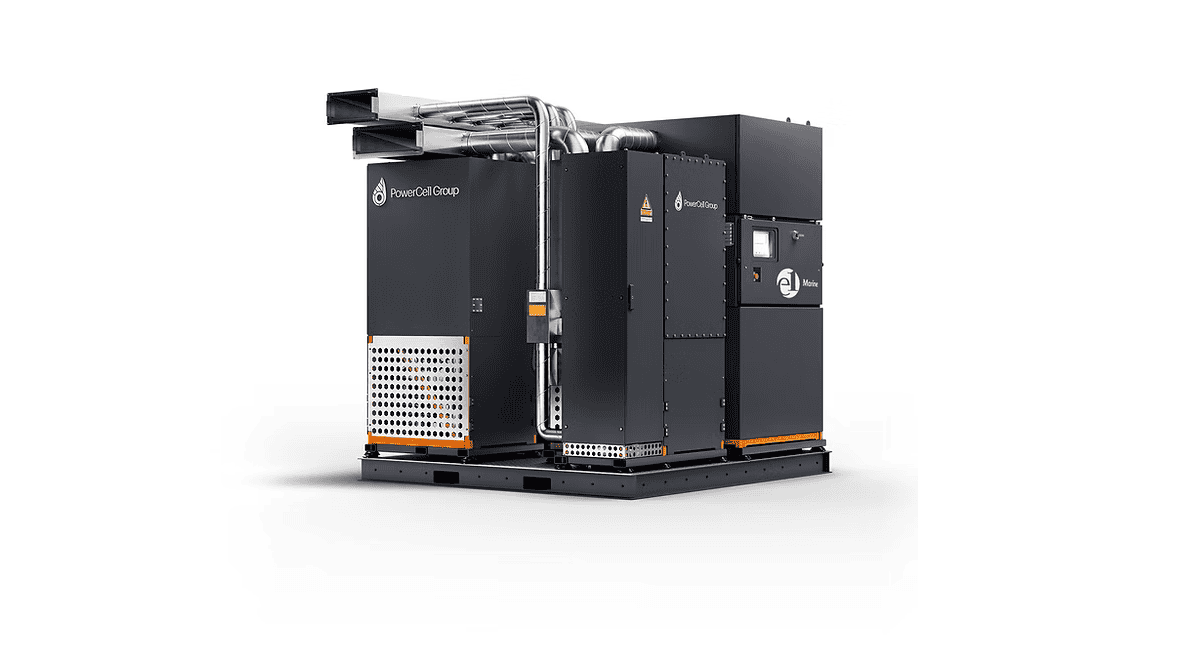
e1 Marine, a developer of advanced methanol-to-hydrogen generator technology for maritime and port industries, announce that it has received an order from PowerCell Group, a premier provider of hydrogen-electric fuel cell solutions. The order includes eight M30 reformers to support PowerCell’s first commercial sale of its new M2Power 250 system.
The order, comprising of one reformer per M2Power 250 system, forms part of PowerCell’s SEK 150 million contract with a major European shipyard for a 2 MW methanol-to-power installation, marking the first commercial deployment of a fully integrated, methanol-reformer-and-fuel cell solution for the marine market. Delivery is scheduled for 2029 and includes product supply and engineering support.
Each 250 kW M2Power 250 module combines e1 Marine’s M30 hydrogen generator with PowerCell’s marine fuel cell stacks to produce clean, efficient electrical power for onboard systems. Designed to replace traditional marine diesel gensets, the integration also eliminates the need for high-pressure hydrogen storage by generating fuel cell-grade hydrogen directly onboard using a methanol and deionized water blend as feedstock.
e1 Marine’s compact, modular M-Series generators produce hydrogen on demand with up to 80% energy efficiency and minimal environmental impact, generating up to 16.2 kg of fuel cell-grade hydrogen per hour (≥99.97% purity, ISO 14687 compliant). Approved in Principle by Lloyd’s Register, the American Bureau of Shipping, and the Republic of the Marshall Islands Maritime Administrator. When powered by renewable methanol, now rapidly scaling in availability, the system cuts GHG emissions by up to 85% compared with diesel engines while producing zero NOx, SOx, and particulate matter emissions. Together with PowerCell’s fuel cells, this capability underpins the combined M2Power 250 system, achieving energy efficiencythat outperforms conventional internal combustion engines and delivering additional efficiency gains when waste heat is recovered for onboard use.
This development builds on several successful joint initiatives between e1 Marine and PowerCell, including the Hydrogen One project and the ongoing STAX Engineering partnership. These projects helped refine the integration between reformer and fuel cell, ensuring mechanical, thermal, and control systems work seamlessly within the vessel’s existing energy management and safety systems.
Dave Lee, Executive Director, e1 Marine, commented: “This collaboration brings together two proven technologies in a single, pre-assembled solution that makes integration easier for shipyards and operators alike. By combining our M30 methanol-to-hydrogen reformer with PowerCell’s marine fuel cells, we’ve effectively created a plug-and-play system that eliminates the need for separate onboard integration and reduces system footprint. It’s a streamlined approach that cuts installation complexity, shortens delivery timelines, and ensures consistent performance from the outset.”
Richard Berkling, CEO of PowerCell Group, added: “With the M2Power 250, we’re taking PowerCell beyond fuel cell electrification, simplifying integration for shipyards and system integrators while accelerating hydrogen adoption in markets where infrastructure is still catching up. Working with e1 Marine’s proven methanol-to-hydrogen technology ensures we can offer customers a complete, reliable, and efficient pathway to decarbonized onboard power.”
Lee concluded: “PowerCell has quickly become one of the leaders in the marine fuel cellspace, and our ongoing collaboration demonstrates how partnerships built on complementary expertise can accelerate the maritime industry’s energy transition. This is another important step toward scalable, real-world adoption of hydrogen-based power at sea.”