



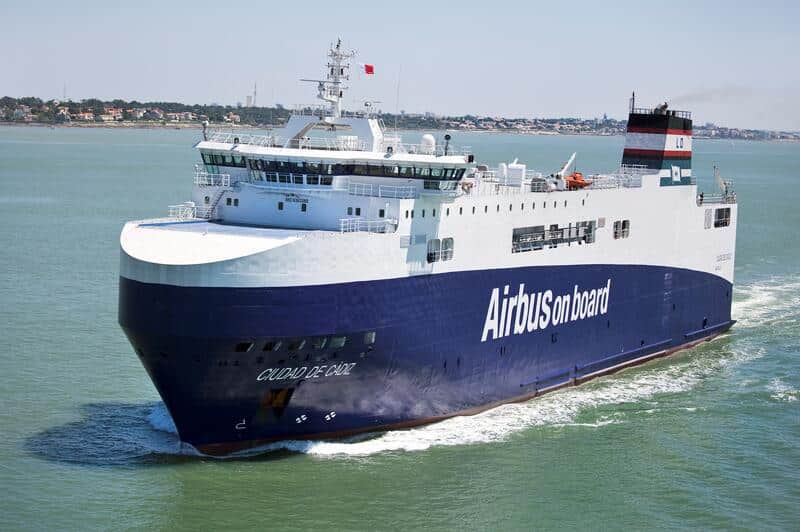
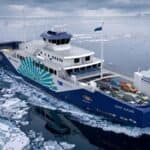
By testing a new routing method based on ocean currents, the Ro-Ro Ciudad de Cadiz fitted out by the Louis Dreyfus Armateurs (LDA) group was able to reduce its consumption by 5%.
The ro-ro Ciudad de Cadiz, fitted out by the Louis Dreyfus Armateurs group and chartered by Airbus, tested a new method of routing based on in-depth knowledge of ocean currents. Prior to Amphitrite’s technology, ocean currents were provided by digital models but their limited reliability and low accuracy did not allow ship routing.
This technology is based on the fusion of multiple satellite data, coupled with artificial intelligence, making it possible to very precisely detect variations in the position and intensity of surface currents that can slow down or accelerate commercial vessels. This technology is the result of research work carried out in recent years at the CNRS and the École Polytechnique by the founding team of Amphitrite. It paves the way for fine ocean routing which optimizes the trajectory of ships on a day-to-day basis to reduce their fuel consumption and their CO2 emissions.
On April 8, 2023, following the Ocean Bulletin provided by the Amphitrite company, the Ciudad de Cadiz deviated a few tens of nautical miles north of the direct route between Sardinia and the Strait of Gibraltar to avoid counter-currents and benefit from carrier currents. This slight deviation from the course enabled her to increase her average speed from 16.5 to 17 knots for 36 hours and to reach a top speed of 18.2 knots without increasing the power delivered by her engines. This optimization made it possible to save 70 minutes on the arrival time at the port of destination and to reduce the vessel’s consumption by 5%.
This result is the result of close collaboration between the Innovation department of Louis Dreyfus Armateurs and the French start-up Amphitrite.
“Always aiming for zero-emission shipping, our Innovation department continues to implement immediate solutions. After the very positive trials of using HVO biofuel on the Ciudad de Cadiz ro-ro ferry in December 2022, we have passed a first test of a new routing concept showing very good results. ” explains Jean-Louis Cadoret, Managing Director, LD Seaplane.









 group was able to reduce its consumption by 5%.Suresnes, France – June 28, 2023 The ro-ro Ciudad de Cadiz, fitted out by the Louis Dreyfus Armateurs group and chartered by Airbus, tested a new method of routing based on in-depth knowledge of ocean currents. Prior to Amphitrite's technology, ocean currents were provided by digital models but their limited reliability and low accuracy did not allow ship routing. This technology is based on the fusion of multiple satellite data, coupled with artificial intelligence, making it possible to very precisely detect variations in the position and intensity of surface currents that can slow down or accelerate commercial vessels. This technology is the result of research work carried out in recent years at the CNRS and the École Polytechnique by the founding team of Amphitrite. It paves the way for fine ocean routing which optimizes the trajectory of ships on a day-to-day basis to reduce their fuel consumption and their CO2 emissions. On April 8, 2023, following the Ocean Bulletin provided by the Amphitrite company, the Ciudad de Cadiz deviated a few tens of nautical miles north of the direct route between Sardinia and the Strait of Gibraltar to avoid counter-currents and benefit from carrier currents. This slight deviation from the course enabled her to increase her average speed from 16.5 to 17 knots for 36 hours and to reach a top speed of 18.2 knots without increasing the power delivered by her engines. This optimization made it possible to save 70 minutes on the arrival time at the port of destination and to reduce the vessel's consumption by 5%.This result is the result of close collaboration between the Innovation department of Louis Dreyfus Armateurs and the French start-up Amphitrite .“Always aiming for zero-emission shipping, our Innovation department continues to implement immediate solutions. After the very positive trials of using HVO biofuel on the Ciudad de Cadiz ro-ro ferry in December 2022, we have passed a first test of a new routing concept showing very good results. ” explains Jean-Louis Cadoret, Managing Director, LD Seaplane.)