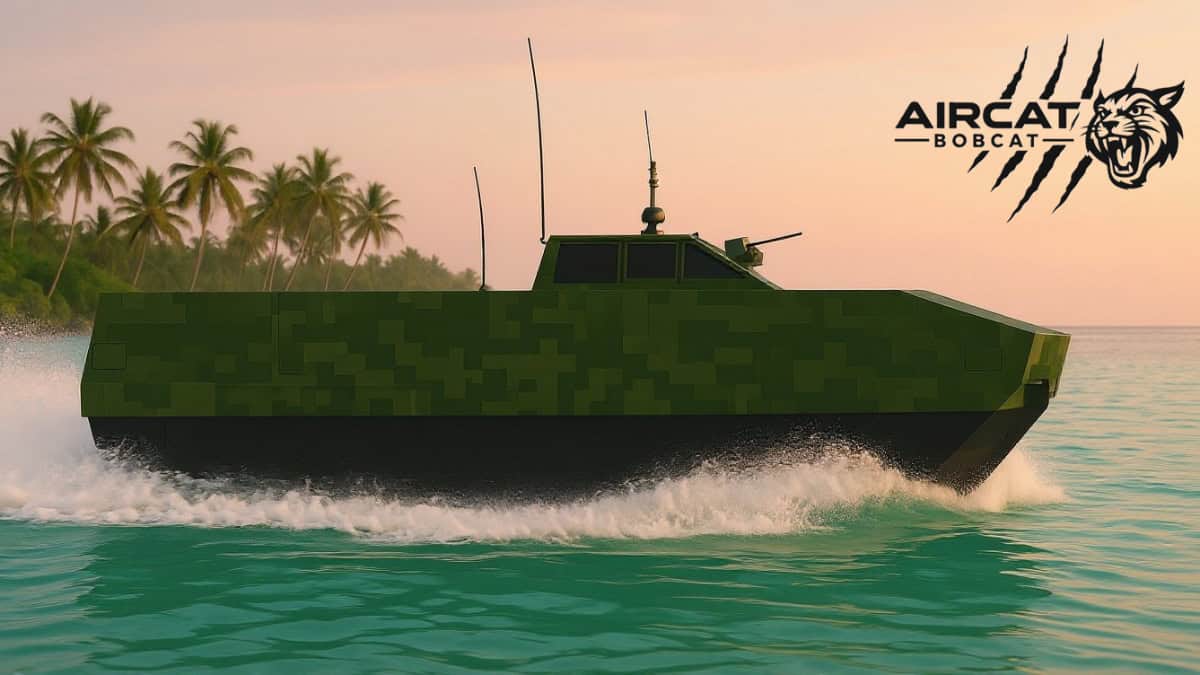
Eureka Naval Craft unveil the AIRCAT Bobcat, a 57-foot ultra high-speed catamaran landing craft engineered to transport personnel and materiel swiftly into littoral zones, upriver routes, and estuaries where access is constrained or denied.
Autonomous or optionally manned, the all-aluminum AIRCAT Bobcat can carry up to 10 tons of cargo or 36 troops. It has a top speed of 50 knots and a range of 350 nautical miles at an average speed of 38 knots, while range can be extended with additional modular fuel tanks.
“The Bobcat is quite literally the pick-up truck of the littorals and will revolutionise Army and Marine Corps expeditionary operations,” said Bo Jardine, CEO of Eureka Naval Craft. “It is the practical workhorse for modern ship-to-shore movement, and it is production-ready today.
“Bobcat can be produced rapidly and cost-effectively in multiple Tier 2 and Tier 3 U.S. shipyards with which we have collaborated, including Bordelon Marine in Houma, LA, and Shoreline Offshore in New Bedford, MA.”
Jardine explained that Eureka is scheduling AIRCAT Bobcat briefings, technical exchanges, and virtual demonstrations during AUSA week.
The Bobcat’s open-top deck can carry outsized and irregular loads, support modular weapons payloads, and enable offshore load and discharge alongside larger ships and port quaysides.
The high-speed landing craft is fitted with both bow and stern ramps to provide rapid roll-on/roll-off capabilities. It is also equipped with SH Defence’s modular deck lock system to allow rapid securing of containers, mission modules, small vehicles, and other cargo.
With its catamaran design, the AIRCAT Bobcat can operate effectively in as little as 1.6 feet of water, and is capable of beaching and self-recovery. It is optimised for conveying personnel and materiel into littoral zones and for transit up rivers and estuaries.
Richard Byno, EVP of Defense at Eureka Naval Craft said: “The design supports ship-to-shore and island-to-island operations as well as inland-waterway operations. We have designed it for high-tempo forward operations with features to support sustained sorties and rapid turnaround in austere environments.”
For contested littoral operations, the low-profile craft with minimized visual signature can be fitted with a stabilized remote weapon station and a compact counter-UAS systems suite for self-protection. Appliqué armor can be added to the hull and superstructure as required for specific missions.
Byno emphasised the Bobcat’s field serviceability with main engines fitted on quick-change modular mounts at main deck level with standardised mechanical and electrical interfaces. Accessible service hatches and on-deck lifting provisions allow engine swaps and repairs without the need for specialised shore support equipment. Additionally, parts commonality with commercial energy-industry components simplifies spares and reduces mean time to repair – keeping the warfighter in the fight.