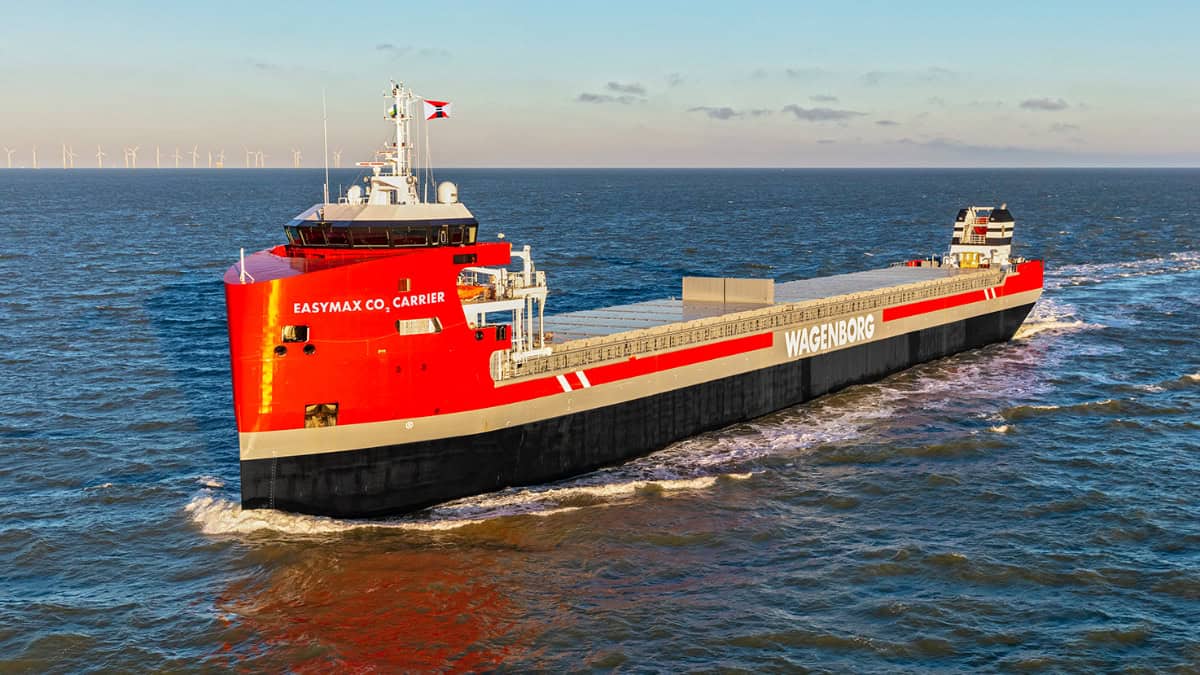
The completion of the hull of Europe’s first offshore CO₂ carrier marks a pivotal milestone in the energy transition and the advancement of carbon capture and storage (CCS) infrastructure within Europe. All ship sections of the vessel have now been successfully constructed and assembled at Royal Niestern Sander shipyard in the north of the Netherlands. This milestone signals the beginning of the final preparations for the vessel’s official christening and launch, set to take place on May 14.
Built under a long-term agreement with INEOS, a leading partner in Project Greensand, the ship is based on Wagenborg’s proven EasyMax concept and is being constructed by Royal Niestern Sander. Once operational, the carrier will transport captured CO₂ to the Nini West offshore platform in the Danish North Sea—supporting the complete CCS value chain: capture, transport, and permanent offshore storage.
The construction of this unique vessel in the Netherlands underscores the innovative spirit of northern Dutch shipbuilding. Wagenborg and Royal Niestern Sander have previously pioneered game-changing vessels such as ‘walk-to-work’ offshore support ships and the EasyMax series.
The landmark agreement between INEOS and Wagenborg for the delivery of this new-build CO₂ carrier was signed in November 2024, in the presence of HM King Willem-Alexander of the Netherlands and HM King Frederik of Denmark.
The vessel is specifically designed to transport liquefied CO₂ from onshore capture sites to offshore storage in the Danish part of the North Sea. Once launched and operational, the carrier will sail regular routes from Port Esbjerg to the Nini West platform, where the CO₂ will be injected for safe and permanent storage to the Nini reservoir approx. 1,800 metres beneath the seabed.
These geological formations have securely contained hydrocarbons for millions of years and have been thoroughly assessed and certified for safe and permanent CO₂ storage.
“The completion of the ship’s hull is a giant step forward for transportation of CO₂ in the EU,” says Mads Weng Gade, CEO of INEOS Energy. “This ship is essential to our ambition of establishing the first full-scale CO₂ storage facility in the EU. With the carrier now entering its next construction phase, Greensand is getting closer to completing Europe’s first full CCS value chain.”
“We are proud to reach this important milestone together with INEOS for Project Greensand,” says Edwin de Vries, Director of Wagenborg Offshore. “This is the first offshore CO₂ carrier to be launched of its kind made in Europe and a shining example of how the maritime industry in the North of the Netherlands is contributing to the energy transition.”
Mads Gade, CEO INEOS Energy Europe says: ”The geology in the Danish part of the North Sea is very well suited for safe and permanent storage of CO2. By fulfilling the potential for storage of CO2 deep below the subsurface in the Danish North Sea we can make a significant contribution to achieving both Danish and European climate goals. The CO2 carrier will play a pivotal role for Greensand in establishing and developing the first operational CO₂ storage facility in the EU aimed at mitigating climate change”.
The offshore CO₂ carrier itself is designed to meet the highest standards for safety and environmental performance and is tailored to the specific technical requirements of CO₂ transport, including onboard cooling and pressure systems. With the completion of the ship’s hull, the vessel enters the next phase of construction, which includes retrofitting, commissioning, testing, and sea trials.
This milestone follows a series of major developments in the Greensand project. In December 2024, INEOS and its partners Harbour Energy and Nordsøfonden made the Final Investment Decision (FID) to move ahead with full-scale CO₂ storage operations in the Nini Field.
With the plan to initiate safe sand permanent CO₂ storage in the Nini Field by late 2025/early 2026, Greensand is expected to become the EU’s first operational CO₂ storage facility aimed at mitigating climate change. This investment decision has paved the way for expected investments exceeding 1 billion DKK across the Greensand CCS value chain to scale up storage capacity.
The dedicated carrier is central to fulfilling this ambition, enabling safe, efficient, and scalable transport of captured CO₂ from across Europe to the Danish storage site.
Construction has progressed steadily with several key sections of the vessel completed and assembled. Earlier this year, the successful and safe transport of the aft ship marked another significant step forward.
Project Greensand aims to begin regular offshore CO₂ injection by the end of 2025 or early 2026. The project’s initial phase targets the permanent storage of 400,000 tonnes of CO₂ annually, with the potential to scale up to 8 million tonnes per year by 2030. The arrival of the new CO₂ carrier will be vital in ensuring this ambition becomes a reality – not only for Denmark but for Europe’s broader climate goals.