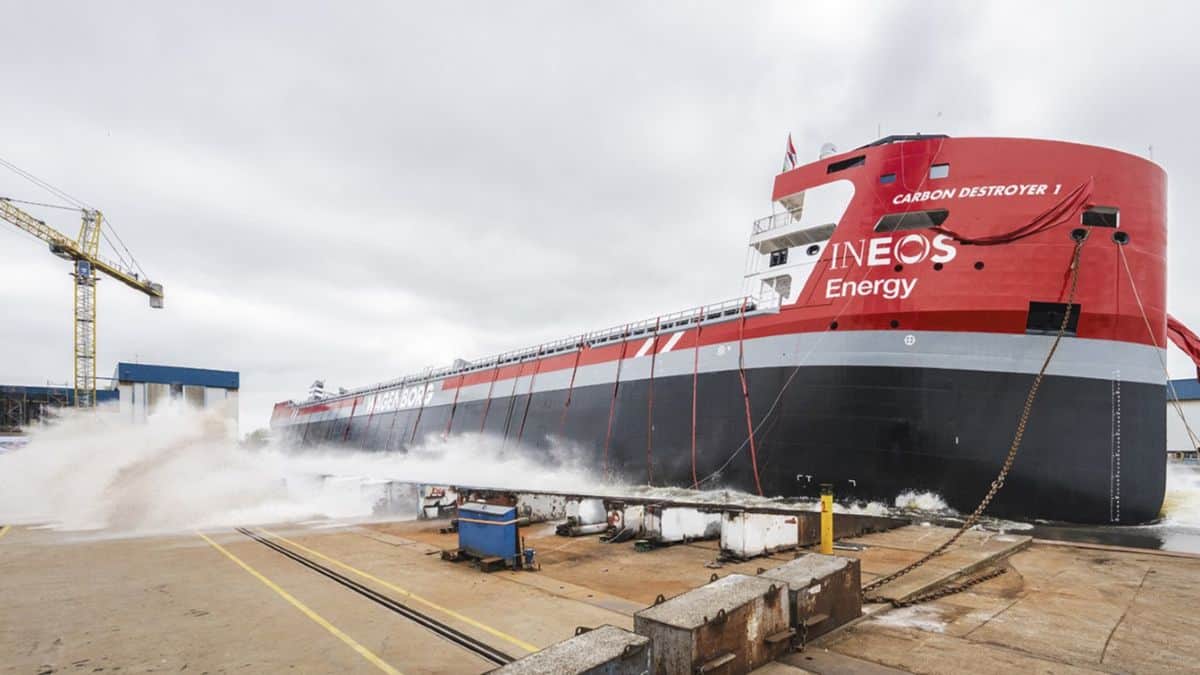
Royal Wagenborg and INEOS Energy celebrated the launch of Carbon Destroyer 1, Europe’s first dedicated offshore CO₂ carrier, a pivotal advancement for cross-border carbon capture and storage (CCS) under Project Greensand. The vessel, commissioned to transport liquefied CO₂ to offshore storage sites, a major breakthrough for Project Greensand and Carbon Capture and Storage across the EU.
Lady Catherine Ratcliffe, as Godmother of the vessel, performed the traditional naming ceremony, to launch the carrier at the Royal Niestern Sander shipyard in the Netherlands, as part of a close partnership between Royal Wagenborg and INEOS Energy.
Designed for the safe and efficient transport of liquefied CO₂, the newly launched vessel will play a crucial role in the Greensand project in the Danish North Sea, led by INEOS Energy. This pioneering ship —developed in close cooperation with partners in the energy and shipbuilding sectors—is the first of its kind to be built entirely in Europe and tailored specifically for offshore CCS operations.
Egbert Vuursteen, CEO Royal Wagenborg, says: “This launch is a defining moment for Wagenborg. It combines over a century of maritime experience with a forward-looking vision of sustainability. As the first European-built offshore CO₂ carrier, this vessel positions us—and our partners—at the forefront of the energy transition in Europe.”
Sir Jim Ratcliffe, Chairman of INEOS, says: “The launch of Carbon Destroyer 1 is an important next step for Carbon Capture and Storage in Europe. We are demonstrating that Carbon Storage is commercially viable and a far better way to decarbonise Europe without its deindustialisation.”
Based on the proven EasyMax design, the ship features a cargo capacity of approximately 5,000 ton of liqued CO2 and meets the highest standards for safety, fuel efficiency, and low emissions. Its innovative design and DP2 capabilities ensures it can operate reliably and year-round under various offshore conditions, while its reduced environmental footprint supports Wagenborg’s long-term commitment to greener shipping solutions. The groundbreaking CO2 carrier is another example of the importance of the maritime cluster here in the Northern Netherlands.
Mads Weng Gade, CEO of INEOS Energy Europe, says: “Carbon destroyer 1 will transport captured CO2 from across Europe, creating a virtual pipeline between the point of capture and permanent storage deep beneath the sea bed of the North Sea. The delivery of the first dedicated offshore CO2 carrier is a prerequisite for commercial scale CCS across the continent.”
Edwin de Vries, Director Wagenborg Offshore, says: “All available knowledge, the craftsmanship, the innovation coming from the shipyard, all suppliers and partners – it rivals the very best globally. We should be proud. And we should continue to invest in this maritime ecosystem. Because the challenges ahead – from energy transition to digitalization – will demand even more cooperation and creativity.”