



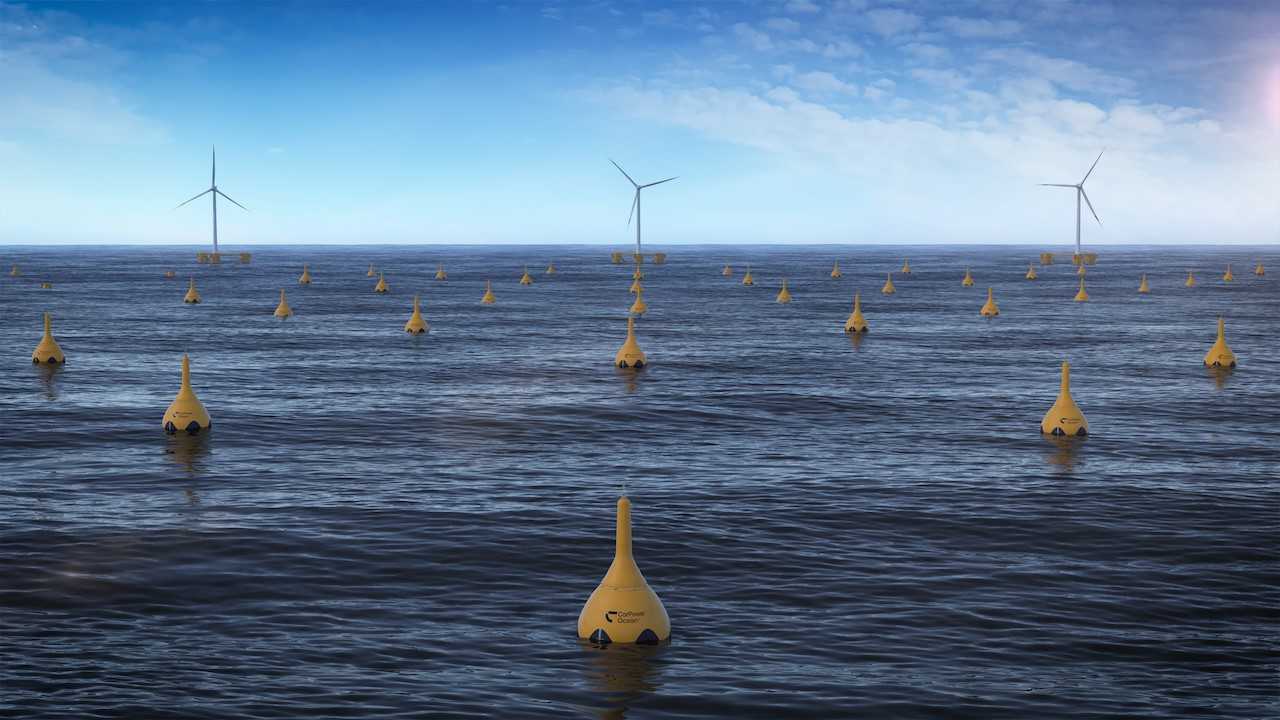
Official results from the pan-European EVOLVE project involving world-leading academics, research institutions and technology developers have been released today (Thursday, Jan 26), providing a firm evidence base supporting the acceleration of ocean energy in Europe’s future energy system.
The spatial modelling study focused on three specific territories – Great Britain, Ireland and Portugal, identifying close to 60GW of practically viable wave energy and 10GW of tidal stream energy. More specifically, results show resources of 34.8GW in Great Britain, 18.8GW in Ireland and 15.5GW in Portugal.
Projections further indicate that 10GW of ocean energy installed in Great Britain alone could save £1.46bn per year in power system dispatch costs, with emissions reduced by up to 1.05 MtCO2 (Millions of metric tonnes).
Results show a consistent pattern with increases in ocean energy reducing overall system dispatch costs – including the cost of delivered fuel, and other variable operation and maintenance – and annual carbon emissions. These system benefits are due to the offsetting of ocean energy availability with other renewables such as wind and solar. It was found that a more diverse mix of renewables, including ocean energy, results in a more consistent renewable production profile which is better able to meet hourly electricity demands, key for reaching future international net zero targets.
The rigorous two-year initiative was led by Aquatera with support from WavEC Offshore Renewables, Research Institutes of Sweden (RISE) and The University of Edinburgh, along with wave and tidal energy developers CorPower Ocean and Orbital Marine Power.
EVOLVE Technical Manager Dr Shona Pennock, who also serves as a Research Associate in Marine Energy within Edinburgh University’s Policy & Innovation Group, said: “There has been much commentary in recent years about the potential benefits of adding wave and tidal to the broader energy system, but this has been hampered by limited quantifiable studies. The EVOLVE Project aimed to directly address this point producing tangible results in terms of the costs and carbon savings associated with deploying ocean energy into future low-carbon energy mixes. Following extensive work over a number of years we can now draw clear conclusions from firm evidence. The key headline from the EVOLVE Project is that including a higher proportion of ocean energy within our future electricity system consistently results in higher renewable dispatch, for the same total renewable energy availability, due to the offsetting of wave and tidal with wind and solar generation. The ability to dispatch more renewables also results in lower fossil fuel and peaking plant dispatch, and thus lower total dispatch costs and carbon emissions.”
Swedish wave energy developer CorPower Ocean and Scottish tidal stream energy developer Orbital Marine Power contributed significant internal ocean energy data. Analysts used these data sets to create a hypothetical generation series, calculating the potential impact of ocean energy on the overall energy system. Evidence shows that wave energy supplies higher volumes of power when wind energy dips and that tidal stream generation is completely decoupled from wind; meaning a combination of ocean and wind profiles provides greater value, rather than working in isolation.
Anders Jansson, Head of Business Development at CorPower Ocean, said the EVOLVE report places further academic weight behind the case for ocean energy, helping inform decision makers across Europe. “The key challenge in the race to net-zero and 24/7 Carbon Free Energy lies in the supply of consistent and stable renewable energy,” he said. “By modelling future power system scenarios across Europe, the EVOLVE Project has been able to clearly demonstrate the role ocean energy can play in the future, ensuring a more cost-effective matching of energy supply and demand. Wave energy, in particular, has been found to correlate best to peak demand and could improve overall system security. This is particularly pertinent given the current climate and broad demand to ease reliance on gas imports.”
Oliver Wragg, Commercial Director at Orbital Marine Power said: “The net zero energy system of the future will need multiple forms of renewable energy generation. We know that the tides rise and fall like clockwork and can be predicated hundreds of years into the future. With the results of the EVOLVE project, we now also have clear projections for how the additional of predictable stable power generation from Europe’s fantastic tidal stream resource can help to cost effectively reach our net zero ambitions”.
THE EVOLVE Project has received support under the framework of the OCEANERA-NET COFUND project, with funding provided by the following national/regional funding organisations: Scottish Enterprise, Swedish Energy Agency and Fundação para a Ciência e a Tecnologia.
The OCEANERA-NET COFUND project has also received funding from the European Union’s Horizon 2020 research and innovation programme under grant agreement [no.713200].










, providing a firm evidence base supporting the acceleration of ocean energy in Europe’s future energy system. The spatial modelling study focused on three specific territories – Great Britain, Ireland and Portugal, identifying close to 60GW of practically viable wave energy and 10GW of tidal stream energy. More specifically, results show resources of 34.8GW in Great Britain, 18.8GW in Ireland and 15.5GW in Portugal. Projections further indicate that 10GW of ocean energy installed in Great Britain alone could save £1.46bn per year in power system dispatch costs, with emissions reduced by up to 1.05 MtCO2 (Millions of metric tonnes).Results show a consistent pattern with increases in ocean energy reducing overall system dispatch costs – including the cost of delivered fuel, and other variable operation and maintenance – and annual carbon emissions. These system benefits are due to the offsetting of ocean energy availability with other renewables such as wind and solar. It was found that a more diverse mix of renewables, including ocean energy, results in a more consistent renewable production profile which is better able to meet hourly electricity demands, key for reaching future international net zero targets. The rigorous two-year initiative was led by Aquatera with support from WavEC Offshore Renewables, Research Institutes of Sweden (RISE) and The University of Edinburgh, along with wave and tidal energy developers CorPower Ocean and Orbital Marine Power.)