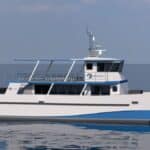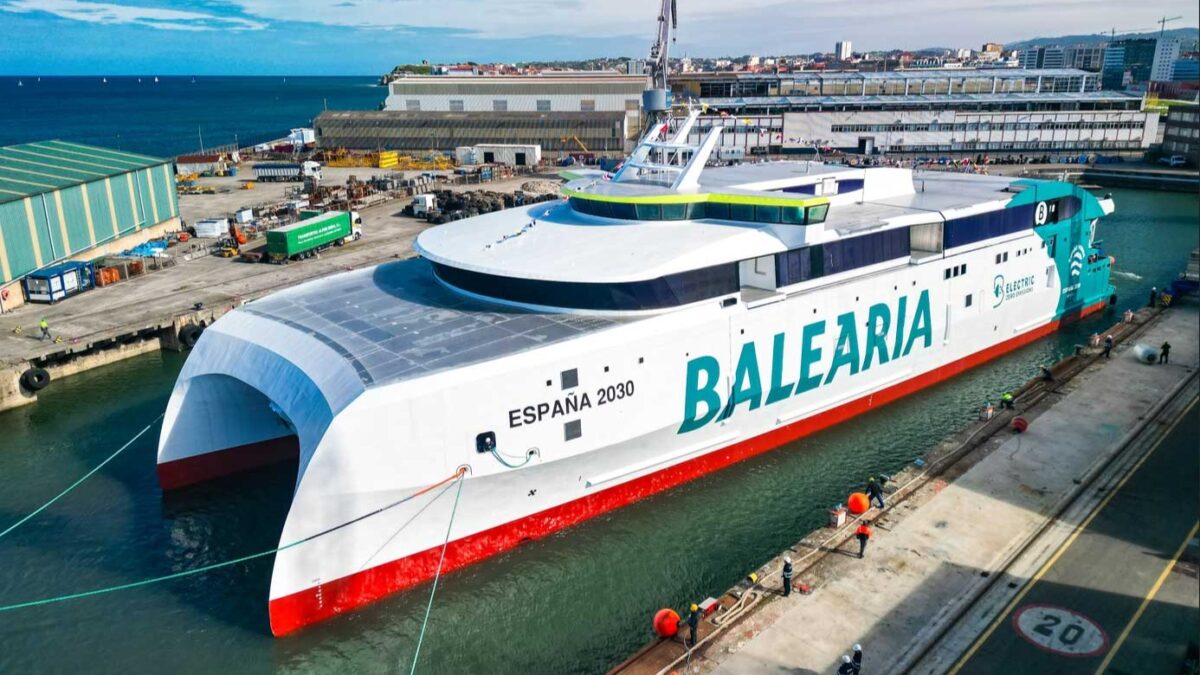
Built by Armon Shipyards, the new fast ferry is the first of two vessels being developed for Baleària’s fully electric Strait of Gibraltar service
Baleària has launched its first 100% electric fast ferry at Armon Shipyards in Gijón, Spain, marking a major milestone in the development of a zero-emission maritime corridor between Spain and Morocco.
Named ESPAÑA 2030, the new catamaran is scheduled to enter service on the Tarifa–Tangier route in summer 2027. Its sister vessel, MAROC 2030, is currently under construction and is expected to join the fleet later in the year.
Both vessels will operate exclusively on electric power and propulsion, eliminating operational emissions, noise and vibrations. The two catamarans will form the first fully electric green maritime corridor between Spain and Morocco, connecting Europe and Africa across the Strait of Gibraltar.
Designed by Incat Crowther, ESPAÑA 2030 and MAROC 2030 will each feature an installed electric power capacity of 16 MW, delivered through four electric propulsion units. The propulsion systems will be powered by 14 AYK Energy battery banks, providing a combined energy storage capacity of 14 MWh.
The project represents a significant investment in ferry electrification and demonstrates the potential for battery-powered vessels to support sustainable, high-frequency passenger services on short-distance maritime routes.
The president of Baleària, Adolfo Utor, stated that “this launch makes a strategic project for Baleària a tangible reality and brings us closer to the commissioning, in 2027, of the first 100% electric maritime connection between Europe and Africa. With these vessels, we are advancing the net-zero emissions target set for 2050 by several decades and demonstrating how innovation, investment, and industrial collaboration can accelerate the decarbonization of maritime transport.”
Armón CEO Laudelino Alperi stated: “It is an honour to contribute our experience and industrial capacity to such an innovative and emblematic project. Beyond the business collaboration, we want to highlight the excellent human and professional relationship that unites our teams, based on mutual trust, understanding, and shared commitment. This project reaffirms our commitment to developing increasingly sustainable and technologically advanced naval solutions.”
The fast ferry that has just left the dock is the fifth vessel built by Armon for Baleària. The shipyard estimates that the two catamarans generate more than 300 direct jobs daily at its facilities, depending on the project phase. Furthermore, the construction generates indirect employment, reinforcing the positive impact of shipbuilding on the auxiliary industries.
The project to build the two ships and electrify the ports of Tarifa and Tangier City has a cost exceeding 200 million euros.
The launching process, which involves the controlled flooding of the dry dock until the vessel begins to float, is one of the key milestones in the construction process. In this case, the operation presented a unique challenge, as the two catamarans are being built in parallel in the same dock, with space for one complete vessel and part of the second. During the launching of the first unit, the already assembled structure of its sister ship also floated, though it remained in place.
After the launch, the dry dock will be emptied again to complete the second catamaran in dry land. The first one, now afloat, will undergo interior outfitting and the gradual commissioning of all its auxiliary systems. Following this, sea trials will be conducted to certify its operational reliability and safety before final delivery.