CAIMEN Japan High-Speed Landing Craft combines BMT’s tri-bow hull form with high-speed performance and beaching capability for Japan Self-Defence Force operations
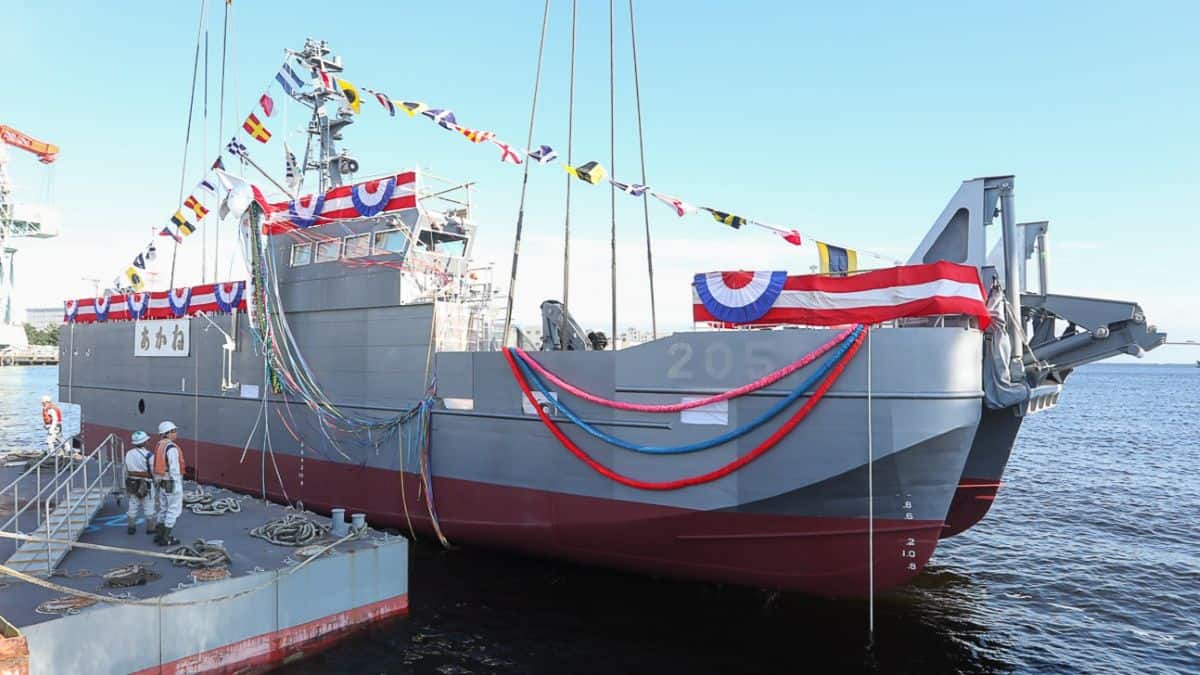
The first CAIMEN ® Japan high-speed landing craft has been launched, marking a significant milestone in Japan’s next-generation High Speed Landing Craft programme for the Japan Self-Defence Force (JSDF). The aluminium landing craft is based on a platform designed by BMT, with detailed design, production design and construction undertaken by Japan Marine United Corporation (JMU) at its facilities in Japan.
The launch follows the December 2025 contract award by Japan’s Acquisition, Technology and Logistics Agency (ATLA) to JMU for design and build of the next-generation High Speed Landing Craft. Under the programme, BMT provides the CAIMEN® landing craft design, while JMU undertakes production design and construction at its facilities in Japan.
The vessels are set to serve with the JSDF’s Maritime Transport Group, a joint unit of the Japan Maritime, Ground and Air Self-Defense Forces established in March 2025 supporting the rapid and flexible movement of personnel, vehicles and equipment between sea and shore, including to remote islands in Japan’s southwestern region where established port facilities are limited.
Approximately 35 metres long and of aluminium construction, CAIMEN® Japan incorporates BMT’s distinctive tri-bow hull form and is designed to achieve speeds of approximately 18 knots while carrying vehicles and personnel. The hull form combines high-speed transit with the seakeeping, manoeuvrability and stability required for beaching operations – the product of extensive research and development across the CAIMEN® family of landing craft.
The launch marks the first application of a BMT design to a Japanese shipbuilding programme, and a significant step in the continuing evolution of the CAIMEN® family. Developed and refined over many years, the CAIMEN® family has been engineered to meet diverse littoral manoeuvre requirements across a wide range of operating environments – with variants in service and production for allied armed forces internationally, including the U.S. Army’s Maneuver Support Vessel (Light), an evolution of the BMT CAIMEN-90® adapted through the Vigor–BMT partnership and now in full-rate production. It is a proven design, tailored as a localised solution to Japan’s specific operational requirements, and delivered as sovereign national capability through an in-country build partner – reflecting BMT’s long-standing experience of partnering with national shipbuilders across North America, Asia Pacific and Europe.
Graeme Nayler, Managing Director – Asia Pacific, BMT, said: “The launch of the first CAIMEN® Japan is a proud moment for everyone involved in the programme and, more importantly, a demonstration of what genuine international partnership can deliver. JMU brings world-class shipbuilding capability and a deep understanding of the JSDF’s requirements; BMT brings a proven design shaped by years of research and development. Together, that combination has carried this vessel from contract award to launch with confidence.”
“The programme is also significant in representing a rare instance of an overseas vessel design being adopted for a Japanese defence programme. We see this launch not as an end point but as a milestone in a long-term commitment to Japan’s maritime sector. It strengthens the defence industrial relationship between the United Kingdom and Japan, and it deepens BMT’s presence and partnerships across the Asia Pacific region where so much of the future of maritime capability is being shaped.”
Mr. Eto Atsushi, JMU Director and Managing Officer, said:“The launch of the first CAIMEN Japan marks a significant achievement for both JMU and BMT, one that neither company could have accomplished independently. BMT’s proven CAIMEN design, combined with JMU’s engineering expertise, production design capabilities, and shipbuilding craftsmanship, has been successfully realized through close and productive collaboration between our two organizations. Despite a demanding construction schedule, the project has progressed smoothly through meticulous planning, effective coordination, and the unwavering dedication of all those involved. This achievement reflects not only the strength of our teamwork, but also JMU’s enduring commitment to quality, precision, and craftsmanship, together with the strong partnership we have developed with BMT.”
“Today’s launch is not only a proud milestone for all of us, but also an opportunity to reaffirm the responsibility that begins at this stage of the vessel’s journey. As we move through the final phase toward delivery, we remain fully committed to achieving the highest standards of safety, quality, and performance. At the same time, we will continue to strengthen the close partnership between JMU and BMT, dedicating our utmost efforts to ensuring the long-term success of this vessel.”