


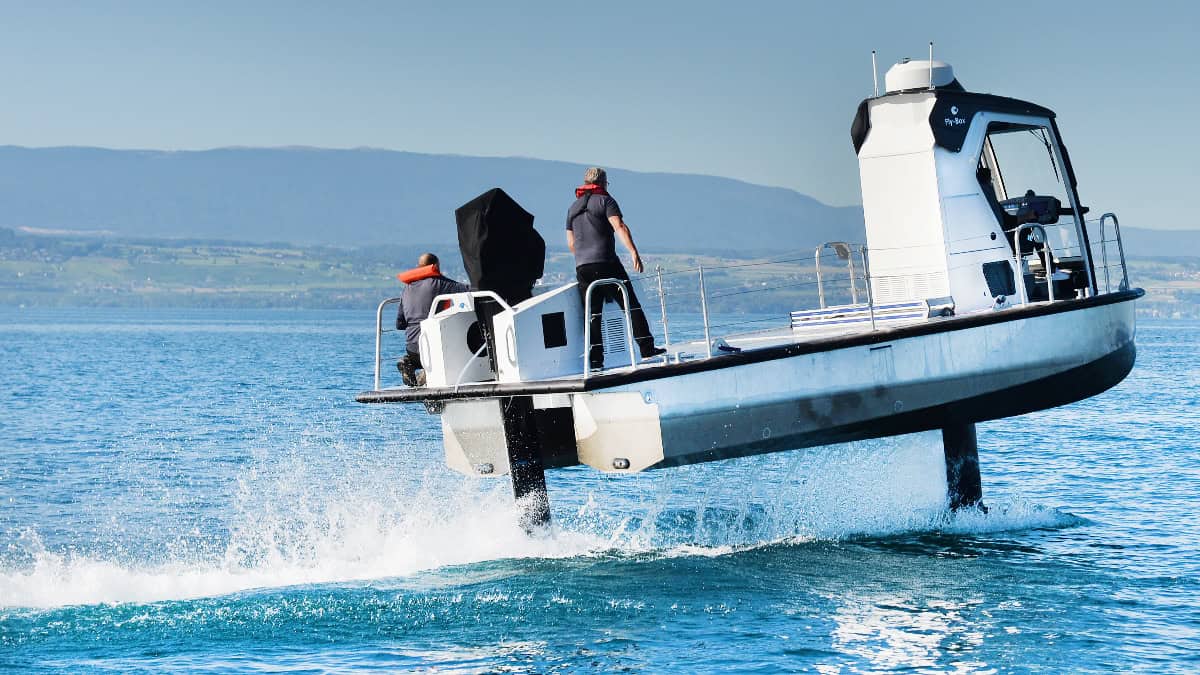
On Lake Geneva, Swiss start-up Fly-Box, founded by inventor and sailor Alain Thébault, has successfully flown a scaled-down prototype of its electric foiling vessel designed for freight transport. The milestone marks a key step toward developing sustainable, high-speed logistics solutions for inland waterways.
The Fly-Box Prototype is a 8-meter aluminium electric foiling vessel prototype is 100% electric. It lifts off at 12 knots (25 km/h) thanks to two large retractable T-foils, which drastically reduce energy consumption. Reaching speeds of up to 25 knots (50 km/h) and able to carry up to 700 kg of cargo, this “Proof of Concept” is a world first. It paves the way for the future 20-meter Fly-Box vessels, designed to carry a full 40-foot container with 30 tons of freight.
Today, trucks congest roads with pollution and delays, while traditional feeder vessels remain slow, rigid, and high emitters. The future Fly-Box fleet offers a credible alternative: operating along coastlines, rivers, and lakes, they will function as “taxis” carrying a single container, or as digitally linked convoys of platforms, much like a “freight train of the sea.”
Concrete examples: Between Evian and Lausanne, a truck takes 1h15 to cover 65 km, while a Fly-Box will cross in just 25 minutes. Between Nice and Monaco, where roads are saturated, a Fly-Box will make the trip in about 20 minutes. In the Gulf, between Doha and Manama, the 6h30 road journey will be cut to 5 hours at sea — with no congestion and zero emissions.
“With Fly-Box, we could remove thousands of trucks from the roads in the coming decade. Electrifying road fleets alone will not solve the environmental equation; complementary solutions must be deployed urgently to scale impact. Fly-Box brings an original answer to this challenge,” says Alain Thébault, CEO and founder of Fly-Box.
Freight transport is the lifeblood of globalized economies. For logistics operators, transoceanic container routes are only one part of the challenge. With a planned range of 150 nautical miles (280 km), lift-off from 12 knots, and a cruising speed of 25 knots, the future Fly-Box will be particularly suited to upstream and downstream segments: redistribution between major hubs and secondary ports (feedering), short sea shipping, and final port delivery.
At first, Fly-Box electric foiling vessel “sea trains” will be led by a pilot operating the lead platform, with the following units digitally tethered. Ultimately, the ambition is to operate these convoys in autonomous mode.
For operators, Fly-Box technology will:
- Improve agility and reliability of intermediate flows, particularly for critical goods (medicines, fresh produce, high-value cargo);
- Contribute to decarbonization by meeting increasingly stringent regulatory thresholds;
- Help decongest port cities and roads, currently saturated by freight trucks and their impacts.
This scaled-down Proof of Concept was designed to test the technological and architectural foundations of future 20-meter platforms. Six patents have already been filed. This autumn, the prototype will continue its trials on Lake Geneva before beginning an international demonstration campaign: first in Monaco, then in the Gulf, notably in Dubai and Bahrain.
“Following this first success, our priority is to build experience and enhance the reliability of the Fly-Box Prototype. We have received strong interest, and the time has come to deliver concrete results. In parallel, we are preparing the next financing phase: we are opening a final CHF 1.5M round to complete our pre-seed, ahead of a CHF 20M raise to fund the studies and construction of the first two full-scale 20-meter Fly-Box units capable of operating in platooning mode,” explains Admiral Antoine de Roquefeuil, COO of Fly-Box.
This first flight is the result of a collective effort by a multidisciplinary team: sailors, naval architects, foil and hydrodynamics experts, systems and energy engineers, specialists in mechatronics and software engineering. Together, they aim to deploy a fast, robust freight solution into the maritime ecosystem, combining the robustness of port operations with the most advanced technologies.
“These first two days of testing have been decisive: our prototype now flies! In the coming weeks, we will work on stabilizing flight and begin cargo trials. The following months will be dedicated to advancing vessel teleoperation,” adds Éric Prada, Head of Performance & Data Engineering.