



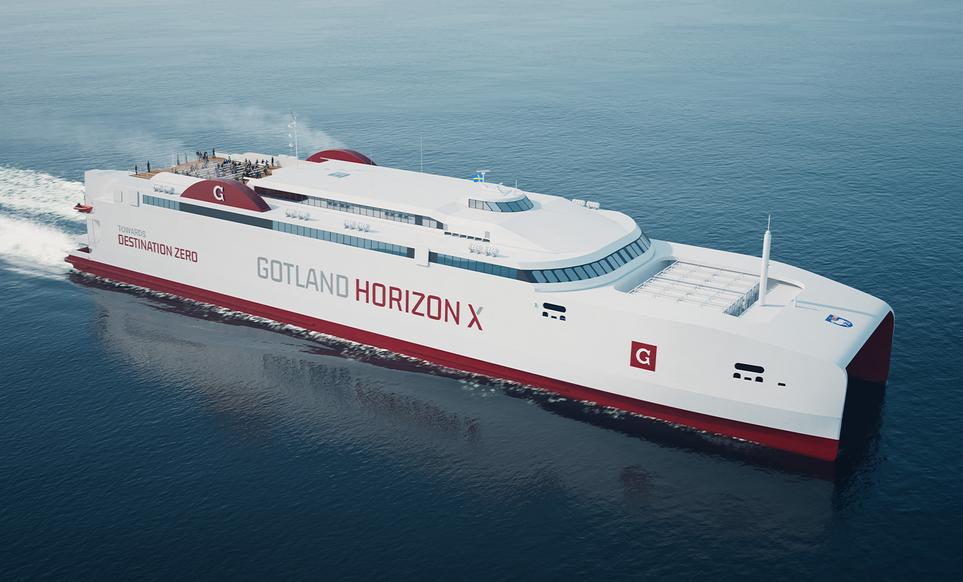
Gotlandsbolaget and the Australian shipyard Austal Limited have signed a letter of intent to enter into an agreement for the design of Gotlandsbolaget’s new high-speed catamaran. Austal and Gotlandsbolaget intend to develop the design of a 130-metre high-speed catamaran, with a multi-fuel solution designed for fossil-free fuels, which means that it can be powered with, among other things, hydrogen gas.
“This is an important step in our climate journey. We are working on developing the ships of the future, and in 2022 presented the second ship concept in our Horizon series, Gotland Horizon X. It is a high-speed catamaran that will be able to run on fossil-free fuels, and which we believe will be an excellent complement to the Gotland traffic. She will be used above all during the summer months and will be able to make the trip between Gotland and the mainland in under 3 hours,” says Håkan Johansson, CEO of Gotlandsbolaget.
Gotland Horizon X will be able to travel at 35 knots, carry 1,650 passengers and have space for 450 passenger cars.
“The ship’s design is based on Gotland’s and our passengers’ needs to be able to travel with a short crossing time and at competitive prices, without negatively impacting the climate or the environment. In order to minimize the energy requirement and obtain a high degree of efficiency, we develop energy-efficient hulls, minimize weight, optimize energy consumers on board and streamlines operations and flows throughout the vessel. Austal is a leader in the development of large catamarans and they are an excellent partner to take Horizon X forward,” says Christer Bruzelius, Gotland Tech Development.
For Australian Austal, the letter of intent is further proof of the company’s ability to design and build fast ferries with high demands on sustainability.
“The letter of intent with Gotlandsbolaget confirms that Austal is ready to design and build a 130-metre high-speed catamaran that can be powered by hydrogen, and which will help us on the journey towards zero emissions,” says Paddy Gregg, CEO of Austal.
“Austal develops hulls that are optimized for different types of fuel and propulsion, including hydrogen and electricity. We offer solutions for shipping companies that need fast-moving ships and look forward to working together with Gotlandsbolaget to produce a new, exciting design with high quality,”
Gotlandsbolaget has previously presented a larger passenger and freight ship, Gotland Horizon, with room for 1,900 passengers and 600 cars. The plan is for at least one of the ships to be in service by 2030 at the latest.














