
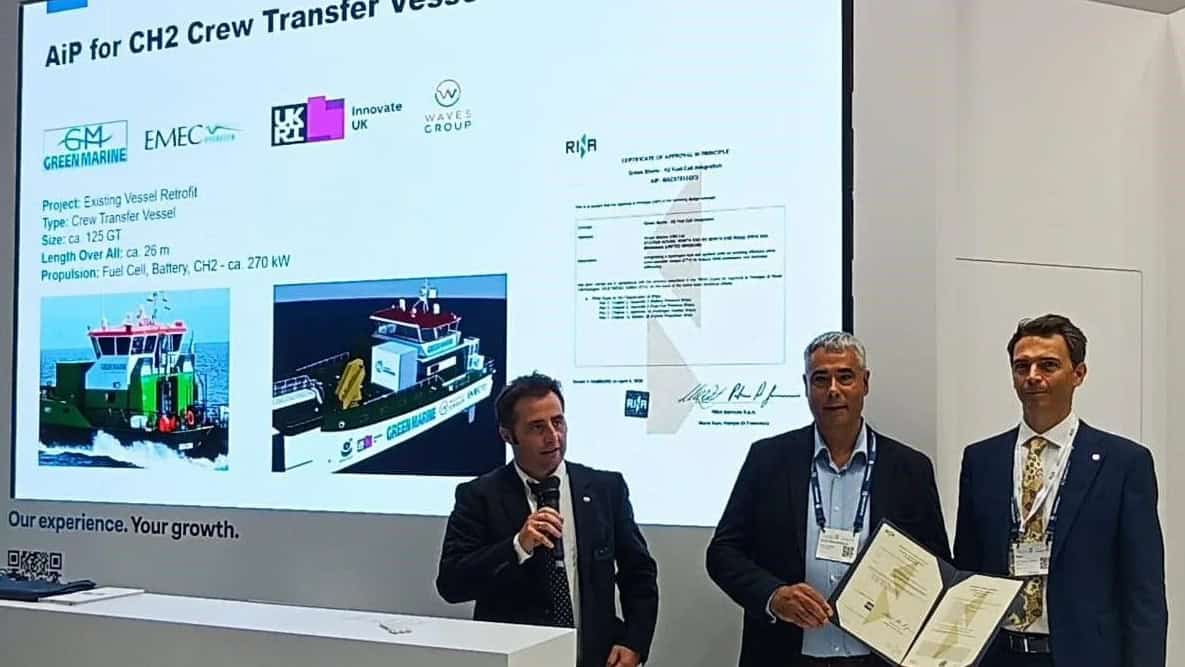
Green Marine UK has been officially awarded Approval in Principle (AiP) for its pioneering maritime initiative, Project Verdant, by global classification society RINA at SMM Hamburg 2024.
Phase 1 involving preliminary design and feasibility studies is now complete illustrating the hybrid system’s ability to reduce CO2 emissions by up to 30% and NOx emissions by up to 40% – opening the door to subsequent project phases seeking to execute design, engineering and sea trials.
Led by Green Marine UK, the Innovate UK funded project involved maritime consultancy Waves Group and EMEC (European Marine Energy Centre). Global leader in hydrogen systems and marine fuel cell generators Energys supported with design, engineering and modelling. Meanwhile, Engineered Marine Systems (EMS) provided design for the battery room.
Green Marine UK’s Managing Director Jason Schofield said: “Speaking on behalf of the Project Verdant consortium we are thrilled to officially receive this AiP from RINA. It is particularly fitting to receive this at SMM Hamburg – a world leading maritime trade fair which places major emphasis on the ‘maritime transition’. Ultimately, Project Verdant is illustrating the readiness of hydrogen fuel cell technology in CTVs. This represents an important milestone for the global offshore wind industry enabling a greener and more sustainable approach to service maintenance.”
The project findings are hugely significant when considering the scale of the opportunity. OREC (Offshore Renewable Energy Catapult) has estimated the offshore support sector will be worth around £26 billion by 2050 – with an additional 1200 vessels to service UK industry alone. Approximately 400 CTVs are currently operating in offshore wind farms around the UK and Europe. This is projected to almost double to 700 by 2030.
“Retrofitting CTVs in the manner prescribed by Project Verdant will help significantly de-risk the implementation and testing of hydrogen fuel-cell vessels in the coastal environment,” added Mr Schofield. “With technical feedback from RINA, we now have all the necessary input to accelerate the detailed design and implementation phase. Once the concept has been proven up, there is potential to rapidly replicate – enabling economies of scale to be leveraged with the removal of barriers to adoption.
“We would like to thank all partners and stakeholders for their dedication to this pioneering project to date, and RINA for its robust analysis of our proposals. Together, we look forward to continuing this important work, demonstrating that a new standard for environmental responsibility in offshore services is achievable from both a technical and commercial perspective.”
Project Verdant’s conceptual design incorporates hydrogen fuel cells connected to electric motors, working in conjunction with existing diesel-fuelled engines, which can be shut down to enable zero emission operation at slow speed while servicing offshore wind farms.
The system enhances vessel redundancy and flexibility by utilising locations where hydrogen is, or will be, readily available. This approach creates a test bed to advance maritime decarbonisation in a challenging sector without significantly impacting the vessel’s operational profile.
RINA’s AiP framework performs an important function ensuring robust analysis of innovative and novel concepts which are not currently covered by traditional classification rules, providing a level of safety in line with current marine industry practice and applicable regulations.
Project Verdant’s AiP provides confidence in the CTVs’ ability to operate safely in UK waters in accordance with the MCA (Maritime & Coastguard Agency) regulations MGN 664 and RINA Rules Pt C, Ch 1, App 14, Appendix 14 Hydrogen Fuelled Ships.
Broader industry has also recognised Project Verdant’s potential with Waves Group receiving the ‘Innovator Award’ at this year’s Scottish Renewables Green Energy Awards in Scotland for their contribution to the project.