


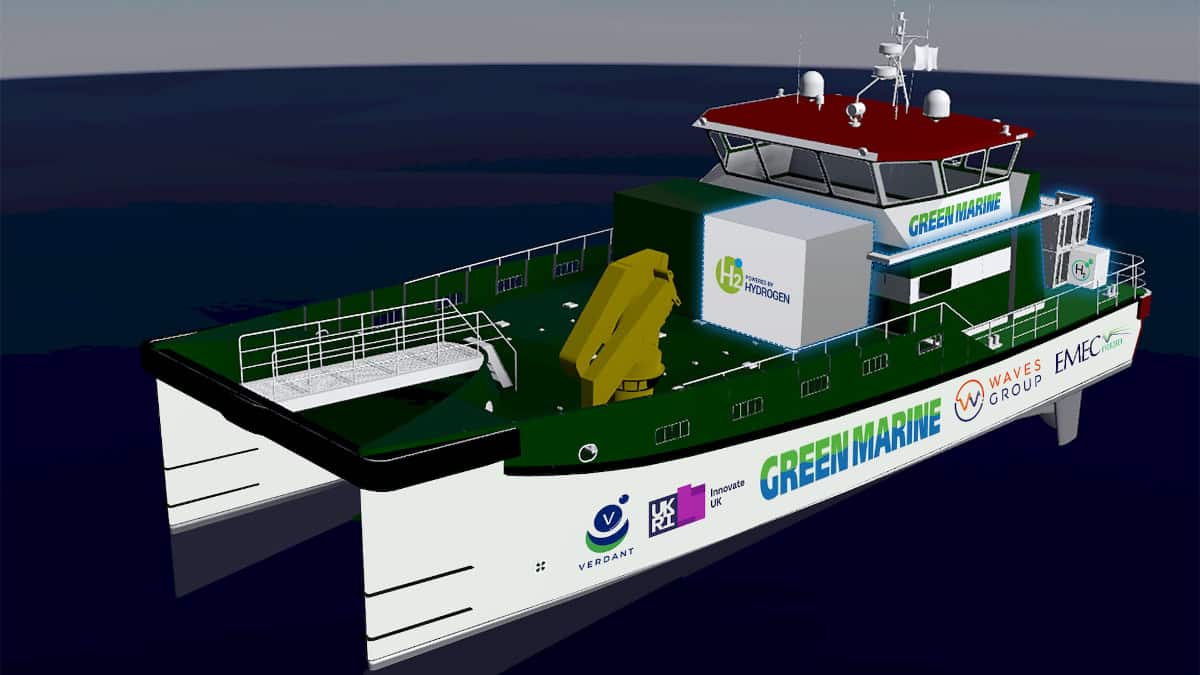
Green Marine UK’s pioneering maritime initiative aiming to retrofit CTVs (Crew Transfer Vessels) with hydrogen, fuel cells and battery – to cut emissions while servicing offshore wind farms – has been granted Approval in Principle (AiP) by global classification society RINA.
Phase 1 of Project Verdant, involving a preliminary design and feasibility study, has now been completed and deemed viable, opening the door to subsequent project phases seeking to execute design, engineering and sea trials.
Led by Green Marine UK, the Innovate UK funded project includes maritime consultancy Waves Group and EMEC (European Marine Energy Centre).
Project Verdant’s conceptual design incorporates hydrogen fuel cells connected to electric motors, working in conjunction with existing diesel-fuelled engines, which can be shut down to enable zero emission operation at slow speed while servicing offshore wind farms.
Global leader in hydrogen systems and marine fuel cell generators Energys helped design and provide engineering and modelling. Meanwhile, Engineered Marine Systems (EMS) supplied a design for the battery room, drawn from its extensive experience involving multiple hybrid CTVs.
Findings show the hybrid system could reduce the vessel’s CO2 emissions by up to 30% and NOx emissions by up to 40% – with CTVs commonly operating in loiter mode for long periods at a time.
Green Marine UK’s Managing Director Jason Schofield said obtaining AiP was a key objective for Project Verdant, providing confidence in the CTVs’ ability to operate safely in UK waters in accordance with the MCA (Maritime & Coastguard Agency) regulations MGN 664 and RINA Rules Pt C, Ch 1, App 14, Appendix 14 Hydrogen Fuelled Ships.
The ultimate mission is to capture sufficient learning from the operation of a retro-fitted vessel to enable Green Marine UK to expand its fleet with new-build Zero Emissions CTVs and SOVs (Service Operation Vessels).
“Following the review of a comprehensive package of design documentation and drawings, Project Verdant’s technical solution has been officially approved in principle by RINA,” he said. “With technical feedback supplied by RINA we now have all the necessary input to progress to the detailed design and implementation phase. Retrofitting CTVs in the manner prescribed by Project Verdant provides a means of significantly de-risking the implementation and testing of hydrogen fuel-cell vessels in the coastal environment. Once the concept has been proven up, there is potential to rapidly replicate. This would enable economies of scale to be leveraged and remove barriers to adoption.”
According to the Offshore Renewable Energy Catapult , the offshore support sector will be worth around £26 billion by 2050, and an additional 1,200 vessels will be needed to service UK industry and support the transition to Net Zero. Approximately 400 CTVs are currently operating in offshore wind farms around the UK and Europe, and this could increase to 700 by 2030.
RINA UK Wind & Marine Offshore Business Development Director David Lynch said the AiP of the hydrogen fuelled CTV is a milestone in the wind industry assuring a greener service maintenance.
RINA North Europe Special Projects Manager Patrizio Di Francesco emphasized how the AiP framework performs an important function ensuring robust analysis of innovative and novel concepts which are not currently covered by traditional classification rules, providing a level of safety in line with current marine industry practice and applicable regulations.
Waves Group Engineering Director Jeremy Panes said: “The system is designed to enhance vessel redundancy and flexibility by utilising locations where hydrogen is, or will be, readily available. This approach creates a test bed to advance maritime decarbonisation in a challenging sector without significantly impacting the vessel’s operational profile. This initiative demonstrates that a new standard for environmental responsibility in offshore services is achievable from both a technical and commercial perspective.”
Engineered Marine Systems Managing Director Ben Pym said: “This project marks a step change in the industries decarbonisation journey and is necessary if the sector is going to deliver on net zero targets. The output of this project demonstrates the readiness of hydrogen fuel cell technology for use in CTVs and there is significant opportunity for the industry to take lessons learnt from the design work completed here.”
Energys Vice President and Founder Dr Noel Dunlop said: “Energys is thrilled to play a critical role in this market-leading marine project,” he said. “The marine hydrogen industry is expanding rapidly, particularly in Europe, and the selection process for projects like this highly competitive. I am extremely proud that the Energys team were able to provide the type of lead edge expertise in design, engineering and modelling that made it possible to chart a smooth course to RINA AiP. It’s a strong endorsement of Energys’ leading position in marine hydrogen fuel cell solutions.”
Project Verdant has further benefited from economic modelling and insights on hydrogen refuelling, logistics and safety from EMEC. An early mover in hydrogen, EMEC operate a hydrogen R&D ecosystem in Orkney, demonstrating assets across the full value chain from production and storage to transportation and end use. EMEC’s R&D activity has explored the application of hydrogen in the aviation and maritime space as well as synthetic fuel production.
Wider industry has also recognised Project Verdant’s potential. Roberto Tuda, a Naval Architect from Waves Group and a key team member, received the ‘Innovator Award’ at this year’s Scottish Renewables Green Energy Awards in Scotland for his contribution to the project. This recognition underscores the importance of such initiatives in driving decarbonisation across the industry.
Globally, the shipping industry is responsible for 940 million tonnes of CO2 – equating to around 2.5% of the world’s total CO2 emissions. The International Maritime Organisation has set a target to cut these emissions by 50% by 2050, with the UK government being the first jurisdiction in the world to include emissions from international shipping in its domestic carbon budget.