Grieg Maritime Group has signed the contract for up to four ammonia-ready, 82,300 dwt Open Hatch vessels for delivery in 2026
CSSC Huangpu Wenchong Longxue yard will deliver the first of the four future-proof Open Hatch vessels in the spring of 2026, with the following three throughout the year. With a carrying capacity of over 82,000 dwt, the new ships will dwarf the 50,800 dwt L-class, previously the latest and largest vessels in the Grieg Maritime Group fleet.
“This class of vessels shows we are serious about climate action and plan to stay a leading player in the Open Hatch segment. We are delighted with the design and specifications of these ships,” says CEO Matt Duke of Grieg Maritime Group
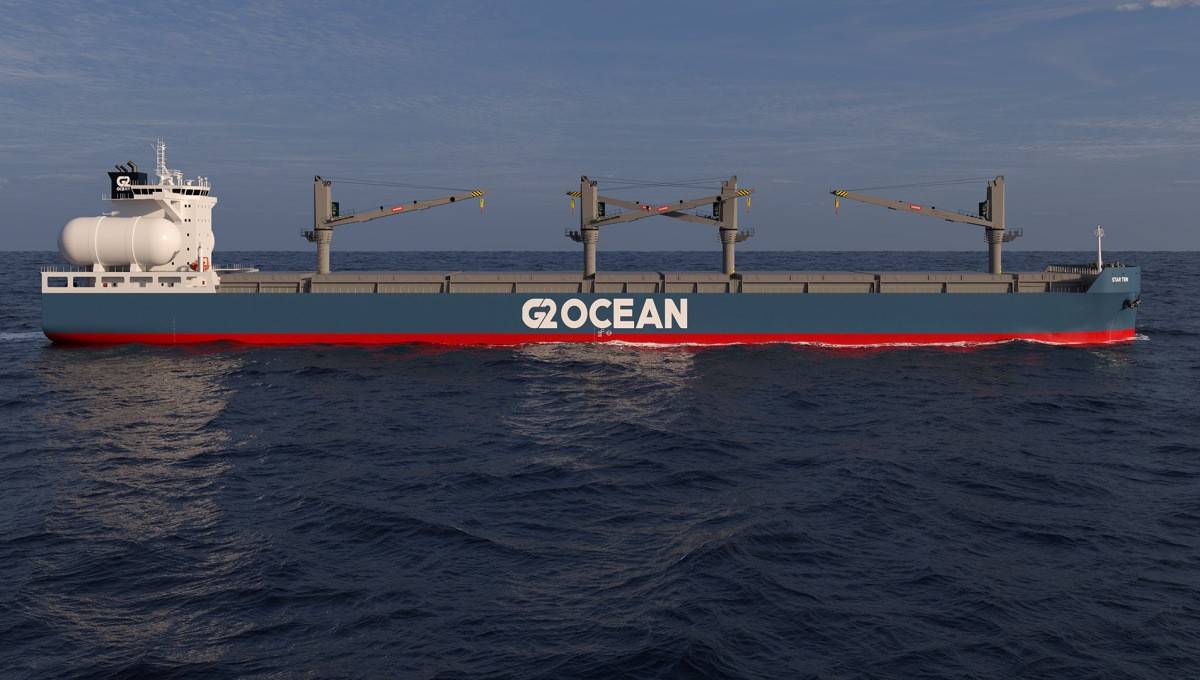
On-deck ammonia tanks
The contract with CSSC Huangpu Wenchong Shipbuilding Ltd is for two vessels, with an option for a further two. The ships will be ammonia ready with a MAN B&W 5S60ME engine and prepared for tanks holding 3,000 m3 of ammonia on deck. Length overall is 225 meters, with a beam of 36 meters and a draft of 13,85. The design will meet the EEDI Phase 3 and has been developed with input from Grieg Shipbrokers and G2 Ocean.
“On behalf of CSSC Huangpu Wenchong, I would like to express my gratitude to the Grieg for their trust and support, and we are excited to receive this new order of 2+2 82,300 DWT MPVs which marks the first order of this size at our shipyard and look forward to working with the Grieg Maritime Group and establishing a long-term and good cooperative relationship,” says Mr Han Jianbing, Deputy General Manager of CSSC Huangpu Wenchong.
Fuel flexibility
Grieg Maritime Group is committed to the Norwegian Shipowner’s Association‘s climate targets. A part of that is to only order ships with zero-emission technology from 2030.
“These vessels are halfway there, as they give us the flexibility to be close to emission-free as soon as the fuels are available. The design doesn’t tie us to just one fuel but lets us keep our options. We believe in ammonia for these ships. However, we can also look to methanol or carbon capture depending on how the technology develops,” says the Head of Shipowning in Grieg Maritime Group, Nicolai Grieg.
Ideal for the pulp trade
The ship is ideally suited for the G2 Ocean pulp trade with eight holds and four electro-hydraulic swing cranes with an individual capacity of 75 tonnes. When lifting in tandem, the cranes can handle cargo of up to 105 tonnes. Internally, the vessels have been dubbed “PulpMax”.
All ships will be DNV classed and have the Norwegian NIS flag, with Bergen as the home port.