


New crane infrastructure has been installed at the Harland & Wolff Belfast yard as preparations continue for the construction of three Fleet Solid Support ships
Harland & Wolff has completed the installation and commissioning of 11 new cranes supplied by County Down-based Walter Watson Ltd, marking another milestone in the modernisation of the Belfast shipyard ahead of construction of three Fleet Solid Support (FSS) ships for the UK Armed Forces.
The cranes represent a combined investment of £1.5 million and form part of a wider £98.5 million modernisation and recapitalisation programme at the Belfast yard under new owner Navantia UK. The investment is intended to prepare the facility for advanced shipbuilding and future naval projects.
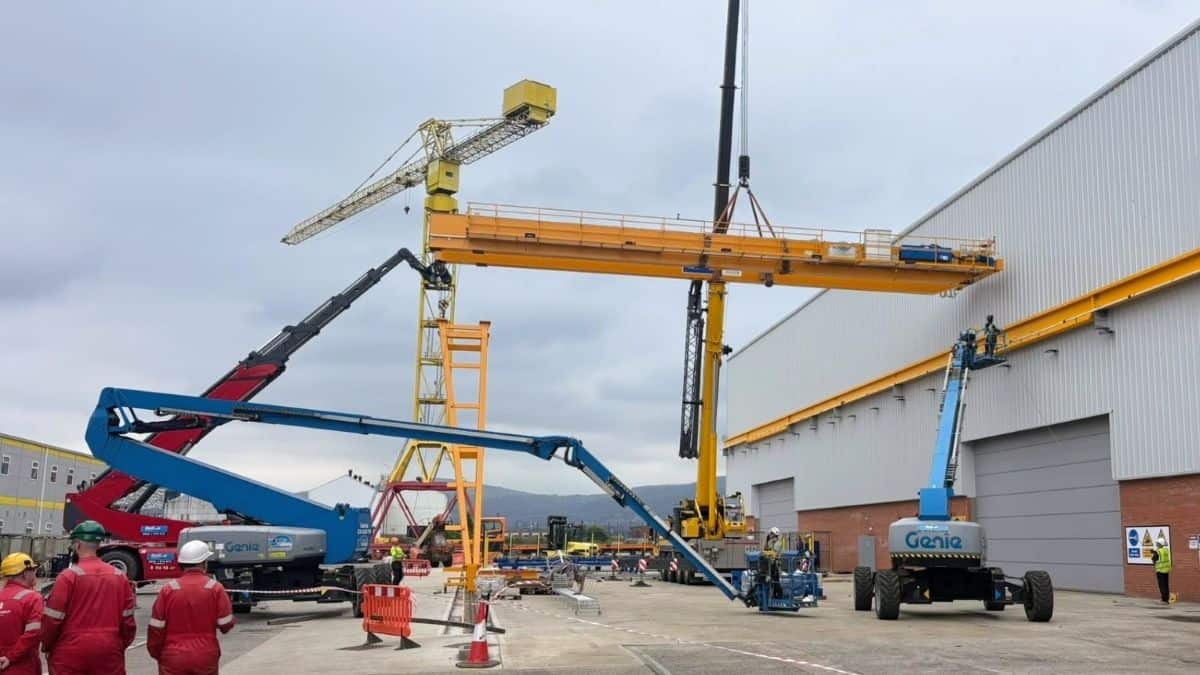
The final crane, a gantry crane with a 20 metre span known as a ‘semi-Goliath’, was commissioned at the shipyard at the end of August. It is capable of lifting 20 tonnes – equivalent to two double-decker buses – and will be used to move steel, and other shipbuilding components, around the site.
A semi-Goliath is a crane with one leg running along a ground rail – a halfway version of the two landmark yellow Samson & Goliath cranes at Harland & Wolff, which are undergoing renovation.
Additionally, Navantia UK has bought six EOT (electric overhead travelling) cranes and four jib cranes for use in and around the yard’s fabrication hall, which has been enlarged with a 5,000 square metre extension.
All of the cranes were purchased from Walter Watson Ltd, a family-owned leader in structural steel and industrial cranes based in Castlewellan, County Down, and established in 1967. The specification for the cranes included full radio control, anti-collision technology, digital weigh load indication and magnet enabled preparation within each control panel.
For Navantia UK, it is the latest in a series of recent contracts with local suppliers. Navantia UK has a local-first approach to procurement to ensure that investment from the FSS programme delivers tangible economic benefits across the region. The company is committed to using UK suppliers wherever it is technically and commercially feasible to do so.
Carlos Lopez Carregado, General Manager at Harland & Wolff, said:“Our local-first means that we award contracts to local businesses wherever possible. That means the economic benefits of shipbuilding for the Ministry of Defence flow straight into the community.
“This new crane will play a key role in shipyard operations. It will be a vital piece of equipment as we assemble ship blocks in readiness to build the Fleet Solid Support ship, and many future ships in Belfast. We’re pleased to be working with Walter Watson, a world class local supplier.”
David Barr, Managing Director, Walter Watson Ltd, said: “We’re delighted to have been awarded the contract to manufacture, instal and commission these 11 cranes for Navantia UK’s Harland & Wolff site. In particular, it’s a privilege to have been entrusted to supply and commission this twin hoist Semi Goliath Crane under the shadow of the iconic Samson and Goliath cranes, from which this model takes its name.
“All of these units were manufactured and tested at our County Down based facility in Castlewellan. We used our in-house transport capabilities to deliver them to Harland & Wolff’s site on Belfast Harbour, prior to erecting them with an 80-tonne mobile crane from our own plant fleet.”
Navantia UK’s recapitalisation of Harland & Wolff has involved installing a new panel line and plasma cutting equipment, plus digital design tools and improvements to buildings and infrastructure.
Harland & Wolff has begun work on the construction of three Fleet Solid Support (FSS) ships for the Royal Fleet Auxiliary (RFA), which will provide essential supplies and logistical support to Royal Navy vessels operating at sea.
The programme forms a key part of the ongoing redevelopment of the Belfast shipyard, with Navantia UK also signalling its readiness to support additional naval shipbuilding and defence programmes.
The company has indicated that it is well positioned to take on further work funded through the Government’s £298 billion Defence Investment Plan, published in June.