



Range is everything when it comes to electric vehicles and vessels – cars and boats alike. That’s why car designers and naval architects pay so much attention to aerodynamics and hydrodynamics respectively. After all, hull resistance affects speed, battery capacity, charging times, power consumption, etc.
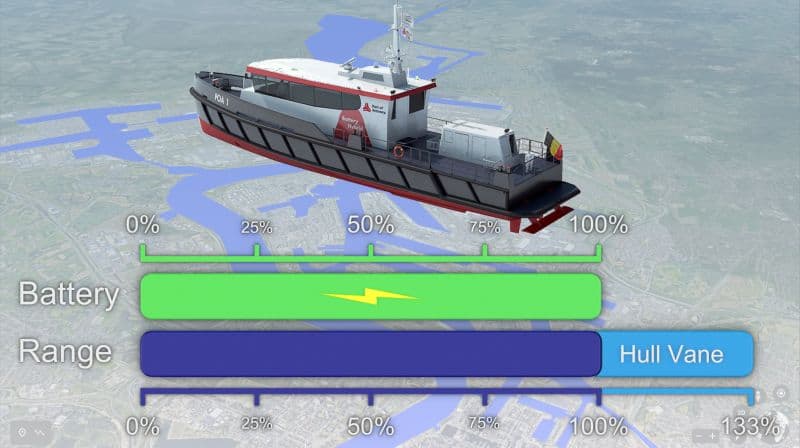
Kooiman Marine Group’s POA-1 is a state-of-the-art, plug-in hybrid patrol vessel for the Port of Antwerp. It cruises at speeds up to 11 knots in full-electric mode. And at 11 knots, cruises 33% farther thanks to the use of our patented Hull Vane® (as shown in model-tests on the same hull tested with and without Hull Vane® at MARIN (Maritime Research Institute Netherlands).
In short, reduced resistance means greater range in electric mode and reduced reliance on diesel power.

Hull Vane® as a ‘Range Extender’ for electric vessels
Categories:
Electric



Latest News
Becker Daggerboard Boosts Wind-Assisted Propulsion
The Becker Marine Systems Anti-Drift Daggerboard system has successfully completed sea trials aboard the 168-metre Spirit of Toulouse, helping maximise the efficiency of its...

ExploMar Pushes Electric Outboard Power to 400HP
Building on its existing 100HP–300HP range, ExploMar is targeting larger vessels with a 400hp electric propulsion solution, ahead of its official launch in March...
LD Armateurs Invests in Three New Cable-Laying Vessels
Three new Platform Supply Vessels will be converted into next-generation cable-laying ships, with entry into service scheduled for early 2028
LD Armateurs (LDA) is strengthening...

Boluda Towage Completes Acquisition of Muller Dordrecht
Founded in 1918, Muller Dordrecht joins Boluda Towage with a fleet of 16 tugs, including seven offshore tugs, and eight barges
Boluda Towage has completed...





.)