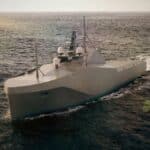
Uber Boat by Thames Clippers is building the UK’s first hybrid high speed passenger ferries, set to launch in autumn 2022 and spring 2023. Leading the way in passenger boat design, the two new vessels, design by One2three Naval Architects, being built at Wight Shipyard on the Isle of Wight, take strides in improving the sustainability credentials of the business as well as propelling the wider marine sector.
The hybrid design will allow the new vessels to operate solely on battery power while transporting commuters and sightseers through the Capital – throughout the Central Zone, between Tower and Battersea Power Station piers – and recharge while using biofuelled power outside of central London. The technology is not reliant on shore-based charging; the new boats will use excess power from the biofuelled engines to re-charge their batteries for the central London stretch.
The new boats push the boundaries in catamaran design to deliver a future-friendly option that can be made even greener as and when technology allows. As well as being the city’s most eco-friendly passenger boats, these will be Uber Boat by Thames Clippers’ quietest vessels.
“After the challenges of the last two years that Covid has set upon businesses, in particular in the transport sector, I’m extremely excited to be increasing our capacity to meet the demands of our customers and partners,” said Sean Collins, Uber Boat by Thames Clippers’ co-founder and CEO. “This development in technology has enabled us to take the first major steps to meet our future environmental vision.
“For over 20 years we have been at the forefront of innovation for the river marine sector. We are committed to supporting the sustainable growth, infrastructure and economic development on and around the river to endorse the river’s importance to London as a form of transport.
“As a business, we are continuing to embrace the emerging technological advances that will see us continue to develop our fleet and infrastructure, thereby supporting a sustainable future in our industry.”
Uber Boat by Thames Clippers is committed to achieving net zero with all new builds by 2025 and for its wider fleet, infrastructure and environmental footprint by 2040. Collins continued: “We’re looking ahead with this hybrid design, ensuring easy conversion to green hydrogen or another renewable energy source – something we’re also focusing heavily on with the new projects we’re undertaking thanks to recent DfT funding. It is the next step in our strategy to net zero and, ultimately, tailpipe zero.”
This announcement comes on the heels of Uber Boat by Thames Clippers’ hire of a new health, safety, environment & quality (HSQE) manager in Gilmark D Mello, and work is underway on three green marine feasibility projects funded by the DfT (Department for Transport); the outcomes of which are due in spring 2022 and should further help inform the business on their route to net zero. It’s also supported by findings from the EU Horizon 2020 TrAM project to develop fully electric, zero emission, high speed passenger ferries, a project in which Uber Boat by Thames is involved and has influenced the specification of the new vessels for London.