



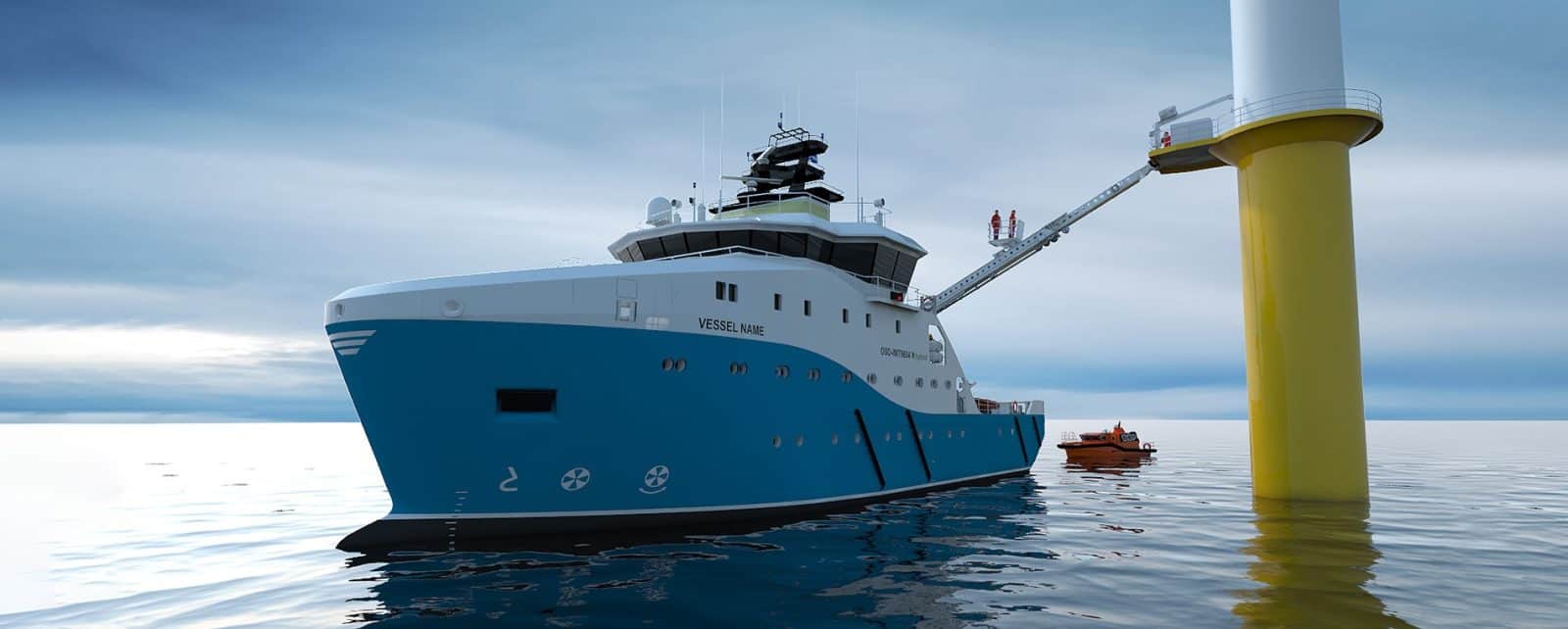
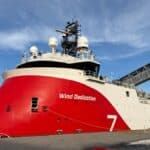
Searching for a more cost effective solution in the ever evolving market of Service Operation Vessels (SOV’s), OSD-IMT came up with the OSD-IMT9604 “mini SOV”. Based on our successful series of ERRV’s, this LOA 51 m design provides comfort for technicians and crew and offers wide operability. The mini SOV fills the gap between (large) CTV’s and the big SOV’s. It is equipped with a Z-bridge Bring-2-Work system, which can work both as a technicians transfer system and as a motion compensated crane. For light weather conditions the daughter craft can be used to transfer up to 2 windfarm service crews. Accommodation space of up to 24 technicians, a covered storage area for spare parts and a battery hybrid power generation system driving the propulsion system make for a full-fledged DP2 SOV.

The Methanol option
Continuously searching for new technologies to contribute to stopping climate change, we are developing a methanol fuelled version of the OSD-IMT9604 to help further reduce emission of GHG’s and pollutants. This development takes place in close cooperation with the research department of Damen Shipyards.
Methanol produced from renewable sources is a so called e-fuel. The use of this methanol reduces the environmental footprint, especially the greenhouse gas emission, of a vessel considerably (50 to 90%, subject to the feedstock of the fuel). In combination with the relatively high energy density it makes for an attractive use as a fuel on ships, creating a lower emission profile while maintaining a good range and endurance. Both aspects are of particular interest for the offshore wind market; SOV’s must be able to remain on station or in the field for a longer period of time, emitting as little as possible to the environment.
The application of methanol does impact the design of the vessel. Methanol is considered a low-flashpoint fuel and as such poses special requirements to a number of arrangements on board. Tanks must be fitted with cofferdams, spaces and ventilation associated with the methanol system must be designed to prevent exposure to ignition sources or even physical contact.
In the OSD-IMT development of the methanol fuelled mini-SOV, these considerations have been taken into account. The design is now being further developed to come to an AiP for the methanol system. Anticipating increased availability of methanol burning internal combustion engines, we feel this design is the right way forward.
Contemplating on how to move forward with your fleet? Feel free to contact us for this or other green solutions.







, OSD-IMT came up with the OSD-IMT9604 “mini SOV”. Based on our successful series of ERRV’s, this LOA 51 m design provides comfort for technicians and crew and offers wide operability. The mini SOV fills the gap between (large) CTV’s and the big SOV’s. It is equipped with a Z-bridge Bring-2-Work system, which can work both as a technicians transfer system and as a motion compensated crane. For light weather conditions the daughter craft can be used to transfer up to 2 windfarm service crews. Accommodation space of up to 24 technicians, a covered storage area for spare parts and a battery hybrid power generation system driving the propulsion system make for a full-fledged DP2 SOV. The Methanol optionContinuously searching for new technologies to contribute to stopping climate change, we are developing a methanol fuelled version of the OSD-IMT9604 to help further reduce emission of GHG’s and pollutants. This development takes place in close cooperation with the research department of Damen Shipyards.)