



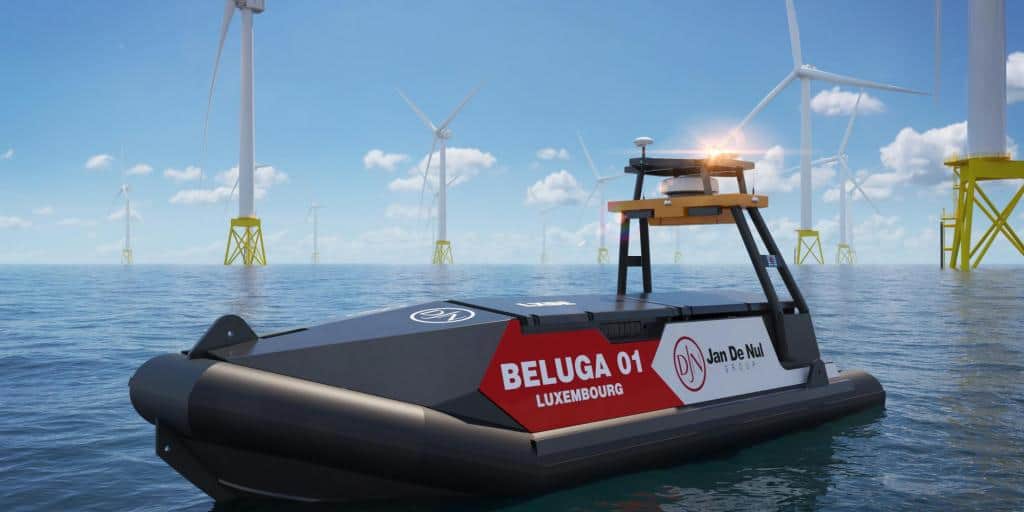
Jan De Nul Group has ordered Maritime Robotic’s well-proven and hybrid Mariner Unmanned Surface Vehicle (USV) as the first step towards unmanned and autonomous offshore survey operations. Named Beluga 01, this vessel will sail under the Luxembourg flag and be deployed for worldwide hydrographical and environmental surveys on marine and offshore construction projects. Jan De Nul is herewith the first dredging contractor to deploy an unmanned survey vehicle in marine and offshore conditions.
The Beluga 01 is based on the innovative Maritime Robotics’ Mariner class USV, which for years has proven its mobility and seaworthiness for data acquisition under rough conditions. Maritime Robotics’ system convinced Jan De Nul of its well-engineered high-quality design, based on 10 years of experience. It is a user-friendly, cost-effective and low-risk platform for data acquisition at sea as an alternative or adjunct to larger manned vessels.
By choosing unmanned surveys and by opting for the Mariner class USV, Jan De Nul fully commits to improved safety and operational control during its survey activities, reduced carbon emissions, and more efficient data acquisition.
Mike Lycke, Survey Manager Offshore Projects at Jan De Nul Group: “For several years, we have been studying different autonomous systems. Our primary focus has always been to build up our expertise on autonomy for maritime survey operations. The global circumstances in 2020 and a maturing USV market enabled us to take it to the next step and order a turnkey vessel for our marine and offshore projects. We found the perfect partner in Maritime Robotics, a leading provider of innovative unmanned solutions for maritime operations and data acquisition.”
Eirik Hovstein, COO of Maritime Robotics: “We are very proud to have been selected as supplier for Jan De Nul Group. We stand for in-house developed systems, with sustainability and autonomy in mind, in close collaboration with civilian, governmental and military partners. We look forward to collaborating with Jan De Nul on the further development of the Beluga 01. Together, we will explore the future of unmanned solutions to ensure safer, greener and more cost-effective data acquisitions at sea.”
Reduced carbon footprint
The Beluga 01 is equipped with a fully redundant hybrid propulsion system. The prime source of propulsion is a diesel engine that is mechanically coupled to the water jet. Alternatively, the vessel can be operated in full electrical mode. The additional electrical Torqeedo propulsion, installed parallel to the main propulsion, can manoeuvre the vessel in sensitive marine areas.
There is also a range extender module to top up the batteries which will operate longer than 12 hours. This system has lower emissions than the main engine, which could also be used as an alternator for the batteries.
Furthermore, the electrical propulsion acts as redundancy for the main engine in case of a failure, or vice versa.
Jan De Nul is committed to cutting carbon emissions. Zero-emission propulsion on future vessels is part of the Group’s strategy. When designing vessels for instance, Jan De Nul takes into account the environmental impact and tackles environmental challenges by focusing on reducing the footprint of its activities, particularly on water and air quality and on the climate.
Proven record in harsh offshore conditions
The Beluga 01 is capable of operating in up to sea state five, although this usually precludes gathering any useful survey data. The vessel can survive in up to sea state seven. The Beluga 01 only needs 80 cm of water to operate in.










 as the first step towards unmanned and autonomous offshore survey operations. Named Beluga 01, this vessel will sail under the Luxembourg flag and be deployed for worldwide hydrographical and environmental surveys on marine and offshore construction projects. Jan De Nul is herewith the first dredging contractor to deploy an unmanned survey vehicle in marine and offshore conditions.)