Ship & Boat BuildingBreakbulk & Heavy Lift VesselJapan's First Coastal Module Carrier to Transport Offshore Wind Turbine Foundation Components

Japan’s First Coastal Module Carrier to Transport Offshore Wind Turbine Foundation Components

Mitsui O.S.K. Lines, announced that its group company MOL Drybulk has signed a basic contract for marine transport with JFE Engineering Corporation. In addition, MOL and Taizhou Sanfu Ship Engineering have concluded a contract for the construction of a new module carrier to be launched under the contract. This will be the first coastal module carrier in Japan to transport components for offshore wind turbine foundation components.

The vessel is scheduled for delivery in the spring of 2026, and will then engage in the coastal transport of offshore wind turbine foundations from JFE Engineering’s manufacturing base in Kasaoka-shi, Okayama Prefecture to offshore wind turbine construction sites in Japan. In April, JFE Engineering began production of monopiles used to build the foundation for offshore wind power generation. MOL Coastal Shipping, Ltd. will operate the vessel under the management of MOL Drybulk.

The new ship will feature the latest design already proven effective in the European market. It will be equipped with a dynamic positioning system (DPS) and offer higher weather resistance than non-self-propelled barges, providing direct delivery of cargo to self-elevating platform (SEP) vessels at offshore wind power construction sites.

The module carrier has a flat deck so that it can directly load wind turbine components, such as monopiles, towers, blades, nacelles, and floating foundations, from the stern and sides of the vessel using multi-axle trucks and so on. As Japan’s offshore wind power generation progresses, demand for wind turbine components in domestic transport is expected to increase in a variety of scenarios. MOL Drybulk currently operates a 3,700-ton class module carrier on a time charter basis to transport onshore and offshore wind turbine components, plant cargo, marine equipment, and so on in waters off the coast of Asia. By leveraging its expertise in operating this module carrier, it will continue to meet customers’ marine transport needs.

The MOL Group will contribute to the realization of a net-zero emissions society in line with the MOL Group Environmental Vision 2.2, by leveraging its accumulated experience and expertise in offshore wind power generation-related businesses.
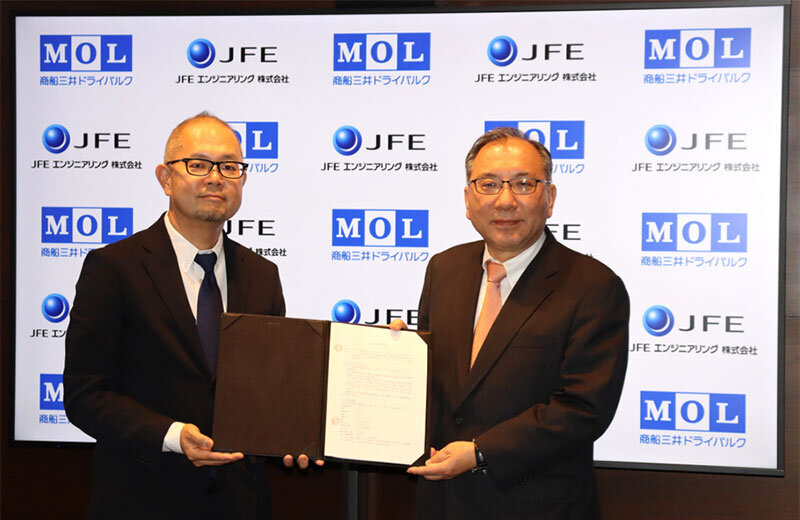

(Koichi Hirata, President & CEO, MOL Drybulk and Atsuo Shikata, Excective Vice President, JFE Engineering Corporation)

Latest News

The International Institute of Marine Surveying (IIMS), working in collaboration with the International Marine Contractors Association (IMCA) and the Workboat Association, has announced the publication of the International Workboat Code of Practice, a 122-page guide providing best-practice guidance for the construction, operation and surveying of commercial workboats.

IIMS, IMCA and Workboat Association Launch International Workboat Code of Practice

IIMS, IMCA and the Workboat Association collaborate on a 122-page guide covering vessel safety, operational standards and crew competency for commercial workboats worldwide The International...
The world’s largest battery-electric ship has officially entered commercial passenger service, marking a major milestone for maritime electrification and zero-emission vessel operations. Built by Incat Tasmania for long-standing customer Buquebus, the 130-metre China Zorrilla has completed its maiden commercial voyage between Buenos Aires, Argentina, and Colonia, Uruguay, across the River Plate.

China Zorrilla Begins Electric Ferry Operations

Built for Buquebus to connect Argentina and Uruguay, the China Zorrilla, the world’s largest battery-electric ferry, marks a major milestone in large-scale marine electrification...
Boluda Towage has expanded its Norwegian fleet with the addition of VB NORWEGIAN FALCON, a new tug built by Sanmar Shipyards to support towing, vessel assistance and offshore operations in demanding maritime environments.

Boluda Towage Takes Delivery of VB NORWEGIAN FALCON

Sanmar-built VB NORWEGIAN FALCON features RAstar 3200 SX design, ASD propulsion and more than 6,700 hp Boluda Towage has expanded its Norwegian fleet with the...
SWITCH Maritime has secured a Design Basis Agreement (DBA) from the United States Coast Guard (USCG) for its SWITCH-150 hydrogen fuel cell-electric ferry, marking a key milestone in the development of the 150-passenger vessel. Designed by naval architecture firm Incat Crowther, the SWITCH-150 combines hydrogen fuel cell-electric propulsion with onboard hydrogen storage to support high-frequency ferry operations without compromising service schedules or requiring shoreside charging infrastructure.

SWITCH Hydrogen Ferry Clears Key US Coast Guard Milestone

The US Coast Guard agreement establishes a regulatory framework to guide construction, commissioning and future commercial operation of the hydrogen-powered ferry SWITCH Maritime has secured...

Related news