Ship & Boat BuildingRescue, Search, SurveillanceKNRM Commissions The Construction of Twelve New Lifeboats

KNRM Commissions The Construction of Twelve New Lifeboats

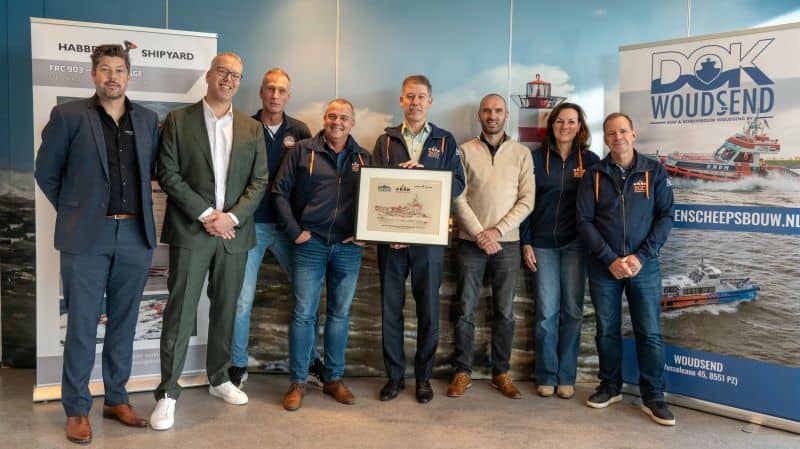
The Royal Dutch Rescue Society (KNRM) has commissioned the construction of twelve new lifeboats. Never before in the 200-year history of the KNRM has such a large assignment been given. The boats will be built at two Dutch shipyards from 2026. The construction involves an investment of approximately 20 million euros. All lifeboats are funded from various donations, legacies and contributions from donors to the KNRM. The name of the lifeboat also comes from the donor who donated most of the construction costs.

The contract for the construction of the lifeboats has been awarded to two shipyards, which have been building and maintaining lifeboats for the KNRM for many years. They are Dok en Scheepsbouw Woudsend B.V. in Woudsend and Habbeké Shipyard B.V. in Hoorn. These yards have already been commissioned for eight of these Van Wijkklasse lifeboats, four of which are still under construction. The new assignment is a follow-up to this.

The twelve lifeboats to be built are a further development of the existing lifeboat class (Valentijn class) of 10 and 11 meters, which the KNRM has had in its fleet since 1990. The oldest lifeboats, with their almost 30 years, are in need of replacement. These so-called rigid-inflatable-boats (RIB, inflatable boats with fixed hulls) are praised by the lifeguards who sail them for their seaworthiness. The lifeboats powered by HamiltonJet’s twin HTX30 waterjets with full AVX systems.  have a top speed of 60 km/h, can be used in all weather conditions and can tip over on their own after a capsize.

Traditionally, lifeboats are given a name by the KNRM that is determined by the donor or testator who donated the construction costs or left them to the KNRM in a will. Six of the twelve new lifeboats to be built have now been named. It is expected that the other six will also have a proud namesake in the coming years.

The twelve lifeboats are intended for lifeboats in Wijk aan Zee, Zandvoort, Harlingen, Enkhuizen, Cadzand, Hansweert, Urk, Terschelling, Westkapelle, Ter Heijde and Noordwijk. Plus one lifeboat for the reserve fleet, which is used as a replacement for the maintenance of a ship.


Latest News

The International Institute of Marine Surveying (IIMS), working in collaboration with the International Marine Contractors Association (IMCA) and the Workboat Association, has announced the publication of the International Workboat Code of Practice, a 122-page guide providing best-practice guidance for the construction, operation and surveying of commercial workboats.

IIMS, IMCA and Workboat Association Launch International Workboat Code of Practice

IIMS, IMCA and the Workboat Association collaborate on a 122-page guide covering vessel safety, operational standards and crew competency for commercial workboats worldwide The International...
The world’s largest battery-electric ship has officially entered commercial passenger service, marking a major milestone for maritime electrification and zero-emission vessel operations. Built by Incat Tasmania for long-standing customer Buquebus, the 130-metre China Zorrilla has completed its maiden commercial voyage between Buenos Aires, Argentina, and Colonia, Uruguay, across the River Plate.

China Zorrilla Begins Electric Ferry Operations

Built for Buquebus to connect Argentina and Uruguay, the China Zorrilla, the world’s largest battery-electric ferry, marks a major milestone in large-scale marine electrification...
Boluda Towage has expanded its Norwegian fleet with the addition of VB NORWEGIAN FALCON, a new tug built by Sanmar Shipyards to support towing, vessel assistance and offshore operations in demanding maritime environments.

Boluda Towage Takes Delivery of VB NORWEGIAN FALCON

Sanmar-built VB NORWEGIAN FALCON features RAstar 3200 SX design, ASD propulsion and more than 6,700 hp Boluda Towage has expanded its Norwegian fleet with the...
SWITCH Maritime has secured a Design Basis Agreement (DBA) from the United States Coast Guard (USCG) for its SWITCH-150 hydrogen fuel cell-electric ferry, marking a key milestone in the development of the 150-passenger vessel. Designed by naval architecture firm Incat Crowther, the SWITCH-150 combines hydrogen fuel cell-electric propulsion with onboard hydrogen storage to support high-frequency ferry operations without compromising service schedules or requiring shoreside charging infrastructure.

SWITCH Hydrogen Ferry Clears Key US Coast Guard Milestone

The US Coast Guard agreement establishes a regulatory framework to guide construction, commissioning and future commercial operation of the hydrogen-powered ferry SWITCH Maritime has secured...

Related news