


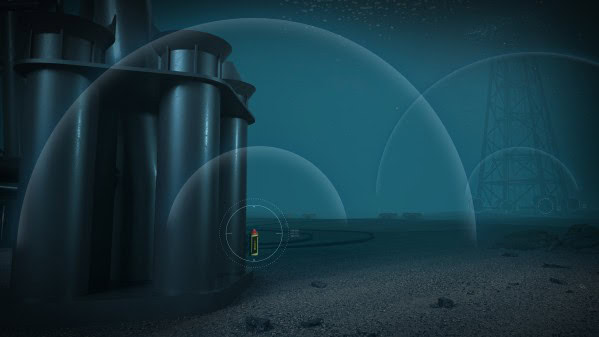
Kongsberg Maritime is pleased to announce that it has augmented its range of cNODE MiniS SSBL (Super Short Base Line) and LBL (Long Base Line) transponders with new models incorporating an internal, high-accuracy strain gauge pressure sensor.
The new transponder units are designed primarily for positioning ROVs, AUVs and towed bodies, and are also well adapted for operations where additional depth data or depth aiding is required, such as when locating subsea structures. This makes them particularly useful for windfarm installation support applications.
A range of models with different pressure sensors are available to maximise the accuracy of the reading. The 100m-rated unit would be best suited for windfarm installation, while the 1,000m- and 4,000m-rated units are ideal for use in contexts such as subsea construction, deep-water research, towfish tracking and AUV missions.
Pressure sensor data can be simultaneously reported on the back of the SSBL navigation reply pulse with no requirement for additional telemetry. The new transponder shares its specification with standard MiniS models and is fully compatible with HiPAP, µPAP and cPAP medium-frequency underwater positioning systems, using KONGSBERG’s Cymbal wideband acoustic protocol and FSK (Frequency-Shift Keyed) signalling. Configuration is carried out via an RS-232 connection or acoustic telemetry.
“Our cNODE MiniS transponders have attained a very solid reputation for the enhancements in accuracy and operational safety they have helped to establish in a broad variety of important functions,” says Erik Bjerke, cNode Product Line Manager, Kongsberg Maritime, “and the new units are destined to bring that same vital level of detail and reliability to an even wider range of applications.”








 and LBL (Long Base Line) transponders with new models incorporating an internal, high-accuracy strain gauge pressure sensor. The new transponder units are designed primarily for positioning ROVs, AUVs and towed bodies, and are also well adapted for operations where additional depth data or depth aiding is required, such as when locating subsea structures. This makes them particularly useful for windfarm installation support applications.)