Kongsberg Maritime has successfully demonstrated a range of remote and autonomous technologies on a cargo vessel operating off the coast of Norway.
The test cruise has been named one of the most complex autonomous journeys at sea so far.
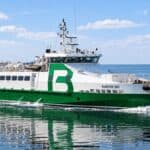
The Eidsvaag Pioner is one of the two vessels that are equipped for remote-operated and autonomous transport demonstrations for the AUTOSHIP project, which is part of Horizon 2020, an EU research programme.
Owned by the Eidsvaag shipping company, the Eidsvaag Pioner operates along the Norwegian coast and in fjord areas where it carries fish feed to ocean fish-farms.
The demonstration was carried out over 13 hours and involved the vessel completing a voyage outside the coast of Kristiansund on the northwest coast of Norway. The ship undocked from the port of Averøy, sailed to the world’s first ocean fish-farm and back to port again, a journey of about 160 nautical miles in total.
CEO of KONGSBERG, Geir Håøy, said: “This was an opportunity to show the world that remote and autonomous technologies can be successfully deployed on a general cargo vessel, carrying out a range of operational aspects of a typical voyage.
“There has been great collaboration between all partners in the AUTOSHIP project, and we have all been impressed with how the Eidsvaag Pioner performed under remote control and during autonomous sailing and docking.
“Today we have demonstrated a range of the key enabling technologies that will lead the way towards routine remote and autonomous operation in the years ahead.”
What was demonstrated
The demonstration was initiated, managed and monitored by the crew from the Kongsberg Remote Operating Centre (ROC) on land in Ålesund. It involved a mix of remote and autonomous operations during different stages of the voyage. For reasons of safety and current regulations, crew members have also been on board the ship during the test cruises.
The first part of the demonstration included automatic undocking from the quay at Averøy. The autonomous technology then took control to navigate and manoeuvre out of the harbour and further out to open sea. Here the ship navigated a route between several islands and avoided other sea traffic, before arriving at the offshore fish farm Ocean Farm 1, owned by Salmar.
Various manoeuvres were then carried out using the Dynamic Positioning (DP) system. The vessel next returned to port, again navigating open sea and congested seaways before it automatically docked again. The entire operation was monitored and occasionally controlled remotely by the shore-based captain and engineer.
During the demonstration, a number of established and new KONGSBERG technologies were deployed, and included Auto-undocking and Autodocking, Situational Awareness System, Autonomous Navigation System, Intelligent Machinery System, Connectivity & Cyber Security System, Remote Operations Centre and Dynamic Positioning. Cloud-based communication systems and advanced simulations have also been involved to test and ensure that the vessel operated safely and optimally.
About AUTOSHIP
AUTOSHIP is a four-year project that has received funding from the European Union’s Horizon 2020 research and innovation programme under Grant Agreement N°815012.
The demonstration in the North Sea has been a collaboration between a large team of people from KONGSBERG and the shipowner Eidsvaag AS, including also expertise from Norway’s leading research organisation, SINTEF and the University of Strathclyde in the UK.
The AUTOSHIP project runs its demonstrations in important areas in Europe where the early use of remote control and autonomy is necessary to accelerate the transition from road to greener and safer sea transport.
The aim of the project is to test and further develop key technology linked to fully autonomous navigation systems, intelligent machinery systems, self-diagnostics, prognostics and operation scheduling, as well as communication technology enabling a prominent level of cyber security and integrating the vessels into upgraded e-infrastructure.
The second AUTOSHIP demonstration will take place on 1st June and involve a cargo barge navigating part of the inland waterway network in Wintam, Belgium.
More information about the project is available here:
https://trimis.ec.europa.eu/project/autonomous-shipping-initiative-european-waters