



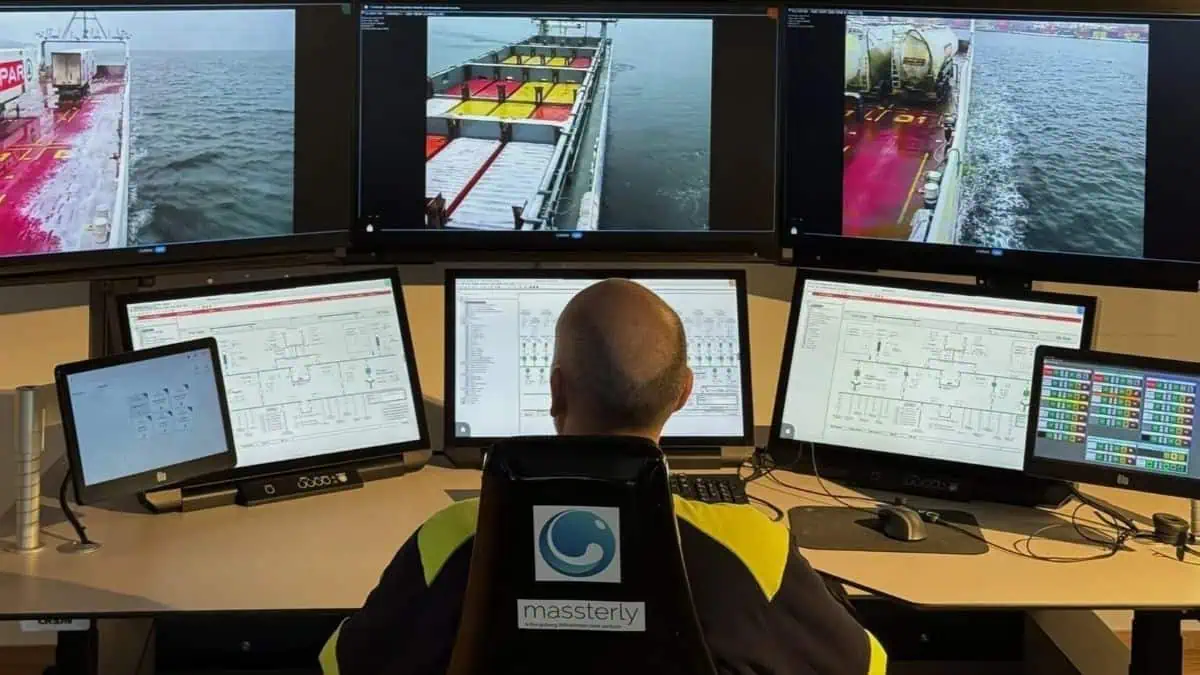
Massterly Remote Operations Centre coordinates Yara Birkeland and two ASKO vessels, Marit and Therese, in first three-ship supervision trial
The Massterly Chief-to-Shore (C2S) project has reached a new operational milestone after its Remote Operations Centre (ROC) successfully supervised three vessels simultaneously for the first time.
Launched in November 2024 by Kongsberg Maritime and Wilhelmsen, the initiative is designed to enable shore-based operators to monitor and coordinate multiple autonomous or highly automated vessels from a single control facility.
Project coordinator Frikk Sandvik said the programme has highlighted that organisational change is as critical as technological development. “I thought this would be all about technology,” he explains. “But the real work is changing mindsets, procedures, and how sea and shore teams trust each other.”
Since its launch, the project has progressed through a series of regulatory and operational milestones aimed at gradually expanding the scope of shore-based vessel supervision.
- July 2025: Approval granted for shore-based operation of one vessel
- October 2025: Expansion allowing two vessels per operator
- February 2026: Completion of internal testing and commencement of a three-vessel trial
During the first operational shift overseeing three vessels, Remote Operations Centre technician Kenneth Vestly took the chair in the operations centre. From the shore-based facility, Vestly coordinated with bridge teams aboard the autonomous container vessel Yara Birkeland and the ASKO vessels Marit and Therese.
On board Therese, bridge crew Ted and Jannicke followed the trial closely, supporting communication and maintaining situational awareness as the vessels operated under remote supervision.
The milestone demonstrates the growing maturity of shore-based vessel operations and provides further insight into how future maritime operations could combine onboard crews with remote supervision from land-based control centres.
“It felt almost like standing on the bridge — just from a comfier chair and better coffee” – Kenneth says. “Good tools help, but it’s the dialogue with the crew that makes it work. Otherwise it would be quite lonely here”
On the bridge, there is noticeable better space, with one person moved to shore, but Ted and Jannicke are looking forward to the mergin the team again, on shore.
The Remote Operations Centre mirrors onboard environments with alarms, camera feeds, and GA drawings, layered with new UX‑driven visualizations. The result is a control room that bridges traditional seamanship with next‑generation digital operations.
As the C2S project advances, the focus shifts toward smarter oversight tools; working closely with the technology provider Kongsberg Maritime to find correct abstraction levels, aggregate data in easily understandable vessel dashboards, low‑attention ‘traffic light’ systems, and full fleet‑level monitoring.
This new phase marks a defining moment — proving that engineering expertise can remain deeply connected to the vessel, even from shore.




 project has reached a new operational milestone)