


As the shipping industry looks to decarbonise and become net zero by 2050, ship owners and operators are looking at alternative fuels with a lower carbon footprint in order to reduce overall emissions from their fleet. In Europe this is linked to the EU ETS scheme coming in 2024 and also the Fuel EU Maritime[1] legislation coming in 2025. As part of the ever-changing marine fuel mix, methanol is now being seriously considered as a low-carbon fuel to assist shipping in achieving its decarbonisation targets.
Methanol (CH3OH) is a liquid chemical used in thousands of everyday products, includingplastics, paints, cosmetics and fuels. Liquid methanol is made from synthesis gas, a mix ofhydrogen, carbon dioxide and carbon monoxide. These components can be sourced from a widerange of feedstocks, using different technologies.
Renewable methanol is an ultra-low carbon chemical produced from sustainable biomass,often called bio-methanol, or from carbon dioxide and hydrogen produced from renewableelectricity.
Renewable methanol can be made from numerous and plentiful sources which are globallyavailable. The carbon molecules required to make synthesis gas for methanol production canbe obtained from CO2 via industrial exhaust streams, or even captured from the air. Synthesisgas also can be produced from the gasification of any carbon source, such as municipal solidwaste or forestry residues. Biogas, obtained through fermentation, from landfills, wastewatertreatment, plants or animal wastes can also be used as a feedstock for methanol production.Additionally, renewable energy can power the electrolysis process to generate clean hydrogenfor the production of renewable methanol.
Methanol is the world’s most commonly shipped chemical commodity and more than 95 billionlitres are manufactured every year. It has been stored, transported and handled safely for over100 years. Since it remains liquid at ambient temperature and pressure, the infrastructurerequired to deploy it as a fuel, is largely in place: combustion engines, fuel cells and powerblocks can easily be adapted to use methanol.
Methanol as a Marine Fuel
The attraction of methanol to shipping, is that renewable methanol can significantly reduce greenhouse emissions to atmosphere including, reducing carbon dioxide (CO2) by up to 95%and nitrogen oxide (NOx) by up to 80%, and eliminating sulphur oxide (SOx) and particulate matter (PM) emissions.
However, there are numerous considerations regarding the use of methanol as a marine fuel.Firstly, methanol exhibits good burn characteristics, but will require a pilot fuel for ignition, ega gas oil, or a biofuel. Further positives are, it is a liquid at atmospheric pressure, its bio-degradable and can run well in existing engine technologies.
However, methanol has a Flash Point of only 12ºC, which immediately raises questions relatingto the Safety of Life at Sea (SOLAS) requirements. SOLAS states no marine fuel with a flashpoint less than 60ºC should be onboard a vessel. Methanol has a low energy content,approximately 40%-50% of the more traditional fossil fuels used within the maritime sector.Methanol is highly reactive and therefore materials with which methanol may contact, shouldbe inert, eg stainless steel.
In order to achieve the Tier III NOx requirements, pure water must be added to methanol prior toburning. This allows for approximately 30% less NOx emissions compared to fossil fuels.
VPS Completes the First Methanol Bunker Quantity Survey, Sampling and Testing
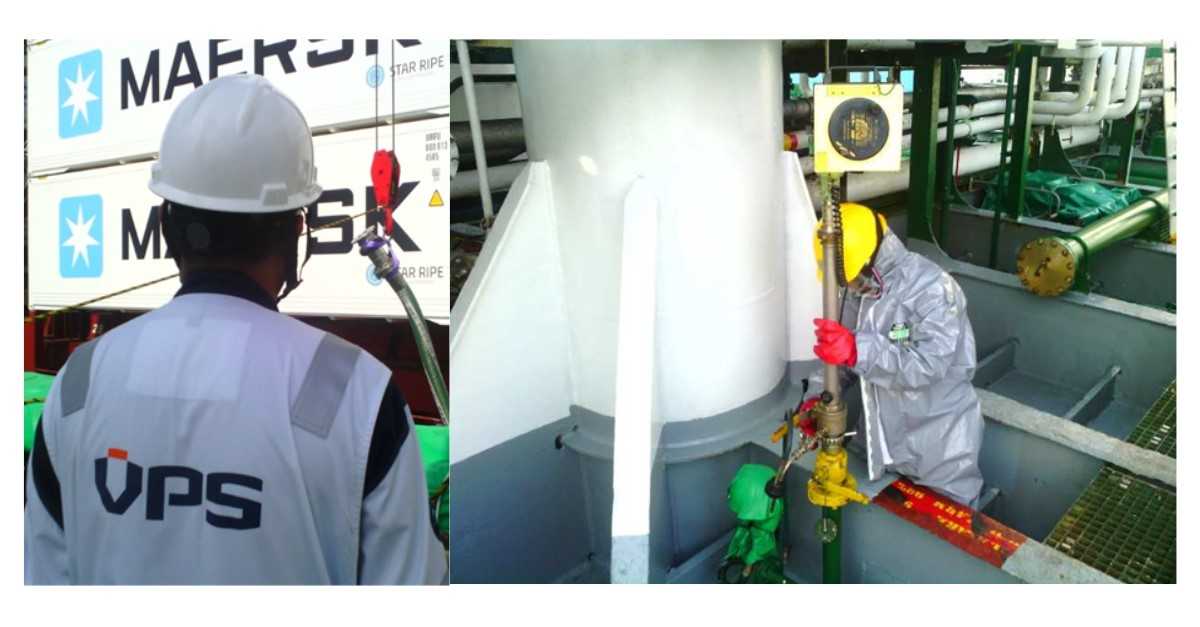
In July 2023 VPS were requested by Maersk to undertake the very first methanol bunker quantity survey (BQS). This took place in Singapore for Maersk’s first methanol-powered container ship, the Laura Maersk.
Prior to this first methanol delivery, various levels of pre-delivery work were required including,the delivery barge tank-cleaning operation and a part loading of methanol to the barge, toensure no cross-contamination could take place, during the actual delivery. VPS, as part of theBQS operation, also undertook the required closed-sampling procedure, to safely harvestrepresentative samples of the methanol delivered to the vessel, which were then transferred toa VPS Laboratory for quality testing.
In the 12 months leading up to this BQS, VPS invested heavily into new laboratory equipmentand R&D in order to provide a comprehensive testing and advisory service in relation tomethanol as a marine fuel.
In order to safely transport methanol samples to the VPS laboratory, the transfer via aeroplane,had to comply with the International Air Transport Association (IATA), rules for the transportation of dangerous goods. It is worth noting when considering using methanol as a marine fuel, it is the person sending methanol samples for testing, who must be trained and accredited to the IATA standards, ie the vessel crew, or vessel agent.
The testing of the samples from the Laura Maersk bunkering, was conducted to the International Methanol Producers and Consumers Association (IMPCA) test slate. The key test considerations here were, the purity of the methanol, the presence of ethanol, water content,the presence of acetone, chlorides, the acidity of the fuel, sulphur content and numerous other impurities, which could be detected.
Following the Singapore bunkering the Laura Maersk set sail for Port Said, Egypt, where VPS repeated the BQS, Sampling and Testing of the methanol delivered to the vessel. The final bunkering stop took place in Rotterdam, where VPS once again completed the BQS operation,sampling and testing.
The VPS surveying and testing of these three methanol bunker stems, showed the fuel delivered matched the Bunker Delivery Note (BDN) and the Certificate of Quality (CoQ).
VPS and Methanol Bunker Fuel
VPS have proven that safe, accurate and reliable, quantity surveys and sampling of methanol can be undertaken. Plus, following significant investment in state-of-the-art laboratory equipment, plus analyst and advisory training, VPS can also provide accurate analytical testing of methanol samples to determine the quality of the fuel and provide the necessary and valuable marine engineering advice, to support ship owners and operators when they look to use methanol as their low-carbon marine fuel of choice.
VPS are currently working with numerous shipping companies, suppliers and engine manufacturers on testing their methanol samples and sharing our experience, expertise and innovative approach in helping them gain a greater understanding of this low-carbon fuel.
With more than 160 methanol-powered vessels currently on order, it is inevitable that methanol use will significantly increase within the maritime sector and VPS have proven high-level performance to support the industry in this aspect of it’s decarbonisation journey.
Methanol as a Marine Fuel – VPS Experience to date – By Steve Bee, VPS Group Commercial Director