Offshore WindCable LayingMOL Gains AiP for Subsea Cable Jointing and Burial Vessels

MOL Gains AiP for Subsea Cable Jointing and Burial Vessels

Mitsui O.S.K. Lines, Ltd. (MOL) announced that it has received Approval in Principle (AiP) from ClassNK for the basic design of specialised vessels designed for subsea power cable jointing and burial.

MOL is working with Sumitomo Electric Industries, Ltd., Furukawa Electric Co., Ltd., and Nippon Yusen Kabushiki Kaisha (NYK Line). The project, subsidised by Japan’s New Energy and Industrial Technology Development Organisation (NEDO), aims to develop fundamental technologies for long-distance subsea DC power transmission, including a next-generation cable-laying vessel.
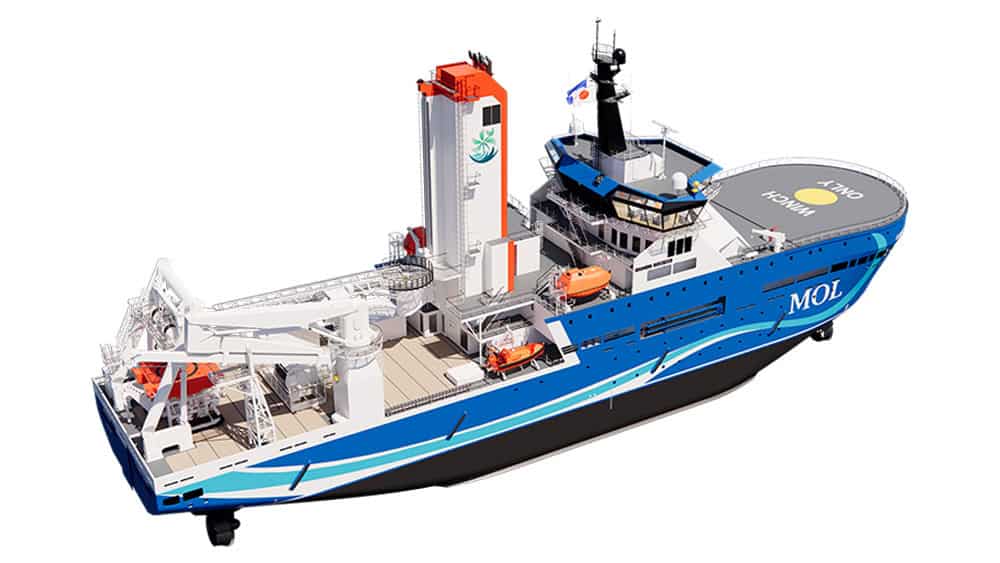
Mitsui O.S.K. Lines, Ltd. (MOL) announced that it has received Approval in Principle (AiP) from ClassNK for the basic design of specialized vessels designed for subsea power cable jointing and burial.
CG rendering of a cable burial vessel

To transmit electricity from wind power generation sites, such as those in Hokkaido, to major consumption centers, power transmission infrastructure must be strengthened. Long-distance subsea DC transmission is considered a promising solution for efficiently transporting large volumes of electricity and is expected to play a critical role in both power grid enhancement and offshore wind power development.

Within the project, MOL is responsible for developing vessel technologies related to subsea cable jointing and burial. The ClassNK AiP confirms the feasibility of the vessel’s basic design from a classification perspective and represents a key milestone toward detailed engineering and future construction.

Offshore wind is identified as a strategic growth area under the MOL Group’s “BLUE ACTION 2035” management plan. By expanding its portfolio of specialised vessels for subsea power cable installation, MOL aims to support offshore wind deployment, power grid modernisation, and broader decarbonisation efforts.


Latest News

The International Institute of Marine Surveying (IIMS), working in collaboration with the International Marine Contractors Association (IMCA) and the Workboat Association, has announced the publication of the International Workboat Code of Practice, a 122-page guide providing best-practice guidance for the construction, operation and surveying of commercial workboats.

IIMS, IMCA and Workboat Association Launch International Workboat Code of Practice

IIMS, IMCA and the Workboat Association collaborate on a 122-page guide covering vessel safety, operational standards and crew competency for commercial workboats worldwide The International...
The world’s largest battery-electric ship has officially entered commercial passenger service, marking a major milestone for maritime electrification and zero-emission vessel operations. Built by Incat Tasmania for long-standing customer Buquebus, the 130-metre China Zorrilla has completed its maiden commercial voyage between Buenos Aires, Argentina, and Colonia, Uruguay, across the River Plate.

China Zorrilla Begins Electric Ferry Operations

Built for Buquebus to connect Argentina and Uruguay, the China Zorrilla, the world’s largest battery-electric ferry, marks a major milestone in large-scale marine electrification...
Boluda Towage has expanded its Norwegian fleet with the addition of VB NORWEGIAN FALCON, a new tug built by Sanmar Shipyards to support towing, vessel assistance and offshore operations in demanding maritime environments.

Boluda Towage Takes Delivery of VB NORWEGIAN FALCON

Sanmar-built VB NORWEGIAN FALCON features RAstar 3200 SX design, ASD propulsion and more than 6,700 hp Boluda Towage has expanded its Norwegian fleet with the...
SWITCH Maritime has secured a Design Basis Agreement (DBA) from the United States Coast Guard (USCG) for its SWITCH-150 hydrogen fuel cell-electric ferry, marking a key milestone in the development of the 150-passenger vessel. Designed by naval architecture firm Incat Crowther, the SWITCH-150 combines hydrogen fuel cell-electric propulsion with onboard hydrogen storage to support high-frequency ferry operations without compromising service schedules or requiring shoreside charging infrastructure.

SWITCH Hydrogen Ferry Clears Key US Coast Guard Milestone

The US Coast Guard agreement establishes a regulatory framework to guide construction, commissioning and future commercial operation of the hydrogen-powered ferry SWITCH Maritime has secured...

Related news