



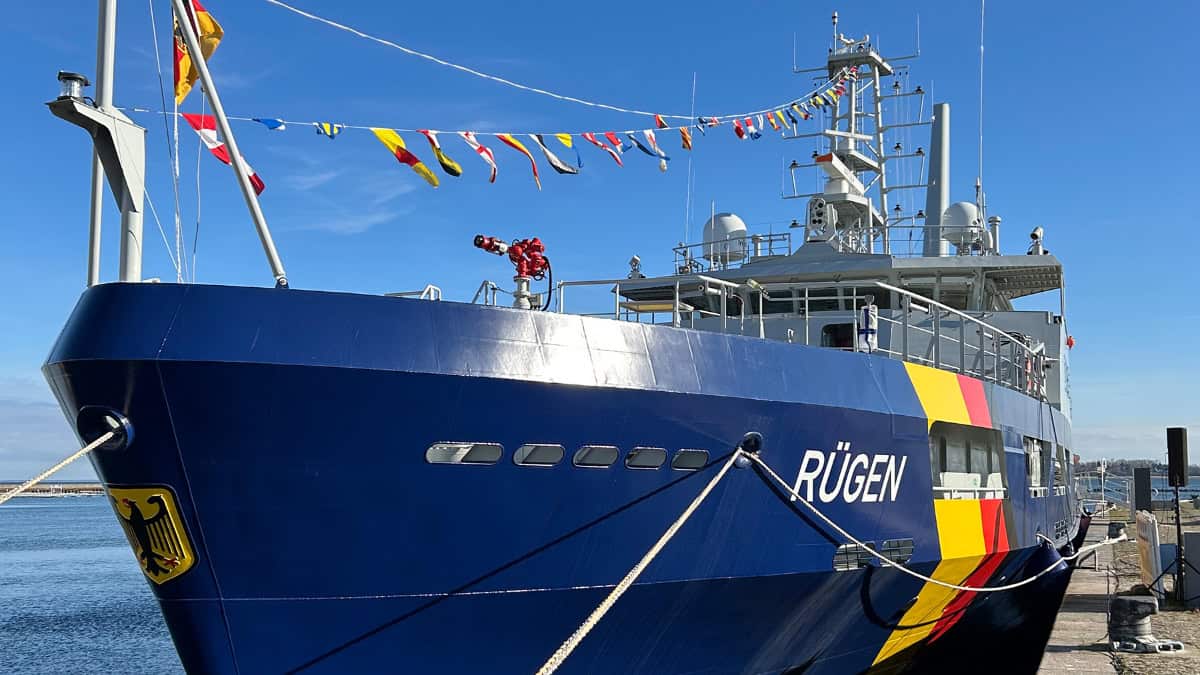
The new customs vessel “Rügen”, the largest in the German customs fleet, was christened and commissioned in Stralsund. Equipped with four mtu gas engines from Rolls-Royce for propulsion and two additional engines for onboard power generation, the Rügen represents a significant advancement in the capabilities and sustainability of Germany’s maritime customs operations.
The President of the General Customs Directorate, Dr. Armin Rolfink, emphasised: “With the commissioning of the “Rügen,” we are setting an important milestone for the strengthening and sustainable modernisation of our customs fleet. This state-of-the-art customs vessel combines high performance with innovative and environmentally friendly technology, enabling us to carry out our important customs duties at sea even more efficiently in the future.”
Rolls-Royce is currently equipping four new German customs vessels with a total of 15 mtu gas engines, which provide propulsion and, in some cases, onboard power. As part of a modernization program, they complement the customs fleet in the North and Baltic Seas, which largely relies on mtu power. The advantages of the mtu gas engines include their low exhaust and noise emissions and their dynamic performance. Rolls-Royce ensures the reliable operation of the customs fleet’s eleven vessels powered by mtu engines through a long-term service contract .
The new 67-meter-long customs vessel “Rügen,” designed for deployments at sea lasting several weeks, was built at the Fassmer shipyard in Berne, northern Germany. It is powered by four 16-cylinder mtu Series 4000 gas engines and two controllable-pitch propellers. Combined with electric motors and two onboard power generators (also 16V4000 mtu gas engines), the vessel can be operated in various modes as needed: purely gas-electric, purely gas-mechanical, and booster mode. In booster mode, all four main engines, each with an output of 1,492 kW, and the electric motors, which receive power from the onboard generators, propel the “Rügen” to a top speed of 23 knots.
The three additional 55-meter-long customs vessels are currently being built by the Peene shipyard in Wolgast, northern Germany, which is part of the NVL shipyard group. Each is equipped with three 16-cylinder mtu Series 4000 gas engines, each driving a fixed-pitch propeller. To achieve a top speed of approximately 26 knots, their power has been increased by ten percent to 1,641 kW each.
“We congratulate the German Customs Service on the commissioning of its new operational vessel “Rügen” and the three other new vessels. Reliability, ease of operation, dynamic engine performance, and low emission levels of the propulsion systems play a key role in the responsible tasks of the coast guard. These advantages of mtu gas engines will help us further expand our market share in our strategic Marine business area,” explained Denise Kurtulus, Senior Vice President Global Marine at Rolls-Royce Power Systems.
Even without exhaust aftertreatment, mtu gas engines significantly exceed the limits of current emissions regulations (such as IMO III). Particulate matter is below the detection limit , and they emit only low levels of nitrogen oxides. Thanks to the double-walled design of the gas system, the engine room can be designed similarly to that of a diesel engine.
mtu gas engines already power tugboats and ferries in Europe and Asia. Ferry operators such as the Doeksen shipping company in the Netherlands particularly appreciate the quietness, low vibration, no unpleasant odor, and no black smoke generated by mtu gas engines. The Konstanz municipal utility company has been operating its newest Lake Constance ferry with mtu gas engines in a climate-neutral manner using biogas since July 2024. The world’s first hybrid tugboat powered by liquefied natural gas (LNG) from the Sembcorp Marine Integrated Yard in Singapore also has two mtu gas engines on board.














