



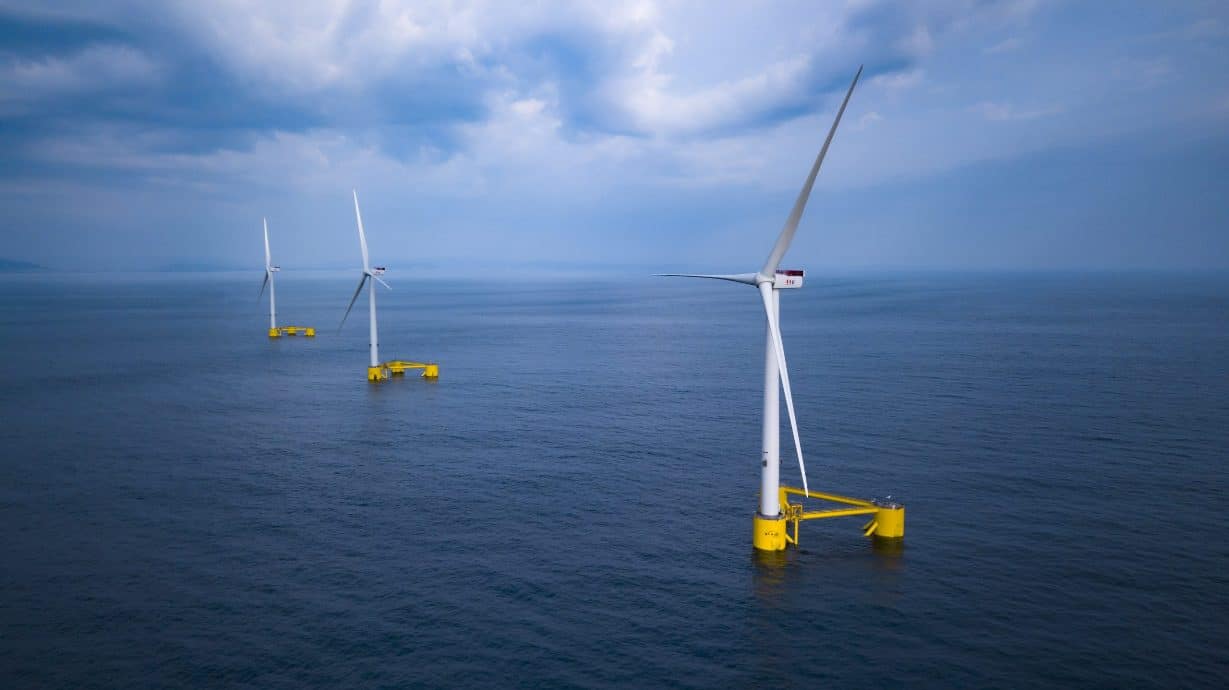
The National Decommissioning Centre (NDC) has teamed up with the Offshore Renewable Energy (ORE) Catapult in a research partnership aimed at developing new offshore wind technologies.
The partnership initially consists of three PhD projects, each focusing on a different aspect of offshore wind development, including the simulation of floating offshore wind turbine (FOWT) systems, design optimisation of these systems, and environmental concerns.
The three projects include:
- Simulations of Floating Offshore Wind Marine Operations – the National Decommissioning Centre’s £1.6 million immersive simulation suite will be used to trial virtual marine operations related to the installation and maintenance of FOWT systems in a risk-free environment.
- Multi-objective Design Optimisation of Floating Offshore Wind Systems – this will develop a numerical tool to improve the design of combined floating platforms and mooring and dynamic cable systems, allowing users to quickly identify the best solutions based on project circumstance and cost.
- Study of Environmental Interactions of FOW Technology – this will investigate how key environmental stakeholders, advisory bodies and research organisations can work together to identify gaps in their knowledge of how offshore wind farms interact with the marine environment, and better identify solutions.
Each PhD project is valued at £84,000 and co-funded by ORE Catapult, the NDC and the School of Engineering at the University of Aberdeen.
Dr Marcin Kapitaniak and Professor Richard Neilson from the University of Aberdeen are coordinating the projects at the NDC in Newburgh.
Dr Kapitaniak said: We are delighted to be a part of this collaborative research project partnership between the NDC and ORE Catapult, which addresses a need for delivering innovation, impact and technical development in the field of floating wind, which is vital for achieving net zero and energy transition goals.
Each project will run for a period of 3.5 years, and the results will inform approaches to offshore wind development and maintenance that have the potential to bring real improvements to current processes as well as cost savings to industry.
Professor Neilson, NDC Director, added: The collaboration between the partners was initiated when the NDC received support from EPSRC’s Supergen ORE Hub for a project aimed at the development of cost-effective methods of installation of floating wind farm anchors, which was co-funded by ORE Catapult and Aubin Group.
This opened discussions about utilising the NDC’s unique and state-of-the-art simulations suite, which as well as being able to undertake detailed marine technology and operational simulations, can also conduct complex data modelling and visualisation.
I am delighted that these discussions have come to fruition, and we look forward to working with colleagues in the ORE Catapult and our PhD students as part of this exciting initiative.
Professor Ekaterina Pavlovskaia, Head of the School of Engineering said: I am pleased that the School of Engineering is able to support this partnership which will help expand the number of our PhD students working on floating offshore wind projects, developing the skillsets required to make real and lasting contributions to the energy sector.
Andrew Macdonald, Director of Offshore Wind Development and Operations at ORE Catapult, said: We welcome this innovative collaboration between ORE Catapult, the NDC and the School of Engineering that will support technology development of floating offshore wind.
At ORE Catapult we have developed the National Floating Offshore Wind Innovation Centre in Aberdeen to accelerate the commercialisation of floating offshore wind technology. These PhD projects will look at the design, installation, and maintenance of floating offshore wind systems, and how they interact with the marine environment, and this will further drive economic growth and our net zero future.
Roger Esson, Head of Industry and Partner Network at Net Zero Technology Centre, said: Our strategic partnership with University of Aberdeen in delivering the NDC is enabling the delivery of crucial industry led, research partnerships. Through innovative collaboration these projects will help accelerate the development and deployment of offshore floating wind, increase efficiency and ensure floating offshore wind is a cost-effective solution in the energy transition. The marine simulation suite is a fundamental element providing an environment to virtually prototype new technology and de-risk the entire lifecycle of floating offshore wind and other energy infrastructure in the marine environment.








 has teamed up with the Offshore Renewable Energy (ORE) Catapult in a research partnership aimed at developing new offshore wind technologies. The partnership initially consists of three PhD projects, each focusing on a different aspect of offshore wind development, including the simulation of floating offshore wind turbine (FOWT) systems, design optimisation of these systems, and environmental concerns.)