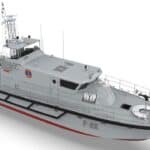




Island Guardian, a new high-speed low-draft landing craft designed by leading digital shipbuilder Incat Crowther, has been delivered to the Great Barrier Reef Joint Field Management Program in Australia. The new custom-designed 21-metre vessel will enhance island protected area management, research, incident response and facilitate more efficient management of the Great Barrier Reef World Heritage Area.
The Great Barrier Reef Joint Field Management Program is delivered jointly by the Great Barrier Reef Marine Park Authority and the Queensland Parks and Wildlife Service, part of the Department of Environment and Science. Constructed by Norman Wright & Sons in Queensland, Island Guardian is the fourth Incat Crowther-designed vessel delivered to the program.
Island Guardianhas been designed specifically to allow the transportation of equipment and vehicles to remote areas of the reef. The vessel can carry up to 7.5 tonnes of deck cargo including vehicles such as four-wheel drives, trailers, excavators, compact track loaders or small tractors.
Cargo loading is facilitated by an Incat Crowther custom designed bi-folding vehicle ramp on the bow. In conjunction with a lowdraft of only three and a half foot and a reinforced forefoot, the vessel can safely land on a large range of gradients, including beaches or boat ramps. A deck crane has also been fitted with the ability to lift a payload of 680kg at a 7.5 metre radius.
The robust engineering of the bow ramp also allows Island Guardian the capability to safely rescue and release marine life weighing up to 600kg.
The vessel has a very economical cruising speed of 20 knots and capability to travel at a maximum speed of 25 knots. The hull has been designed to incorporate the bow ramp while not limiting the ability to combat rough seas from south-east trade winds. Propeller tunnels facilitate the use of efficient propulsion whilst maintaining low draft for beach landings.
Island Guardian can transport up to 24 personnel in addition to its cargo. The main deck has a galley, crew lounge, crew mess, and bathroom. Twin crew berths are located on the main deck, port hull and starboard hull. Additional seating for service personnel is located on the working deck via folding seats. Multiple deck lockers add to the vessel’s functionality.
The wheelhouse features a full walkaround and has been designed to ensure excellent visibility of the working deck and bow ramp from both its central helm position and exterior wing stations. The wheelhouse features a single masters berth, ample storage and crew seating. The exterior of the wheelhouse deck features the vessel’s rescue boat, additional freezer space, a laundry and a bathroom.
Incat Crowther’s Technical Manager Dan Mace said: “The brief we received from the Great Barrier Reef Joint Field Management Program was a complex, yet exciting one. The challenge was to deliver a vessel with several unique elements to enable it to operate safely and efficiently in one of the most pristine environments in the world,”
“Our goal was to design a low-draft vessel that could deliver valuable cargo on high-speed transits in rough seas, land on a range of beaches and boat ramps, and support rescue and recovery missions all whilst minimising impact on the environment. Our team collaborated closely with the client to achieve this, and we are pleased that the customer is incredibly happy with the final product.” said Mr Mace.
Tony Riek of Norman Wright & Sons said: “Island Guardian performed flawlessly on sea trials. The successful build involved use of our lightweight construction techniques and high standard of build quality. The package delivered by Incat Crowther streamlined the physical shipbuilding process and delivered on a very complex set of parameters. We are very pleased to achieve such a successful outcome for the client.”