


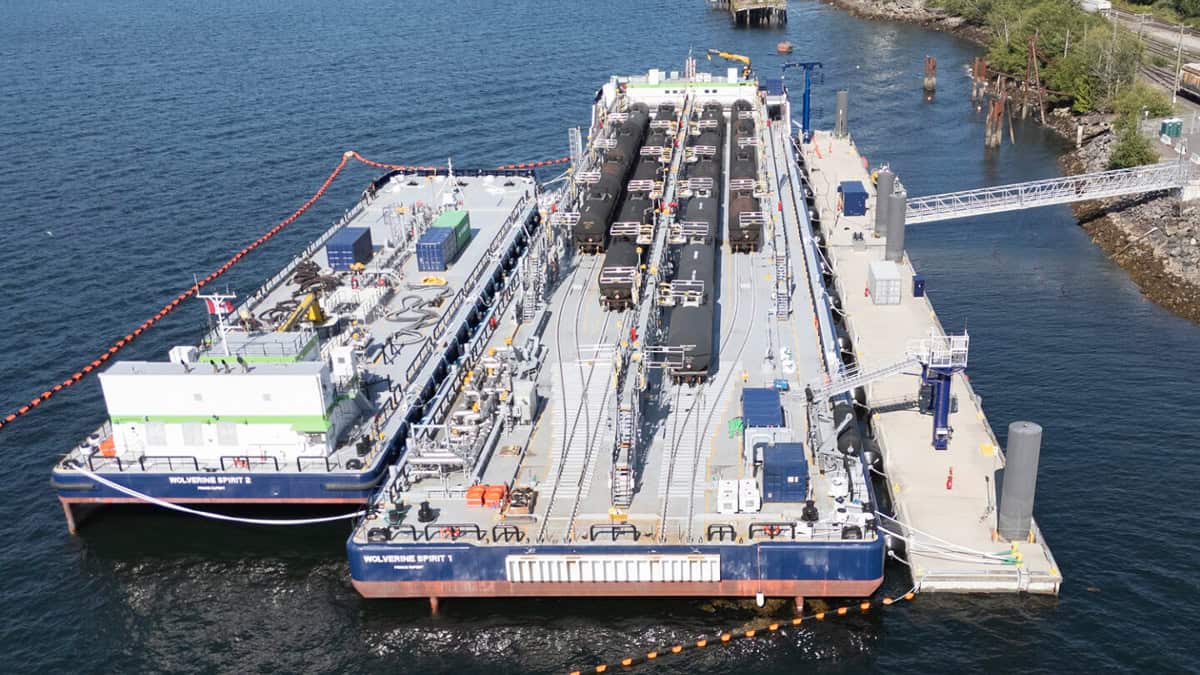
The Port of Prince Rupert has recently welcomed the startup of Wolverine Terminals’ marine bunkering service for deep sea shipping, thus adding a key logistical capability to this strategic deepwater port on the west coast of Canada. Using a unique pair of barges designed by Robert Allan Ltd., Wolverine Terminals can deliver a wide range of fuels to suit the needs of vessels calling at the port, including marine diesel, heavy, intermediate, and other blends to individual customer specifications. By introducing this new service, deep-sea ships may now bunker at this key and growing gateway to North America, which features favourably short trading routes to Asia and access to a supply of domestically produced fuels delivered by rail.
The Wolverine Terminals fleet is composed of a transloading barge and a fuel delivery (lightering) barge.
Wolverine Spirit 1, the 142-metre long transloading barge, has been custom-designed to accept up to twenty-four rail tank-cars on deck. These are loaded using a marine rail ramp in Prince Rupert with maximum efficiency using four rail lanes with a pair of onboard turnouts (switches) – a novel arrangement on a rail barge. Combined with a high-performance ballasting system and Wolverine’s dedicated locomotive, this barge can onboard a full set of railcars during a single tide. Once loaded and secured, the Transloading Barge is moved using tugs from the loading ramp to the Wolverine Terminals project site, where once moored, the railcars can be drained into the barge’s hull tanks, which have a combined capacity of nearly 80,000 barrels of oil products.
Wolverine Spirit 2, the 78-metre long lightering barge, receives fuels from the Transloading Barge, and is towed to client vessels in harbour where it delivers fuel to their individual requirements. With a capacity of approximately 30,000 barrels of products, this barge can efficiently deliver fuels to ocean-going vessels at up to 450 m3/hr.
Both barges have been designed to maximize the safety of operations. In addition to featuring double-hulls, there are extensive containment and response systems aboard both barges, as well as fire-fighting systems and equipment. Access to the railcar tops is via a fixed gantry system with Safe Harbor access platforms/gangways, while access between the barges is via a swinging Verhoef gangway with articulated stairs that adjust to ensure safe passage for all combinations of drafts and freeboards between the two barges. Cranes on both barges facilitate the transfer of equipment from shore and handling of hoses.
Both barges are fully compliant with Transport Canada regulations and are classed for their service with Lloyds Register. Attention has been paid to keep all potential sources of emissions low, with IMO Tier III compliant exhausts equipped with after-treatment, silencing for all diesel-fired machinery, vapour recovery for the cargo systems, and low-intensity lighting.
Specifically tailored to meet Wolverine Terminals’ needs, these barges deliver best-in-class bunkering and logistics whilst minimising environmental impact and contributing to the economic growth of the port and region. They are fine examples of Robert Allan Ltd.’s ability to design highly customised vessels of virtually any type and complexity to customers’ unique project requirements.