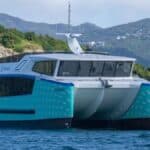
The first, fully-electric road ferries to sail in North America are now on their way from Damen Shipyards Galati to Lake Ontario, Canada, to begin operations. Ordered by the Ministry of Transportation, Ontario, Canada, the Amherst Islander II and Wolfe Islander IV, 68 and 98 metres in length respectively, represent a new generation of zero-emission large ferries. The vessels departed the yard on 26 August to be loaded on the semi-submersible transport vessel Super Servant 4 and will arrive in Lake Ontario in mid-September.
Both of the open-deck vessels are equipped to be fully-electric, but also have twin diesel generators installed to allow hybrid and full diesel propulsion for maximum redundancy. Due to the harsh winters the ferries also feature 1B Ice class hulls and 1A Ice class azimuth thrusters, allowing them to be fully operational down to -25 degrees centigrade.
The delivery of the vessels marks the completion of the first of the two stages of the project. The second stage, which is well underway, involves an ambitious programme in which Damen is working with the Ontario government to install the facilities that will enable the vessels to use shore power supplied via integrated shore charging and mooring systems. This will enable them to recharge their batteries while loading and unloading between the short crossings to and from the islands.
This involves not only the installation of the necessary transmission infrastructure at each of the four ferry docks, but also the complete rebuild of the docks to accommodate the new vessels plus the onshore electrical equipment. The systems will also utilise load displacement and peak-shaving technology to achieve maximum efficiency and minimal costs.
The vessels themselves will use an innovative, fully automatic charging system developed by Wabtec Stemmann with features that include motion compensation to ensure a stable connection between the ship and the shore even in rough seas. Delivering 6MW of power, charging takes just ten minutes.
With the shoreside works due for completion in 2022, following extensive training for crews over the remainder of 2021, the ferries will commence operations in hybrid mode using the diesel generators to supply electricity to the motors.
“This integrated project is the first of its kind and one that we hope will demonstrate that fully-electric ferries of this size are a viable proposition,” says Leo Postma, Damen Area Director Sales Americas. “Damen now offers turnkey packages for organisations looking for integrated all-electric ferry systems, working with local contractors and suppliers to install the shoreside infrastructure that best suits local requirements and conditions. It has been a pleasure working with the Government of Ontario to bring this project to fruition and we very much look forward to seeing it fully operational. This is the future!”
Damen is providing full support with staff in Ontario for the 16-month warranty period and is also establishing a Service Hub in British Columbia to provide long term support to the Canadian market. Damen is currently midway through a programme to build and deliver six Damen Road Ferries 8117 E3 for BC Ferries. While presently fitted with hybrid propulsion systems, they are designed to be adapted for full electric propulsion in the future.
Ontario’s new ferries bring extra capacity and will make crossings faster as well as greener for the one million passengers and 500,000 vehicles which travel annually between Wolfe Island and Kingston, and the 270,000 passengers and 130,000 vehicles which travel to and from Amherst Island each year.