Having already received the Basic Design Approval from DNV for the Deepsea Semi™ 12MW, Odfjell Oceanwind continues to lead the way for harsh environment floating wind foundations by launching the Deepsea Star™ designed to take 15MW and larger Wind Turbine Generators (WTGs).
The Deepsea Star™ is a column-stabilised, semi-submersible steel design with centre WTG tower, designed to take the weights and loads from the 15MW WTGs which will become available for floating wind from 2025 and onwards. The Deepsea Star™ is currently undergoing the Basic Design Approval from DNV based on Siemens Gamesa’s SG 14-236 DD and a multi-location design basis which includes the harshest environment locations relevant for floating offshore wind globally.
“With the Deepsea Star™ we have compiled Odfjell’s 50 years learnings from operating semisubmersible structures in harsh environment conditions with 20 years’ experience in designing floating wind solutions. Stepping up to the 15MW WTGs makes floating wind relevant for larger utility scale wind parks and will be a significant contribution to lowering the LCOE in the coming years”, says Per Lund, CEO of Odfjell Oceanwind.
“The new design has successfully completed the model tank test and our design team is now working in close collaboration with the WTG supplier and DNV to complete the qualification process to a Basic Design Approval (BDA) level. Having a BDA qualified design for 15MW WTG and a multi-locational, harsh environment design basis offer developers of seabed leases in tough locations to potentially cut significant time and reduce risk in their development programs. This is particularly the case for Scotwind, INTOG and Utsira Nord. The Deepsea Star™ can also be optimised to site specific metocean data.”
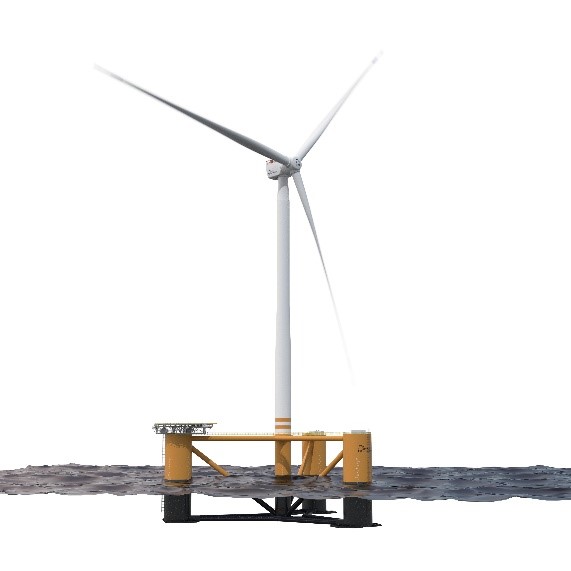
One of the inventors of the Deepsea Star™ design and CTO in Odfjell Oceanwind, Eystein Borgen, explains some of the features of the new design: “When going through the Early Works engineering process with the WTG supplier and the Basic Design Approval with DNV for the Deepsea Semi™ 12MW, we realised that it will be challenging to scale a semi-submersible floater with the WTG in the corner beyond 15MW, for a number of reasons.”
The centre tower reduces the required displacement which gives many benefits like reduced draft at quayside, lower environmental loads acting on the structure and reduced overall steel weight. Furthermore, it enables installation of tower and turbine on a floating structure. The bracing structures transfers the loads efficiently between the satellite columns and the tower. These loads are extreme for harsh environments and large WTGs, in particular when considering load scenarios like cross-sea waves and “split forces” acting between the columns, torsion loads from the tower and mooring line failures.
The symmetric design simplifies the supply chain and lends itself well to mass production, lowering the unit cost and increasing the supply chain efficiency which will be required to develop large wind parks in short time frames.”
The Deepsea Star™ will be available for deployment from the mid 20’s and the design is already being considered for several oil and gas electrification projects in the North Sea.