



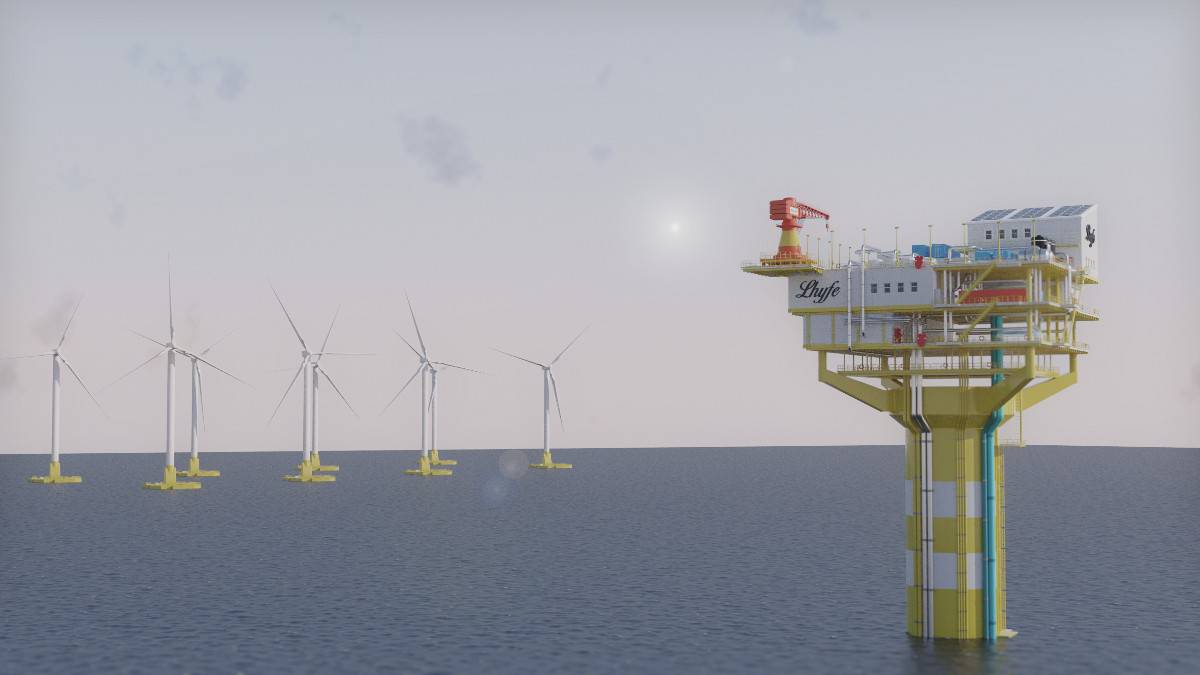
The HOPE (Hydrogen Offshore Production for Europe) project consortium has signed a €20 million grant agreement with the European Commission. This followed the positive evaluation of the proposal submitted by the partners in response to the call for proposals issued by the Clean Hydrogen Partnership, co-founded and co-financed by the European Union.
The consortium aims to pave the way for the deployment of large-scale offshore production of renewable hydrogen. The HOPE project involves developing, building and operating the first 10 MW production unit in the North Sea, off the coast of Belgium, by 2026. The aim is to demonstrate the technical and financial viability of this offshore project, and of pipeline transport for supplying onshore customers.
HOPE Takes Offshore Hydrogen Production to Industrial Scale
Lhyfe completed a first step in 2022 with a world first – the inauguration of Sealhyfe, the world’s first pilot production plant for offshore hydrogen already integrating Plug’s technology and powered by a 1 MW floating wind turbine.
With HOPE, the consortium partners are moving up a gear and aiming for commercialisation. This unprecedentedly large-scale project (10 MW) will be able to produce up to four tonnes a day of green hydrogen at sea, which will be exported to shore by composite pipeline, compressed and delivered to customers for use in industry and the transport sector. HOPE is the first offshore project of this size in the world to begin actual implementation, with the production unit and export and distribution infrastructure due to come on stream in mid-2026.
HOPE will benefit from an ideal location, one kilometre from the coast, in the offshore testing area in front of the port of Ostend (Belgium), which aims to be the central link in the hydrogen chain in Belgium and has contributed to the development of the project since its inception.
The production site will be powered by electricity supplied under PPA (Power Purchase Agreement) contracts that guarantee its renewable origin. The water used for electrolysis will be pumped from the North Sea, desalinated and purified.
The production site will comprise three units: production and compression (at medium pressure) at sea, export by composite pipeline, then compression (at high pressure), storage and distribution onshore.
The first kilos of HOPE hydrogen could be produced as early as 2026. They will supply mobility needs and small industries in Belgium, northern France and the southern Netherlands, within a 300-kilometre radius.
A Flagship Project for the European Commission and the Clean Hydrogen Partnership
This project has been selected for funding under the Clean Hydrogen Partnership call for proposals co-financed by the European Union. HOPE is thus recognised as a flagship project making a decisive contribution to energy transition. By means of a first large-scale demonstration, the project will make it possible to improve the technological solutions for the production of renewable hydrogen offshore and its export onshore, helping to reduce the investment risks for much larger-scale projects in the years to come and paving the way for the production of massive quantities of renewable hydrogen in Europe.
The grant awarded by the European Commission covers a period of five years. This includes three years to develop the demonstrator, and then two years to demonstrate the technical reliability and commercial viability of the model. The commercial operation of the hydrogen production, export and distribution infrastructures developed in this context is intended to continue beyond the duration of the project.
The €20 million grant will be used to finance the design phases, the supply of equipment and the construction work, as well as research, development and innovation work focusing mainly on optimising technological solutions and the operation of this type of infrastructure. The techno-economic analysis of offshore renewable hydrogen production solutions on a much larger scale will be another of the areas of work.
Thanks to an ambitious plan to disseminate and utilise the results, the consortium intends to accelerate the deployment of large-scale offshore hydrogen solutions to help achieve the target set by the European Commission of 10 Mt of clean hydrogen produced in the European Union by 2030 to decarbonise the European economy.
First-Rate Partners for a Series of Technological Innovations
HOPE will combine the expertise and know-how of each of the nine partners involved, covering the entire renewable hydrogen value chain.
Main Key Innovations to be Developed in the Project
- Recycled offshore barge: The structure housing the production unit will be a second-hand jack-up barge, demonstrating that it is possible to transform infrastructure previously used for oil and gas and give it a second life for the production of renewable energy, while helping to reduce costs and lead times.
- 10 MW PEM electrolyser: This highly compact electrolyser will be the first of its size to be installed offshore.
- Seawater treatment system:This low-energy system which is compact, economical and able to use the heat emitted by the electrolyser, will be used for the first time to produce green hydrogen from seawater purified by evaporation.
- Underwater flexible hydrogen pipeline for hydrogen export: The hydrogen will be exported ashore via a flexible thermoplastic composite pipeline of over a kilometre long, which for the first time will transport hydrogen produced at sea after having been technically certified for this specific use.
Expertise and Role of Partners (ranked by requested EU contribution):
- Lhyfe (France): Engineering, equipment procurement, works supervision, operation, optimisation of the overall production, export and distribution system, project coordination.
- Plug (the Netherlands): Supply and engineering of the 10MW electrolyser.
- EDP NEW (Portugal): Contribution to the optimisation of operations and impact analysis. Steering of techno-economic studies for large-scale developments.
- POM West-Vlaanderen (Belgium): Project implementation support in the testing area (studies, permits) and analysis of the social, economic and environmental impacts of the project.
- CEA (France): Optimisation of operations via digital simulation.
- Strohm (the Netherlands): Supply of the subsea flexible thermoplastic composite pipeline (TCP).
- Alfa Laval (Denmark): Supply of the seawater treatment system.
- DWR eco (Germany): Communication and dissemination of project results throughout Europe.
- ERM – Element Energy (France): Coordination support.







 project consortium has signed a €20 million grant agreement with the European Commission. This followed the positive evaluation of the proposal submitted by the partners in response to the call for proposals issued by the Clean Hydrogen Partnership, co-founded and co-financed by the European Union.The consortium aims to pave the way for the deployment of large-scale offshore production of renewable hydrogen. The HOPE project involves developing, building and operating the first 10 MW production unit in the North Sea, off the coast of Belgium, by 2026. The aim is to demonstrate the technical and financial viability of this offshore project, and of pipeline transport for supplying onshore customers. HOPE Takes Offshore Hydrogen Production to Industrial ScaleLhyfe completed a first step in 2022 with a world first – the inauguration of Sealhyfe, the world’s first pilot production plant for offshore hydrogen already integrating Plug’s technology and powered by a 1 MW floating wind turbine.With HOPE, the consortium partners are moving up a gear and aiming for commercialisation. This unprecedentedly large-scale project (10 MW) will be able to produce up to four tonnes a day of green hydrogen at sea, which will be exported to shore by composite pipeline, compressed and delivered to customers for use in industry and the transport sector. HOPE is the first offshore project of this size in the world to begin actual implementation, with the production unit and export and distribution infrastructure due to come on stream in mid-2026.HOPE will benefit from an ideal location, one kilometre from the coast, in the offshore testing area in front of the port of Ostend (Belgium), which aims to be the central link in the hydrogen chain in Belgium and has contributed to the development of the project since its inception.The production site will be powered by electricity supplied under PPA (Power Purchase Agreement) contracts that guarantee its renewable origin. The water used for electrolysis will be pumped from the North Sea, desalinated and purified.The production site will comprise three units: production and compression (at medium pressure) at sea, export by composite pipeline, then compression (at high pressure), storage and distribution onshore.The first kilos of HOPE hydrogen could be produced as early as 2026. They will supply mobility needs and small industries in Belgium, northern France and the southern Netherlands, within a 300-kilometre radius.)