Concordia Damen is proud to announce its collaboration with Amasus, deugro Danmark, Siemens Gamesa, and DEKC Maritime in the development and construction of two new and advanced Offshore Wind RoRo vessels: Rotra Futura and Rotra Horizon. These vessels, of which the first one launched yesterday at Jiangsu Zhenjiang Shipyard, are specifically designed for the transport of large, and ever growing, wind turbine components. Rotra Futura is expected to be delivered to Amasus in 2025.
The development of the Rotra Futura and Rotra Horizon is the result of a partnership. At the basis there is the wish – and a concrete charter agreement – of Siemens Gamesa, Deugro Danmark and Amasus to stay ahead in the market with a new Rotra concept that aims to become a vital link in the logistics chain of the growing wind energy industry. With the design, engineering, project management and shipbuilding capabilities of DEKC Maritime and Concordia Damen added, the five companies worked hard to create a new, cost- and energy-efficient vessel type.
Together, the five partners have accurately mapped the requirements and challenges of the offshore wind industry and created a future-proof and sustainable design that meets the highest standards for safety, efficiency, and flexibility.
The design of the Offshore Wind RoRo vessels Rotra Futura and Rotra Horizon builds on the previous vessels in the Rotra concept, the Rotra Mare and Rotra Vente, which were also developed by Concordia Damen, and have been successfully operating since 2016.
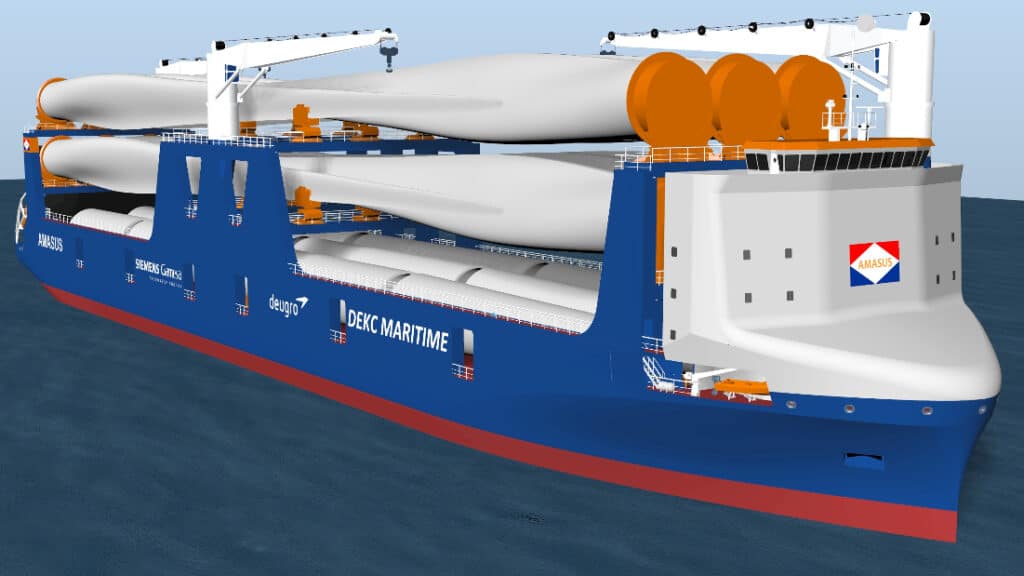
The new vessels are equipped for the latest generation of wind turbine components, which are becoming larger and heavier. Thanks to the unique RO/RO system (Roll-On/Roll-Off) and an innovative ramp, these vessels can safely and efficiently transport larger loads. Additionally, the three Liebherr cranes and the special ramp system enable turbine blades to be stowed in three tiers, providing greater flexibility in loading methods and cargo configurations.
With dimensions of 167.6 x 26 meters, and the wheelhouse and accommodation strategically located at the front of the ship, the new Rotra design maximizes cargo capacity while ensuring optimal loading without obstructing visibility. These vessels are specifically designed to meet the increasing demand for larger and more powerful offshore wind turbines.
“At Concordia Damen, innovation is central to our ship designs, allowing us to effectively respond to the growing demand for more sustainable solutions,” says managing director Chris Kornet. “For the Rotra Futura and Rotra Horizon, we, along with our partners, have focused extensively on energy savings and an environmentally friendly design. The aerodynamic and hydro-optimized hull design, combined with a special low-resistance coating, contributes to lower fuel consumption. Furthermore, the vessels are equipped with an advanced Wärtsilä main engine, which consumes 15 percent less fuel and has a smaller CO₂ emission footprint than current standards.”
With these innovations, the five companies ensure that the new Rotra vessels meet today’s and tomorrow’s sustainability standards. In addition, the vessels feature a hybrid propulsion system that complies with the highest IMO Tier 3 standards. An efficient waste heat recovery system further enhances energy savings, contributing to the sustainability of logistics within the offshore wind industry.
According to Concordia Damen, the Rotra Futura and Rotra Horizon represent a significant step in making logistics solutions more sustainable and support the development of large-scale wind energy projects. Chris Kornet: “By continuing to focus on innovation and collaboration with our partners, suppliers and customers, we aim for Concordia Damen to remain a reliable player in the maritime sector, both for the inland shipping and the offshore wind industry.”