


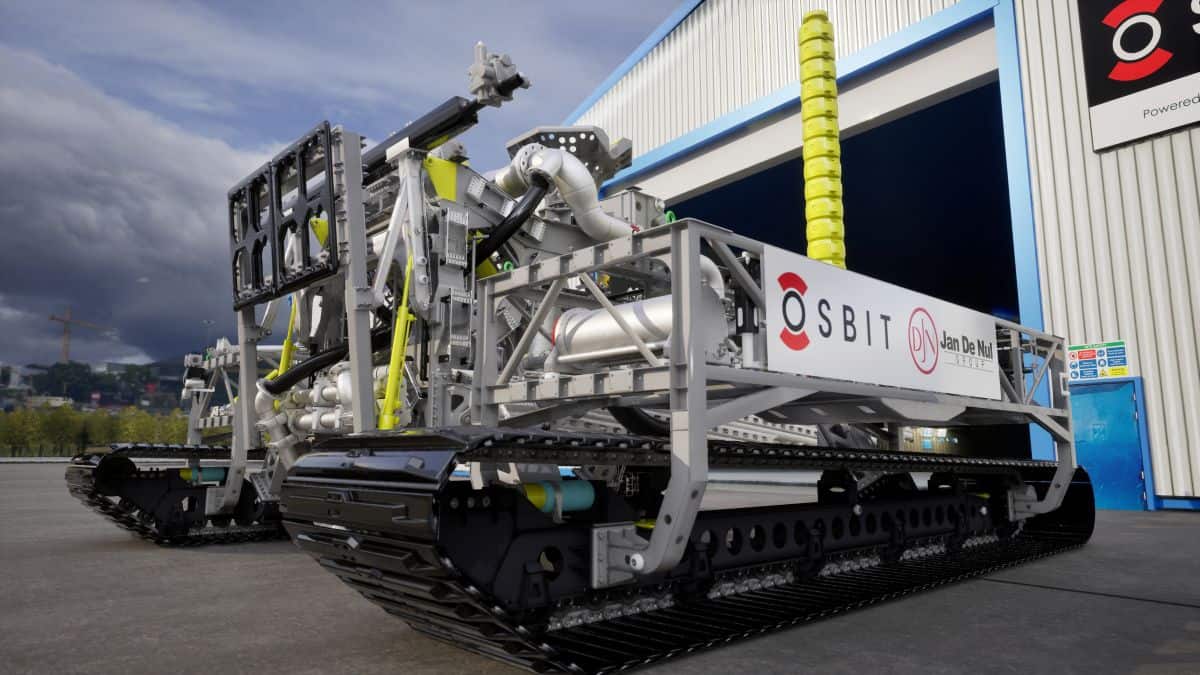
Jan De Nul’s Next-generation trencher combines deep burial capability with a compact, containerised design.
Offshore engineering specialist Osbit, part of Venterra Group, has secured a contract from Jan De Nul Group to design and build a next-generation shallow water trencher for cable burial operations.
The contract extends the companies’ long-standing relationship, following the successful deployment of Osbit’s previous trencher, Swordfish, which has been operating in the field since 2022.
The new trencher has been designed for both land-based and subsea operations, with a focus on shallow water cable burial campaigns. Despite its lightweight and compact footprint, the machine will provide deep burial capability while being readily transportable between project locations.
The trencher features a surface-fed water system, helping minimise overall system weight while retaining flexibility for future upgrades and deeper water campaigns. Its modular construction allows the trencher to be dismantled into containerised sections for rapid transportation and mobilisation between sites.
A key differentiator of the trencher is its modular design, allowing operators to rapidly adapt the system for different projects and burial requirements. Interchangeable swords and depressor options enable variable burial depths and cable configurations for efficient cable installation across complex nearshore environments.
Key specifications include:
- Surface-fed jetting trencher
- Operable on land and subsea
- Highly modular design for adaptability across multiple campaigns
- Burial capability up to five metres below seabed
- Lightweight, compact and fully containerisable design
- Full design and build programme ahead of the agreed 96-week schedule
David Foster, Project Manager at Osbit – “This project is the result of many months of close collaboration with Jan De Nul. Building on the success of the previous trencher project gave both teams a strong foundation and a clear understanding of the operational challenges the equipment needs to solve.
“We have focused on creating a highly adaptable and future-ready system that can support a wide range of offshore cable burial campaigns while remaining lightweight, modular and easy to mobilise. Through close collaboration with the client and a deep understanding of the environments in which the equipment will operate, we have been able to develop a robust and highly versatile solution.”
The project is scheduled for delivery in late 2026, with commercial operations expected to commence in 2027